
In the fall of 2021, over the course of two posts (September 25 and October 9, to be exact), I wrote about Cider With Rosie, Laurie Lee’s wonderful memoir about his childhood in the English Cotswolds, towards the end of the First World War.
Today, I turn to another author, who wrote in a similar lyrical style but about another time and another place, Englishman Robert Gibbings.
Gibbings’ abode was the Thames River and the time was mid-20th century. I guess not so very different from Laurie Lee’s first book, after all, as we’re talking of only a forty year time difference and a traveling distance of barely 52 kilometers (about an hour’s worth of travel on England’s smaller country roads).
In 1939, when England was on the verge of the Second World War, Gibbings moved to a 500-year old town called Long Wittenham, along “one of the most pleasant backwaters” on the Thames River, in the county of Berkshire, just south of Oxford. Once ensconced, he built a flat-bottomed boat, painted it pale green, and, armed with a sketchpad and microscope, made his way up and down the river. He lived there for eighteen years, writing eight books about his life upon the Thames. Three of these books were published during the war, the remainder in the following decade (or so).
The first of these memoirs was Sweet Thames Run Softly, which became an instant hit in wartime England – timeless escapism from the harsher realities of day-to-day life, I imagine. For more detail on the book, see the excellent commentary by Kate Macdonald, a British literary historian who posts about “writing, reading and publishing” in the 19th, 20th and 21st centuries.
Sweet Thames Run Softly was followed by Coming down the Wye (1942), Lovely is the Lee (1944), Over the Reefs (1948), Sweet Cork of Thee (1951), Coming down the Seine (1953), Trumpets from Montparnasse (1955), and, finally, Til I End My Song (1957), all illustrated with his own wood engravings.
I did not know of Gibbings until I inherited the last book in the series (J.M. Dent and Sons: London, 1958) from my mother, when she moved out of the family home in the late 1990’s. It’s typical of many of the books she bought (and held onto): poetic, beautifully illustrated with simple yet exquisite woodcuts, about life in rural England, charting the changing seasons and life and death over the course of a year.
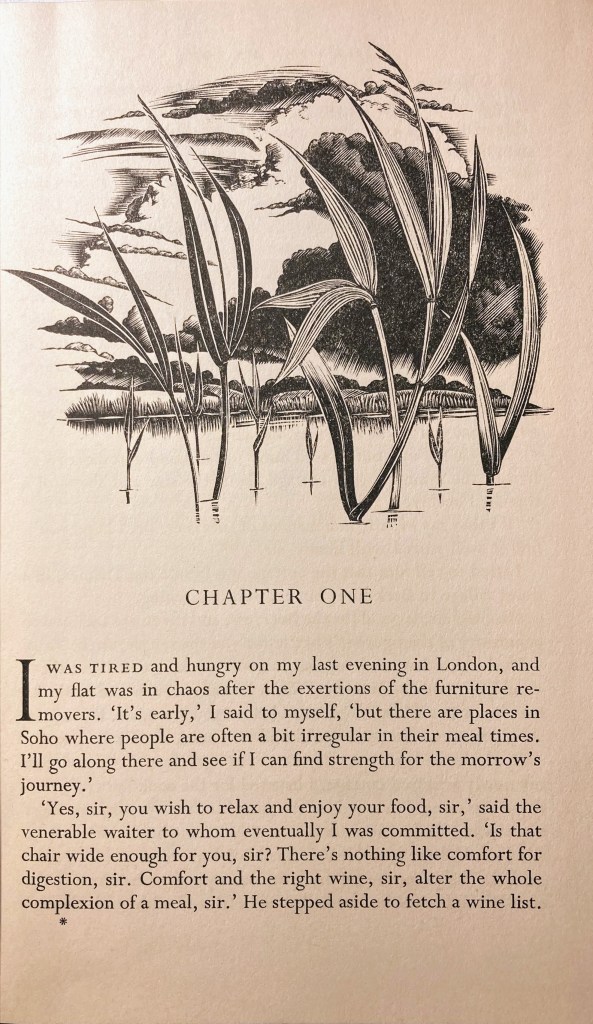
Little of great consequence happens in this small corner – Mr. Gibbings settles in to his new digs and, over the months, meets the locals, many of whom have stories to tell, observes the Thames’ ebbs and flows and records its flora and fauna.
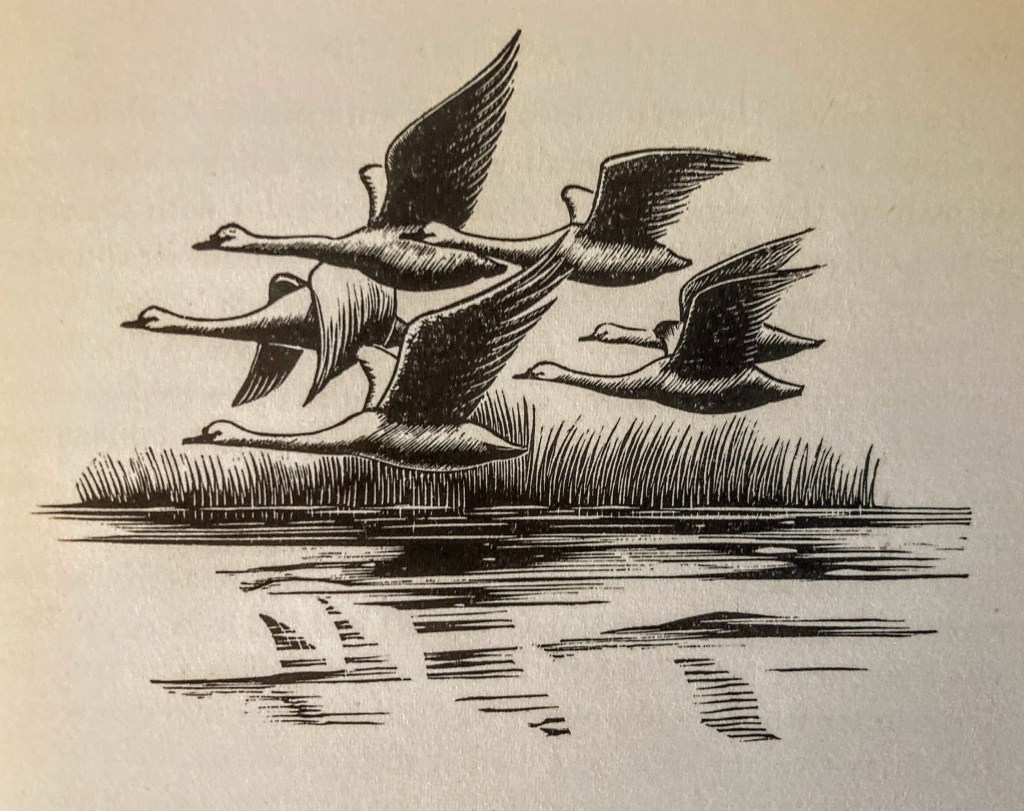
He travels about, throughout the neighborhood, stopping in the pubs and up and down the river, diverted by passing fancies and observations, throwing in a tidbits of history, both political and etymological. Here are a three examples:
- “The water poured into a long moat-like pond whose surface was tapestried with the amber of fallen leaves on the dark and light greens of duckweed and starwort. Bordering the pond, on the further side, was a wilderness of water scrub from which rose islands of crimson dogwood.” (p. 8)
- “As the shank from the cup of a rowlock, so springs the six-arched bridge from its Berkshire foothold. On the one side of the river wide meadows, where coots and and moorhens forage and herons cogitate, spread to the water’s edge, the level of their flood-inviting banks no more than inches above the summer stream; on the other side trees of infinite variety in form and colour, black and silver poplars, lusty elms and ashes, oaks and chestnuts, screen the three-mile loop of the river’s course to Little Wittenham.” (p. 117)
- “It was on a day in August that I set out to visit my eldest son, who had lately acquired Monkey Island, in the Thames near Bray. How would I make my journey? he had asked: fifty miles by water, thirty miles by road. To travel from one point on the river to another by means of tarred roads seemed contemptible. ‘I’ll come by water even if I have to swim’ I told him. The river steamer left Clifton Lock at noon. Not a cloud in the sky, a light wind freckling the water. We passed under Clifton Bridge with its nest-controlled arches; then almost under the small church on the cliff, in whose burial ground lie the bones of Sergeant Dykes of the Grenadier Guards, the man who fired the first shot at Waterloo and that by accident. They say Wellington was none too pleased, but that he relented and forgave him.” (p. 138)
In writing this post, I discovered the existence of the Museum of English Rural Life, in Reading, Berkshire: https://merl.reading.ac.uk (free to visit and with 4.8 stars on 222 Google reviews).
The town of Reading, 38 miles and 22 minutes from London by train, is more famous as the location of Huntley and Palmers Biscuits. The company, founded by Quakers and famous for its tin biscuit boxes, celebrated its 200th birthday in 2022 (https://merl.reading.ac.uk/whats-on/biscuit-town-200/). I’m sorry I missed its annual biscuit weekend (May 28-29); sounds like just my kind of event. The county of Berkshire, of course, is more famous as the location of Windsor Castle.
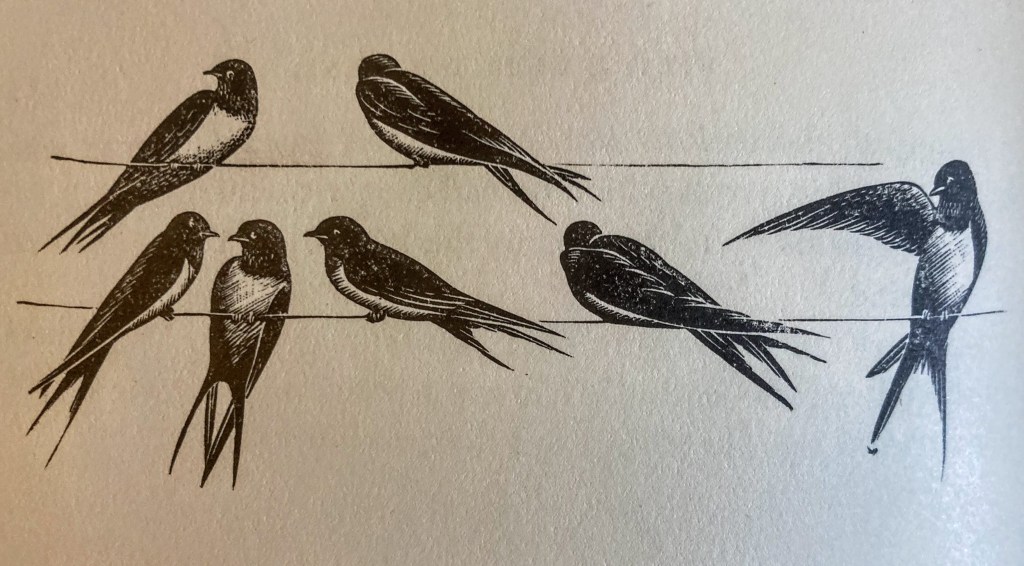
But I digress, much as Mr. Gibbings (1889-1958) was wont to do. Not surprising a tendency given Gibbings’ extensive range of interests: he was an author, naturalist, publisher, illustrator, sculptor and artist, specializing in woodcuts and engravings. Even regarded as the first man to draw underwater!
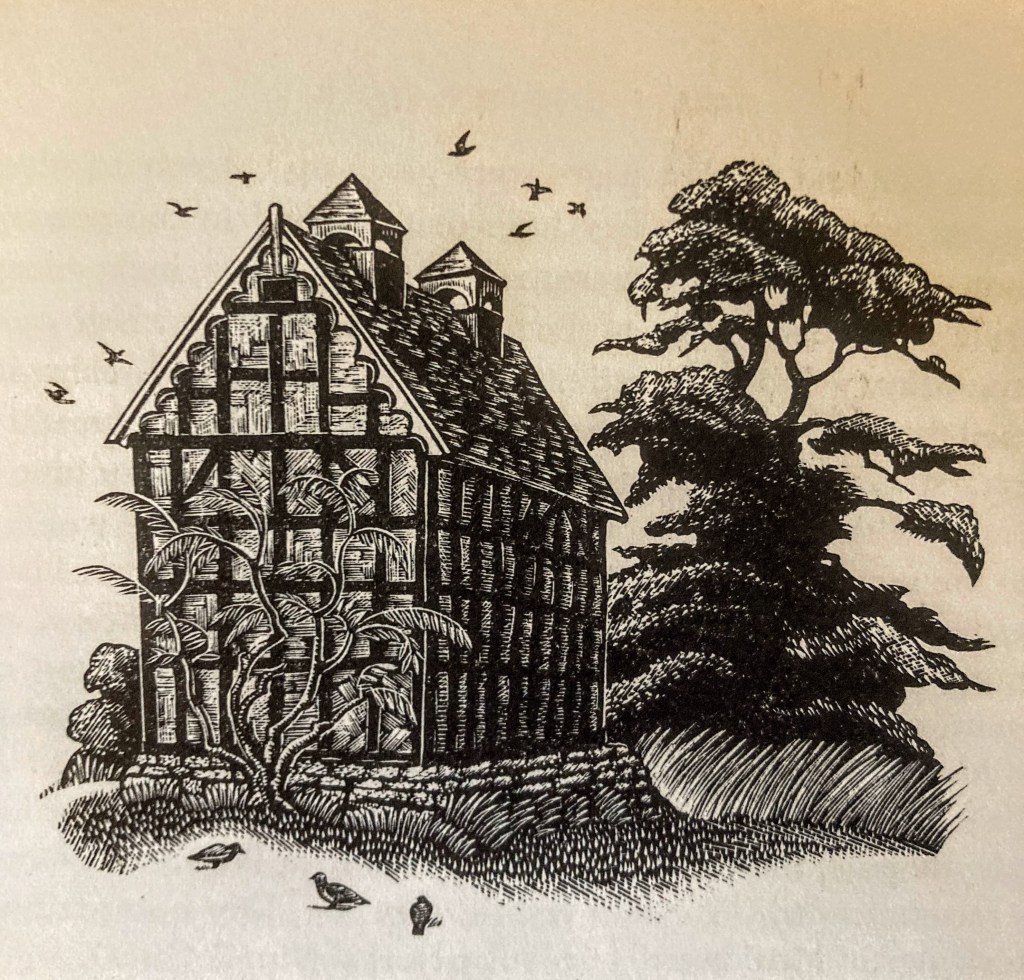
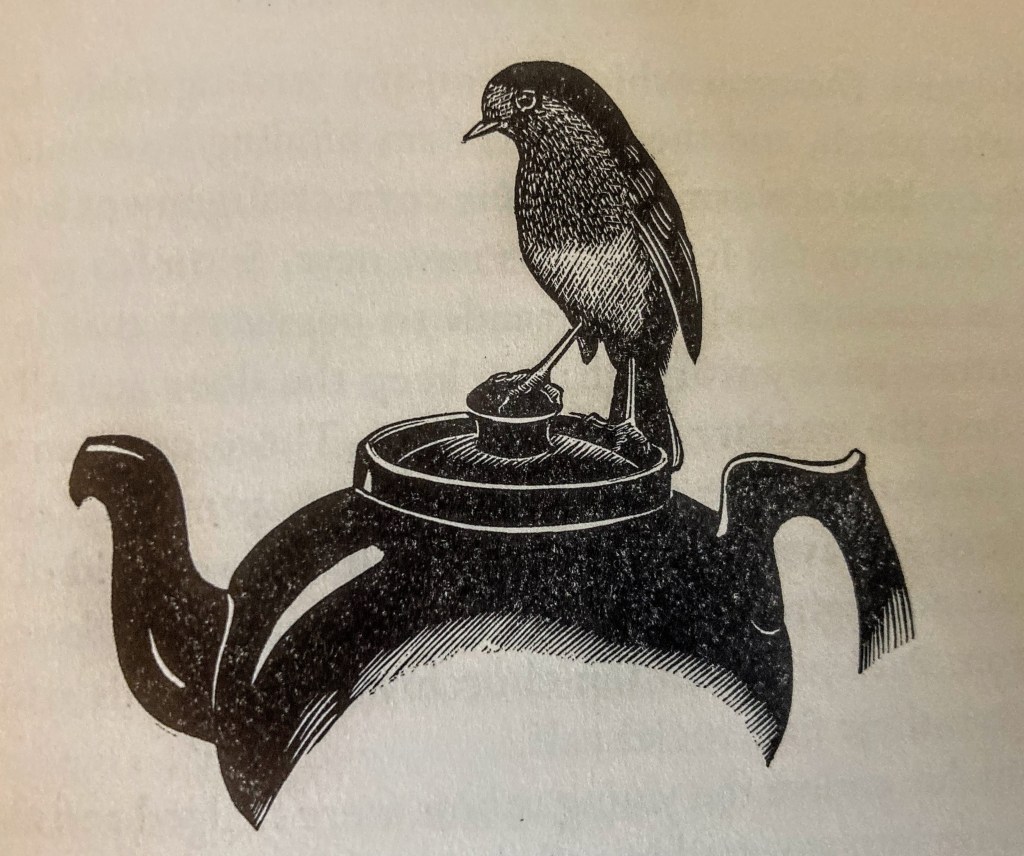
Check out these masterful examples, but small sampling of his drawings, chosen from the 60 books he illustrated (14 of which he authored). Several of Robert Gibbings’ books are still available on Amazon and AbeBooks ($11.74 for a used hardcover edition of Till I End My Song).
The title chosen for this volume was most apt, as it turned out to be his very last publication. Here is how he ends his own story:
“I think it is the unbroken sequences of flowing water, the unchanging destinies of streams, that seem to knit a man’s soul with the eternities. The rhythms of eddying pools, the rhymes of lapping wavelets, bring peace through eye and ear, emphasizing by their unceasing flow the unimportance of our passing lives. On and on they glide, not merely for the brief moments of our attention but through every hour of night and day, varying yet constant. The dancing of a mountain stream may be as entrancing as a ballet, but the quiet of an age-old river is like the slow turning of pages in a well-loved book.” (p. 184)
***
Next post I will continue in this vein, writing about Bruce Hutchison, the only Canadian writer known to me who wrote in a similar fashion to Lee and Gibbings.

You must be logged in to post a comment.