With an English mother (who read everything from natural history and essays to mysteries and poetry) and primarily English relatives, as a child I was invariably inundated with books by authors from the motherland.
As such, aside from The Hardy Boys and Tom Swift, Jnr. series (my father read the original Tom Swift books), I was less familiar with most American writers, coming to them more as a parent.
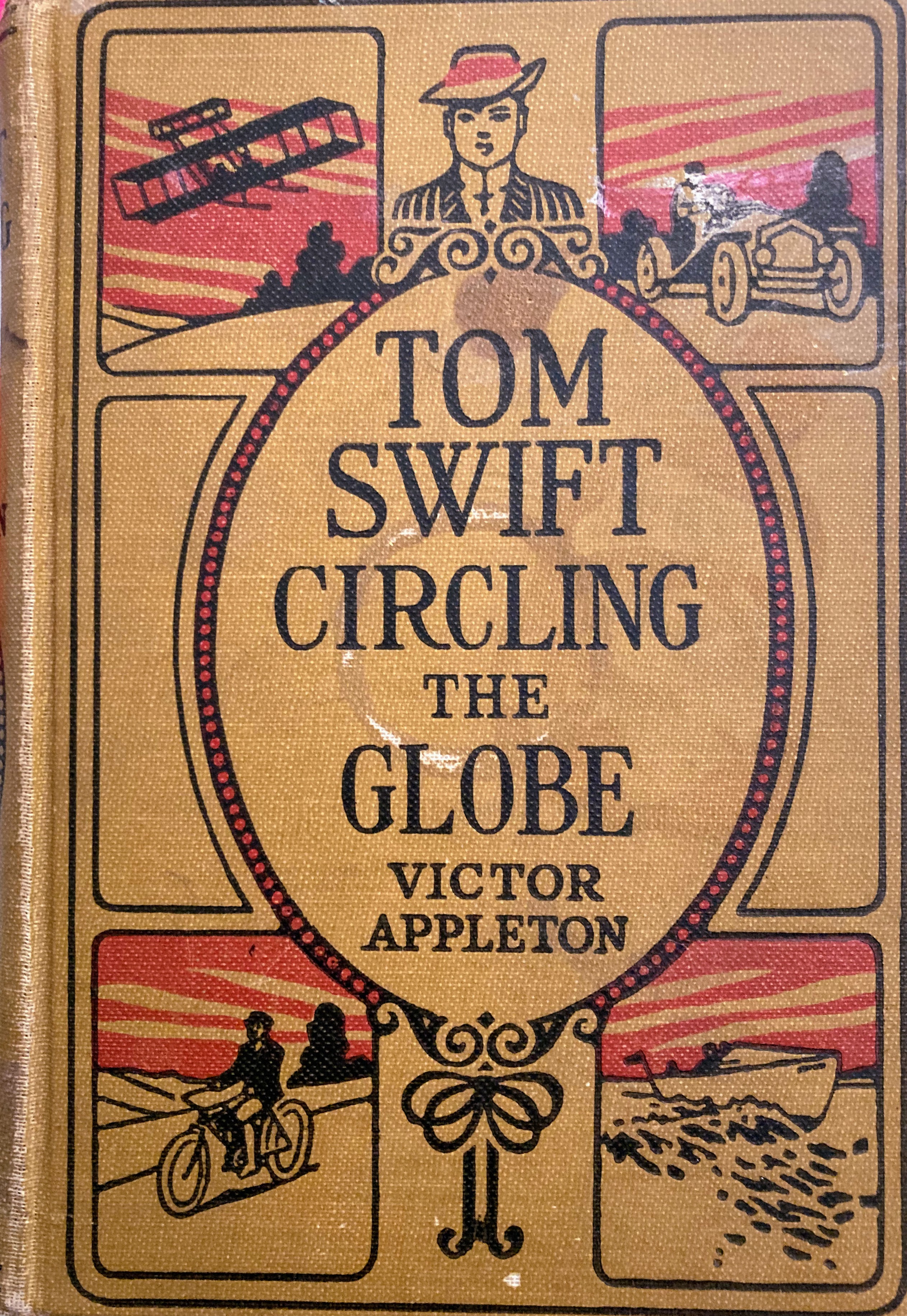
Grosset & Dunlap, New York, 1927
Thus, it was only later in life (in my 30’s and 40’s) that I discovered many of the authors that Bruce Handy discusses in Wild Things: The Joy of Reading Children’s Literature. This awareness came through reading to my children – Margaret Wise Brown (Goodnight Moon, The Runaway Bunny, The Noisy Book series), Theodore Geisel/Dr. Suess (The Cat in the Hat, etc.), Beverly Cleary (the Ramona series) and Judy Blume, to name but a few.
There are so many more I could name – picture books (Richard Scarry, whose Busytown series contain so much more than meets the eye), cartoons (James Stevenson, whose Worst and Grandpa, Mary Ann and Louie series are so incredibly funny). In his pre-school years, Feathers For Lunch (1990) by Lois Ehlert (1934 – 2021) was my son’s particular favourite.
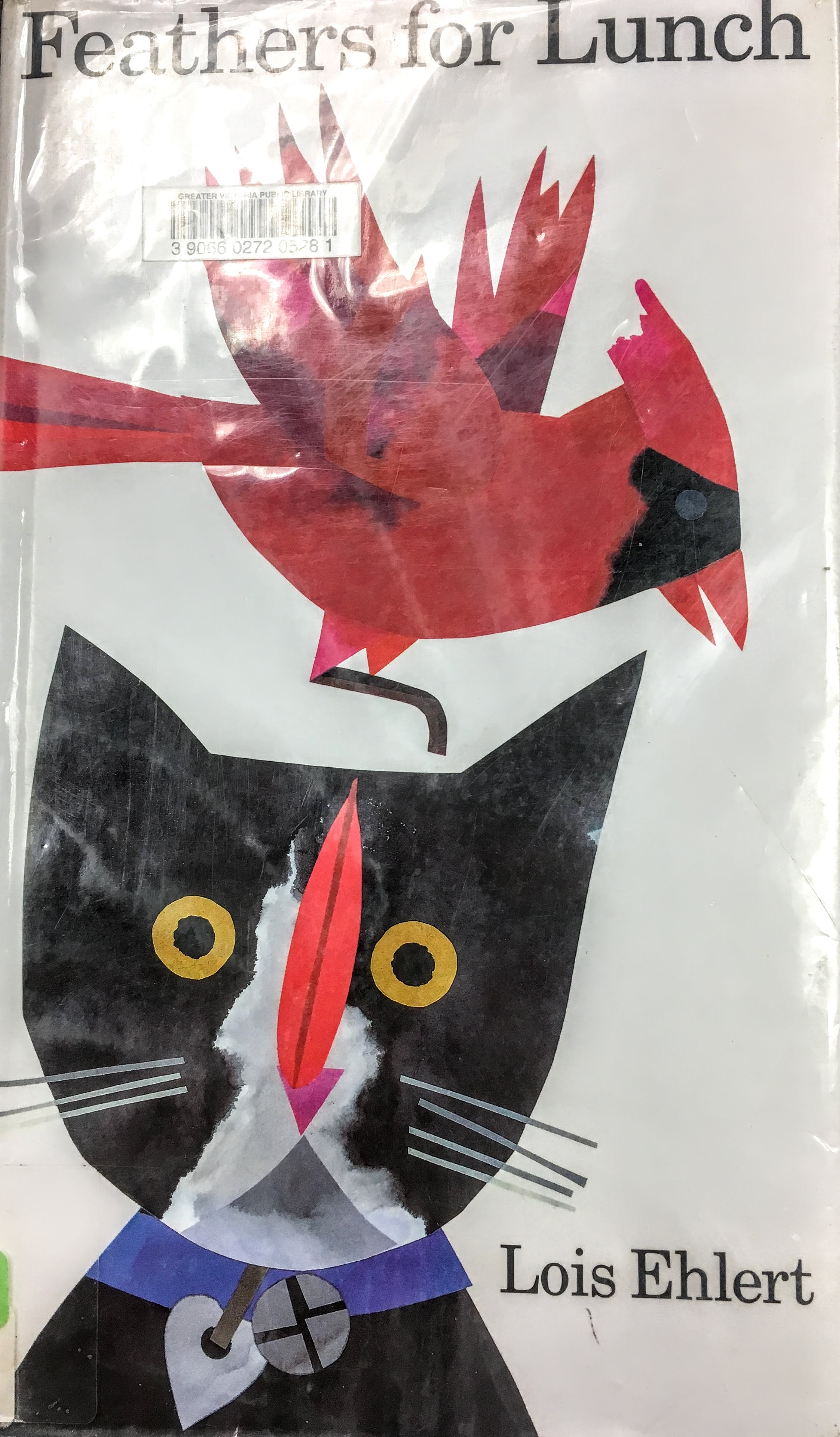
Clarion Books (now part of Houghton Mifflin Harcourt)
But, as an adult and a collector of books, I’ve also searched out children’s books on their own, either for the prose or for the illustrations. I used to frequent old book stores (that is, not old stores, but stores selling old books) just to see what I could find.
Two of my purchases came to mind in preparing this post, although for different reasons.
One is Jock the Scot, The Adventures of the Dog of the House who gave up Town Life to run a Country Estate by Alice Grant Rosman (New York, Minton, Balch & Co., 1930; illustrations by Joan Esley).
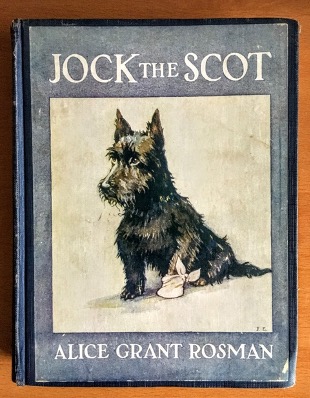
I bought it so many years ago that I can no longer recall the exact date, but I imagine the primary reasons were for the pleasing story, the cover of the injured Scottish Terrier, the illustrations and the fact that the heroine has the same first name as my sister, Gillian. Here’s how she is introduced to the reader:
“Gillian had no views about marriage for herself. She had not thought of it except as something infinitely remote, for the close companionship with her father ever since her school days ended, had made her at once older and younger than her years. She was wise in ways that would amaze her relatives, but ignorant of most of the standards they understood. Her father’s reputation was a matter of pride to her, but no one here seemed to think that he had been a great artist, or mentioned his work.”
Today, Alice Grant Rosman has been largely forgotten. She was an Australian journalist and novelist who moved to England, gaining prominence between the First and Second World Wars.
Encyclopedia.com describes her career as follows:
“In 1911, Rosman traveled with her family to London for the coronation of King George V. She remained in England and joined the literary staff of the British Australasian (also referred to as the British Australian and New Zealander) and the editorial staff of the Grand Magazine. In 1927, however, she relinquished her journalism positions to concentrate on her novel writing.
Rosman quickly earned international acclaim for her novels. The Window (1928) sold 100,000 copies. Visitors to Hugo (1929), which sensitively combined a psychiatric setting with humor, firmly established her reputation and became the standard by which her subsequent works were judged. Rosman was the author of over 15 novels, the best of which have been described as “domestic romances in comfortable households.”
The second book is Higglety Pigglety Pop! Or There Must Be More To Life by Maurice Sendak (New York, Harper & Row, 1967). Sendak both wrote and illustrated the book (not atypical for him).
The story is funny, clever, meaningful and the illustrations are detailed and exceptionally drawn. Of course, Sendak is, who is well-known, standing in a class by himself in this genre, needs no introduction to readers of children’s literature.
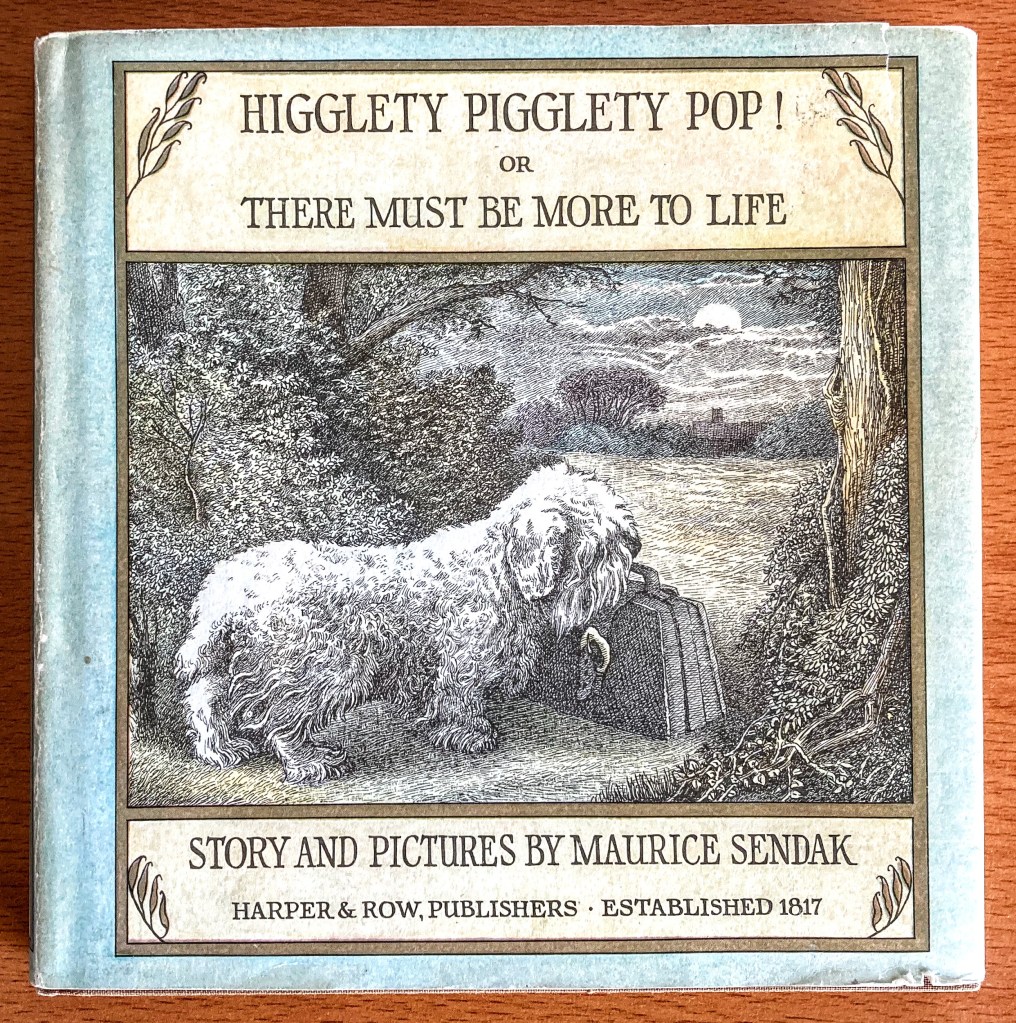
Handy has mixed views about some of Sendak’s books, including his most famous work, Where The Wild Things Are. Here, I share his misgivings: not only is it a story I’ve never warmed up to, but I don’t care for the illustrations (it might be my preference for the sparser lines of Higglety Pigglety Pop!).
Space prevents me from saying much more about either book today. But since children’s literature remains an abiding interest, expect to see more about the subject in the months to come.

You must be logged in to post a comment.