I recently came across a compilation of the 100 best fantasy books of all time, assembled by a panel of contemporary fantasy authors for Time magazine.
It’s a tremendous compendium, the books listed in chronological order, starting with The Arabian Nights (9th century) and ending with Woven in Moonlight by the American/Bolivian writer, Isabel Ibañez (2020). Certainly, other critics and readers could have come up with other favorites, and if time provides, I’ll examine it in more detail at a later date (many books and authors are unknown to me, and many others I appreciate are left off). But what this list demonstrates is the breadth of the genre, its long history and the many sub-genres involved.
One of those sub-genres is called portal fantasy. It’s the one I employ in The Ravenstones series.
How many fantasy sub-genres exist? Best Fantasy Books pulled together a list of 73! You have to work down a long way to get to portal fantasy. It’s listed at number 60, while anthropomorphic fantasy is number 69, almost at the end. I trust these categories aren’t organized by order of importance. (It certainly isn’t alphabetical!) Who knows, perhaps with The Ravenstones I’ve created a brand-new category – anthropomorphic portal fantasy.
In the Time magazine list, Lewis Carroll takes both 3rd and 4th place. These compilations led me to wonder whether Carroll was the first modern writer to use such a plot device – a portal leading to a second parallel world?
He did so twice, first, in Alice’s Adventures in Wonderland (1865) and, then, in the 1871 sequel, Through The Looking-Glass and What Alice Found There (both originally published by MacMillan of London).
In Wonderland, Alice is outside sitting with her older sister on a riverbank. It is a hot day; she is bored, as her sister is reading a book without pictures, and sleepy.
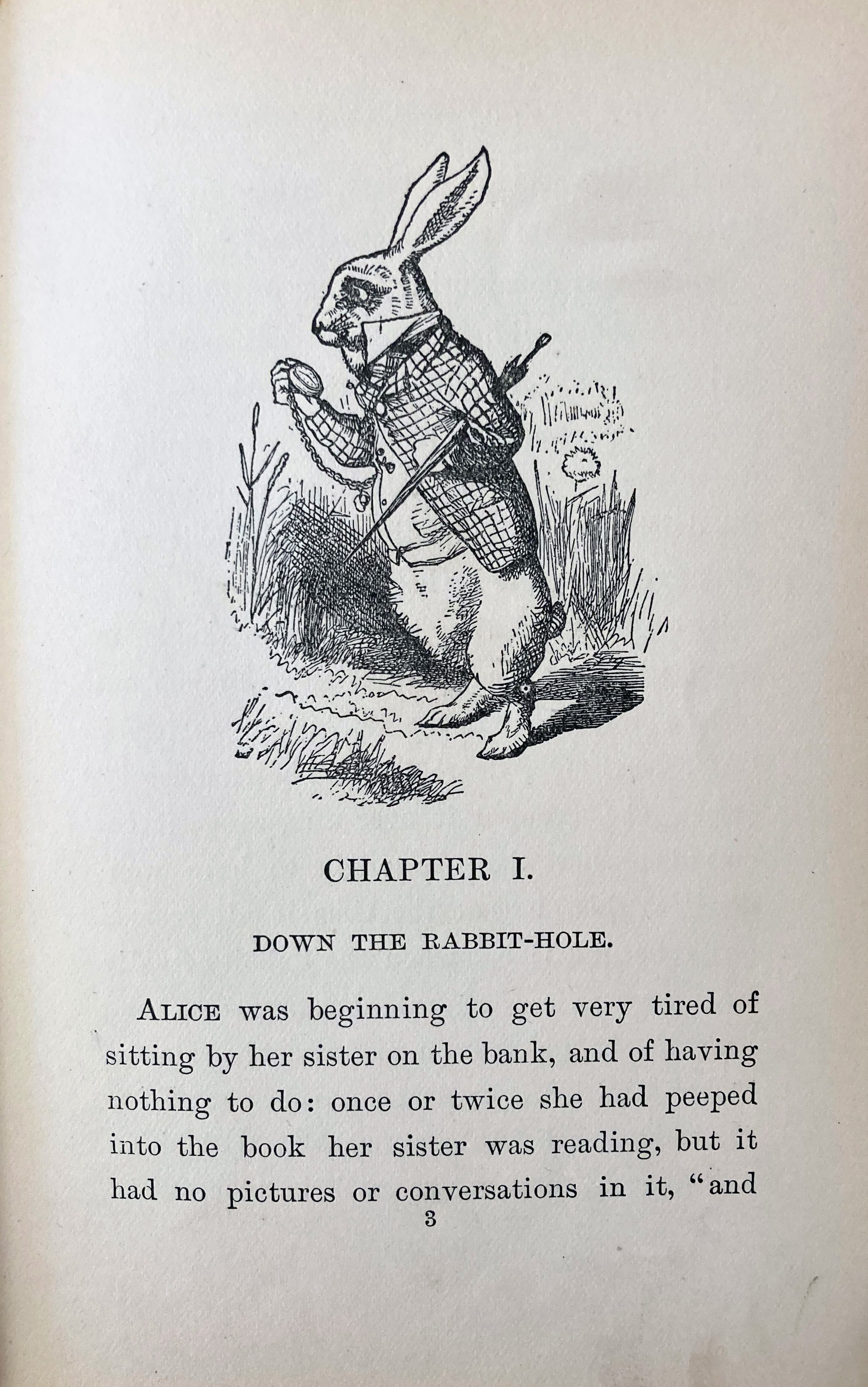
How Alice in Wonderland begins.
She spies a rather unusual rabbit, one with the waistcoat and pocket watch, running by. She chases after the animal, following it down a large rabbit-hole “never once considering how in the world she was to get out again.” (p. 5) At first, the rabbit-hole goes straight on like a tunnel. Then, it suddenly dips down, too quickly for Alice to stop herself.
She falls, and either she fell slowly or the well was very deep, for it was not long before she begins to wonder “how many miles” she’d fallen (p. 6), then, whether she might fall right through the entire earth and come out the other end in Australia or New Zealand and, finally, she begins to worry about her cat, Dinah, and what cats eat. Then, with a sudden thump (two thumps, to be exact) she lands, unhurt, onto a heap of sticks and dry leaves. Spying the rabbit once more, she gives chase, until finding herself in a long, low hall, lit by a row of lamps, with doors all round. Of course, she must find a way through one of the doors, and here the real adventure begins.
In the Looking-Glass, Alice is indoors resting on a big armchair, playing with a pair of kittens, the offspring of the now much older Dinah the cat. It is the first week of November, as the boys outside the house are gathering sticks for the November 5 Bonfire Night (otherwise known as Guy Fawkes Day). The day is cold and snowy. She starts her favorite game of “Let’s Pretend” with one of the kittens, getting up on a substantial mantlepiece and holding the cat up to a huge mirror and threatening to put it through into “the Looking-glass House” on the other side (p. 19).
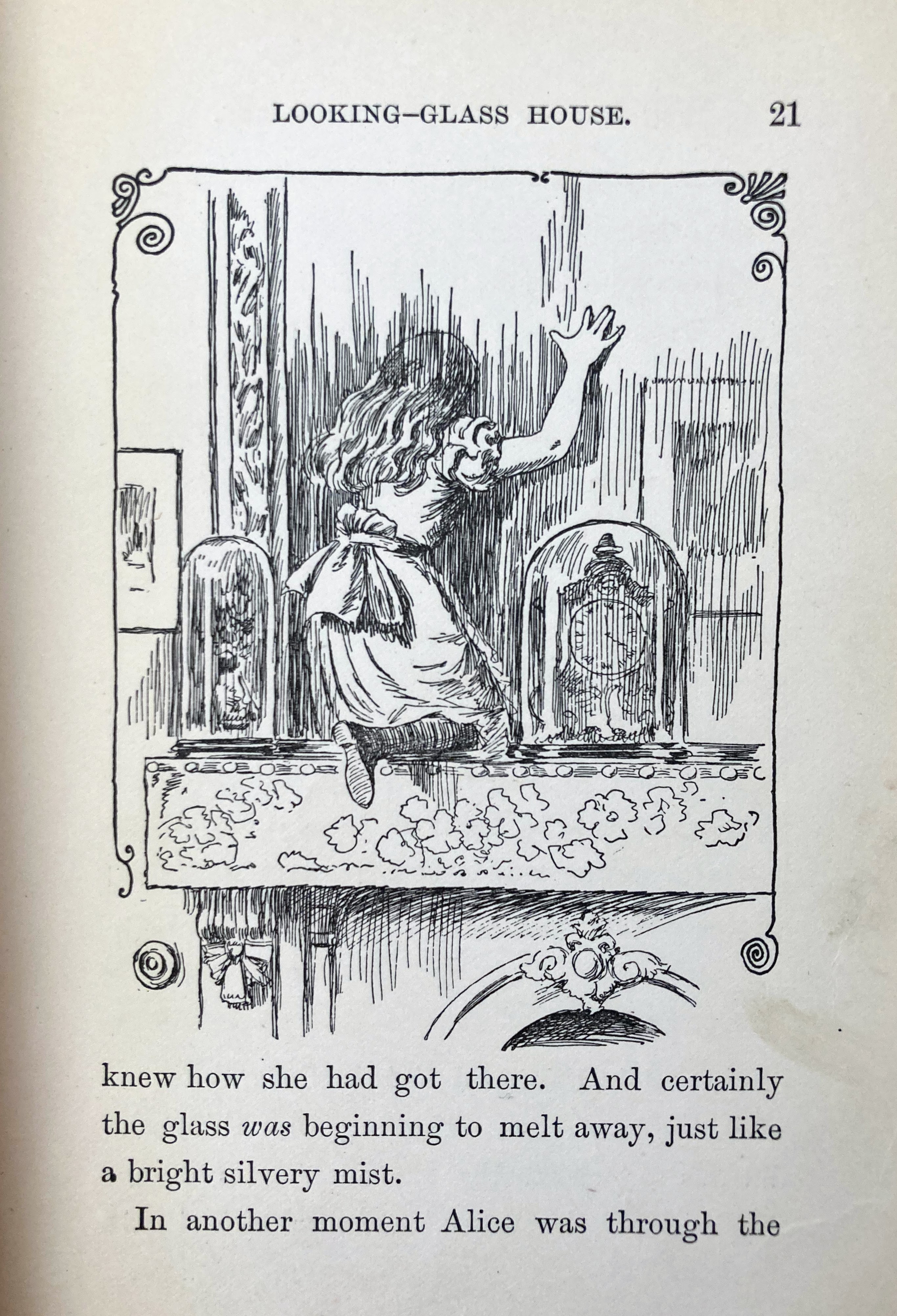
Alice goes through the looking-glass

and comes out the other side.
Alice begins to describe life on the other side – the similar but opposite drawing room, the passageway beyond when the door is left open (but only just a peep into it), how she can see everything but the fire in the fireplace and the books where the “words go the wrong way. She finds the glass “has got all soft like gauze” and then begins to melt away, “just like a bright silvery mist.” (pp. 20-21) The next thing she knows, she was through the glass and had jumped down, immediately checking to see if there really was a fire. Of course, Alice quickly begins to discover differences and the second adventure begins.
My two (well-used) copies of the books come from my Ottawa grandmother’s collection, American first editions, published in 1893 by Thomas Crowell & Co., New York, given as Christmas gifts to her (at least according to the inscription in the front). Although the inside illustrator is unnamed (a huge omission in my opinion) I suspect it is the great Sir John Tenniel, who’d been chosen by Carroll for the English editions. The cover artist is a mystery (and very different from the inside illustrations).
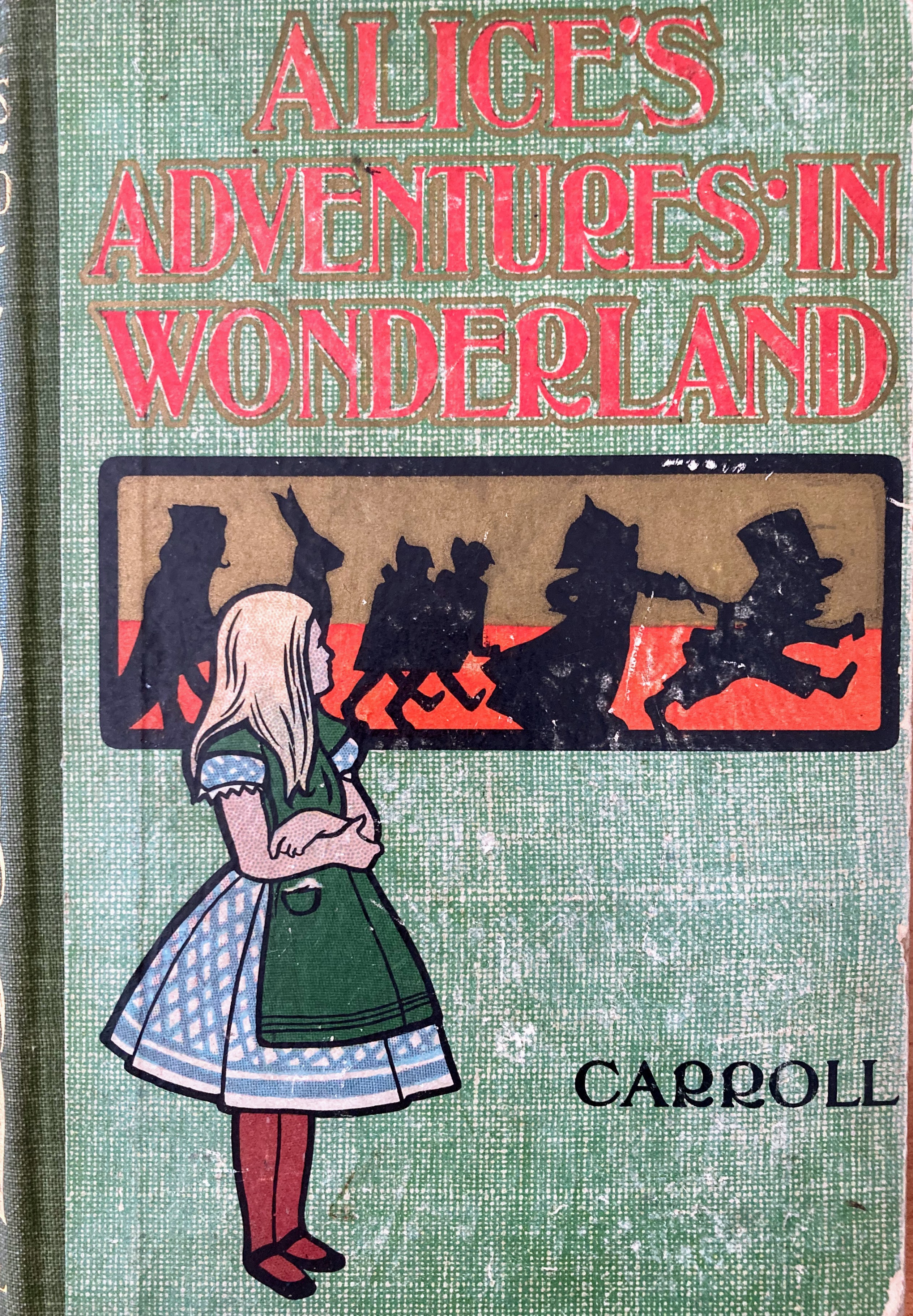
New York: Thomas Y. Crowell & Co.,1893 (no info on the illustrator)
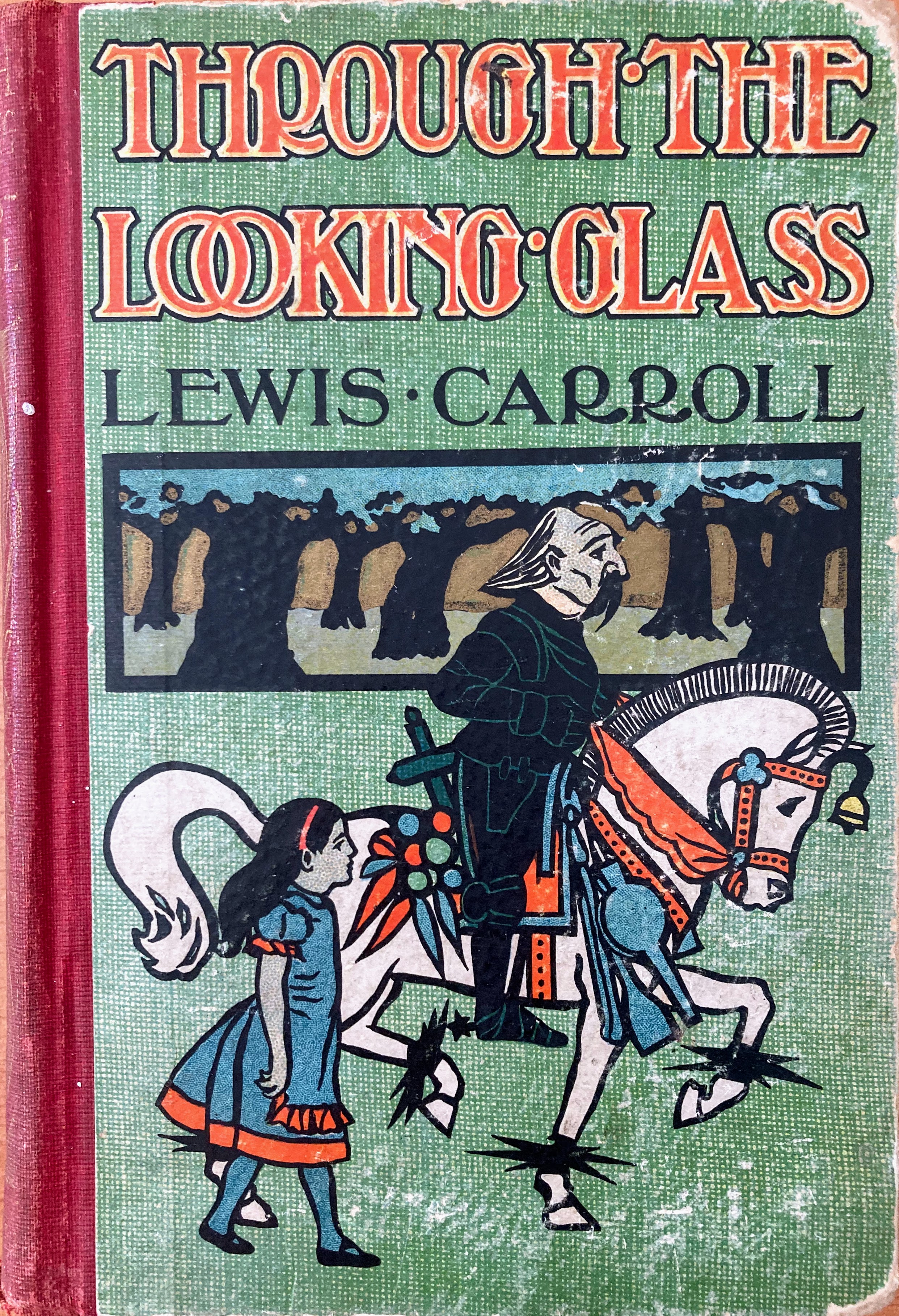
New York: Thomas Y. Crowell & Co.,1893 (no info on the illustrator)
By the way, according to the Wikipedia (based on information gleaned from three of his biographers, Cohen, Thomas and Green), the name Lewis Carroll was a pseudonym, a play on his real one –“Lewis was the anglicised form of Ludovicus, which was the Latin for Lutwidge, and Carroll an Irish surname similar to the Latin name Carolus, from which comes the name Charles.
The transition went as follows: “Charles Lutwidge” translated into Latin as “Carolus Ludovicus”. This was then translated back into English as “Carroll Lewis” and then reversed to make “Lewis Carroll”. This pseudonym was chosen by editor Edmund Yates from a list of four submitted by Dodgson, the others being Edgar Cuthwellis, Edgar U. C. Westhill, and Louis Carroll.”
[This information isn’t exactly relevant to the topic of the day, but I couldn’t resist sharing it.]
So what’s the answer to my question? Sorry, further analysis and the answer will take up too much space. You’ll have to come back in two weeks for the answer and for more on the subject (Portal Fantasy – Part 2).
Photo by Ivan Aleksic on Unsplash

You must be logged in to post a comment.