
In my last post I wrote about portal fantasy, specifically the two famous works of Lewis Carroll, Alice in Wonderland and Through the Looking Glass. I concluded that Carroll was likely the first author to employ the use of portal fantasy in modern literature (a period I consider to be post-1800).
Many came afterwards, of course, the best in my estimation being C.S. Lewis. Besides his well-known Narnia series (The Lion, the Witch and the Wardrobe, etc.) what other books have used portals as a plot device? In my view, the most famous in the English language are:
- Peter Pan by J.M. Barrie (which began as a story within a story in 1904 and then a play in 1911) and uses a magical flight to Neverland as its means of transportation; and
- The Wonderful Wizard of Oz by L. Frank Baum, (1900) which uses the tornado to get Dorothy out of Kansas.
Both, however, came a few years after Carroll, who published his two terrific Alice books in the late 1860’s.
In 2019, Annika Barranti Klein put together a comprehensive list of 50 portal fantasy books for Book Riot – 50+ Must Read Portal Fantasy Books, with brief descriptions of each book.
Some in the list are quite famous (see above). Most are current writers, many of whom will be familiar names to readers, young and old (e.g. Salman Rushdie; Rick Riordan; Cornelia Funke). It’s a great compilation, first, because it breaks the list into age categories (making it very reader-friendly) and second, because it opens the North American audience to several less-familiar authors from around the world.
One thing I did note, however was the following: not one of the fifty is devoted exclusively to a tale about animals. Of course, some of the books have dragons and other mystical characters, but all interact with humans. Although Rushdie has talking creatures, here, too, people are the focus of the story. Narnia is filled with a host of wonderful animals, the lion Aslan most notably, but here, as well, the children are both the heroes (as is the key villain) and main characters of the story. Perhaps with The Ravenstones, I am in a class by myself.
But once again I digress from my initial question – was Lewis Carroll the innovator of portal fantasy?
One could claim that John Bunyan’s fantasy, The Pilgrim’s Progress (1678), uses a portal to travel to a parallel world. But since that portal is nothing more than a dream, in my books, it doesn’t qualify as a gateway. My definition of “portal” requires an actual, physical point of entry.
C.S. Lewis’s retelling of this famous work, The Pilgrim’s Regress (1933), also uses the same plot device. So, in my view, neither one satisfies my criteria. But, I hear some argue, isn’t Alice falling asleep and dreaming? True enough, but Carroll still goes through the effort of having her find and use real entry points (the rabbit hole and then the mirror).
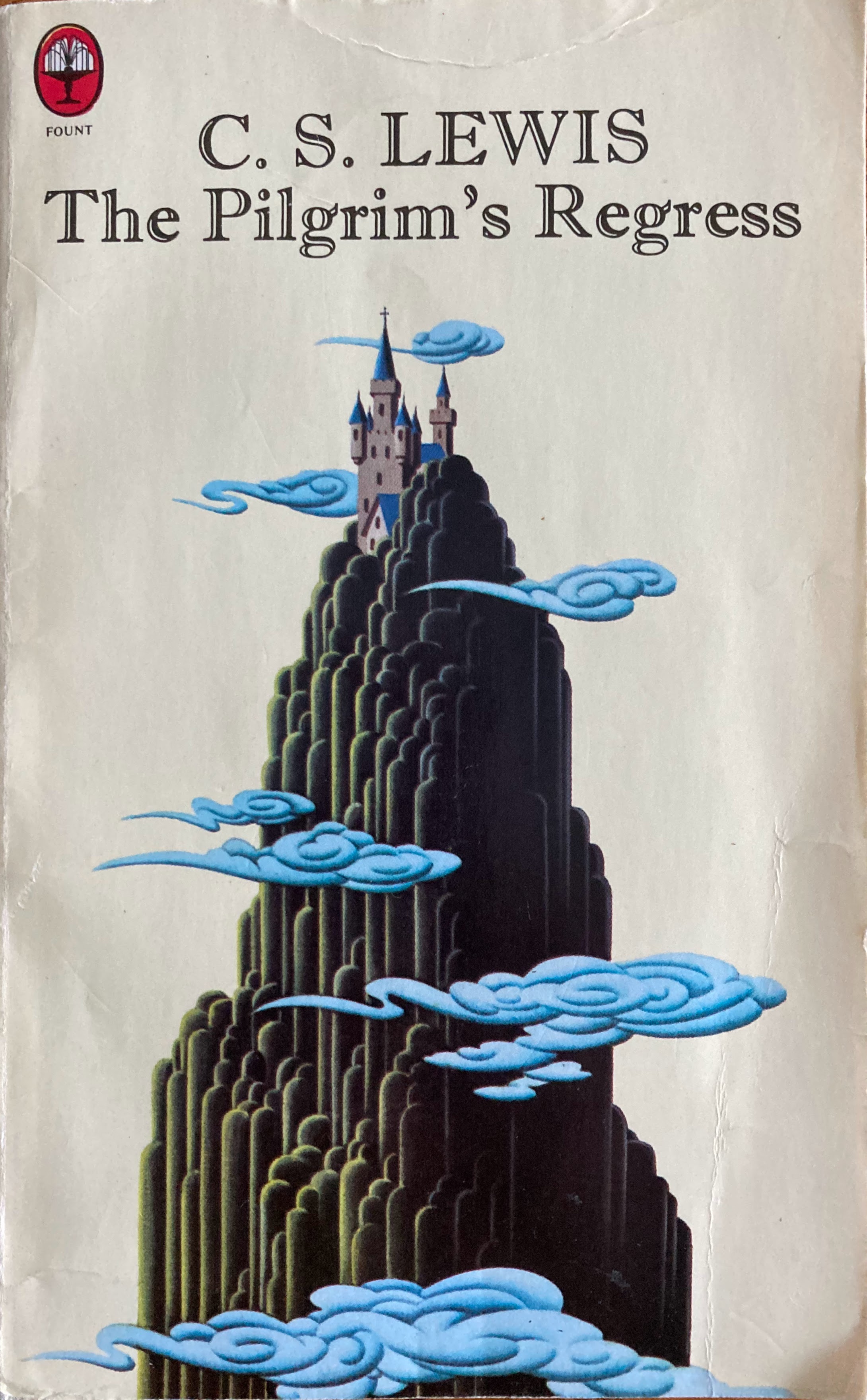
My edition is Fount Paperbacks, Glasgow, 1987 (first published by William Collins Sons in 1933)
Sir Arthur Conan Doyle in The Lost World (1912) also uses the portal approach, employing precarious entry and exit points to reach (and escape from) a prehistoric world in the Amazonian region of South America, but this wonderful story comes well after the Alice books.
I’d say only one other writer of the late 1800’s could make such a claim – Jules Verne. His Journey to the Center of the Earth (1864; revised in 1867; first published in English in 1871) predates Carroll, although by only one year.
It employs a volcano as its portal (located in the crater of the Snæfellsjökull icefield, Iceland) to gain access to the world’s underworld, where our heroes encounter prehistoric animals, gigantic insects and threatening natural phenomena, as well as a different exit point (Stromboli, a volcanic island off Sicily).
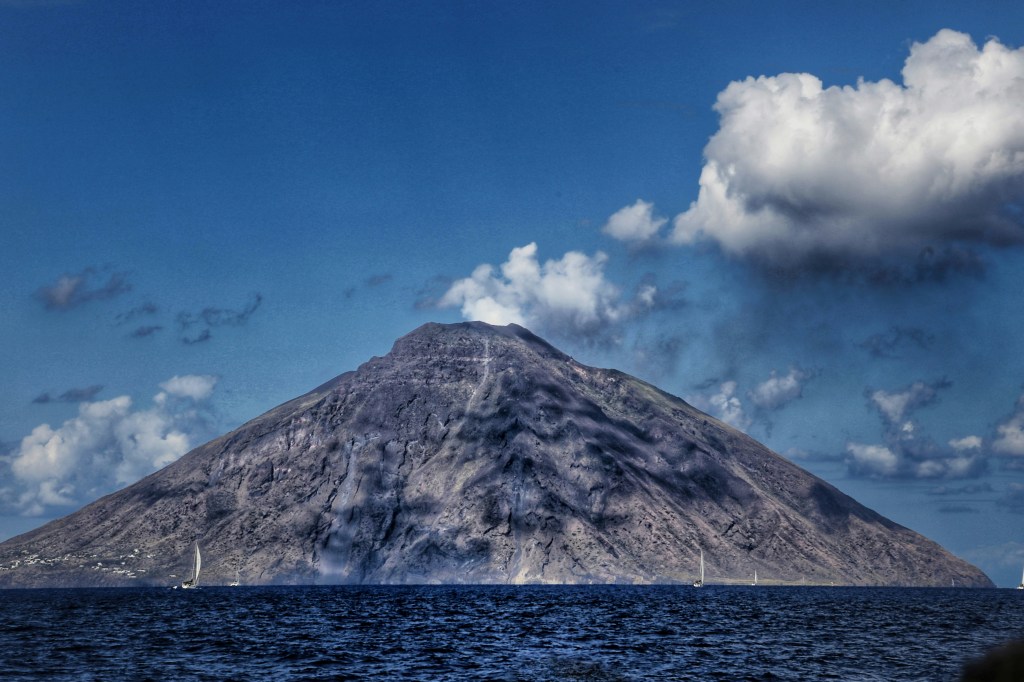
Photo of Mt. Stromboli by Bernd 📷 Dittrich on Unsplash
It’s a terrific story with just enough scientific detail and plausibility to make the journey seem possible, and Verne’s use of two access points is sheer brilliance. I’ve never forgotten the 1959 film Journey to the Center of the Earth by 20th Century Fox (James Mason! Pat Boone!) when I was young and far more impressionable.
Verne is one of the most original fantasy writers of all time, but is Journey to the Center of the Earth a true portal fantasy? Although others may disagree, I would maintain that, as the heroes’ destination is not a parallel domain but simply an exploration of another part of the world, it’s not quite the same thing.
Verne was prolific, publishing 54 novels in his lifetime, over the same time period as Carroll. Unfortunately, since I’ve not read the majority of these works I can’t comment on whether he ever employed the portal plot device elsewhere. Perhaps readers more familiar with Jules Verne can help.
Having made this one disclaimer, after going through my own book collection, knowledge banks and combing these online lists, I believe that both Carroll and Verne could lay claim to being the original user of the portal plot device. But only Carroll could claim to have created a perfect parallel world, mirroring our existing one. So, in my view, Carroll gets the nod as the first of these innovators.
If any other writers of this genre exist, I’m not aware of them. (Readers are, of course, more than welcome to contribute their ideas.)
Cover Photo by Mick Haupt on Unsplash

You must be logged in to post a comment.