
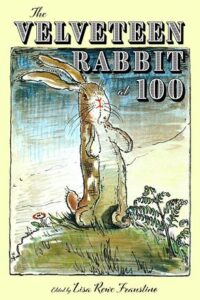
My copy of the reprint of the original (New York: Doubleday, 1991)
On June 23 of this year, Literary Hub published an account by Lisa Rowe Fraustino, Hollins University, on the “Enduring Relevance of Margery Williams’s Most Famous Book”, providing a summary of the author’s life and relevance today. The article serves as an introduction to The Velveteen Rabbit at 100. Given its length, I have taken the liberty of editing it:
Margery Williams was born in London on July 22, 1881, and died September 4, 1944, in New York City. Though she published twenty-seven books, including five translations of works from French and Norwegian, and won the John Newbery Honor Medal for her novel Winterbound (1936) in 1937, Ms. Williams is primarily known today as the author of The Velveteen Rabbit.
While biographers make no mention of her mother that I have been able to find, it is frequently noted that Robert Williams, her father, was a warm and encouraging influence. A fellow of the classics at Oxford as well as a barrister and an opinion writer for periodicals, he held liberal views of education, prescient of today’s unschooling movement.
Williams was taught to read early and then allowed to explore her interests freely, without instruction and, since her only sister was six years older, largely alone. Anne Carroll Moore, who knew Williams well, quotes her as saying, “My favorite book in my father’s library was Wood’s Natural History in three big green volumes, and I knew every reptile, bird and beast in those volumes before I knew the multiplication table.” Her father’s death, when Williams was seven years old, was a deeply saddening formative experience that would shape her artistic vision.
Williams spent the rest of her childhood shuttling back and forth between the United States and England. After two happy years at the Convent School in rural Pennsylvania, ending at age seventeen, she determined to become an author, and at nineteen, she returned to London hoping to publish. That she did and more. Peggy Whalen-Levitt sums up Williams’s next few years: “By 1906, when she was twenty-five, she had published four adult novels; married Francesco Bianco, a dealer in rare books; and given birth to two children.”
Williams’s attentions turned away from writing to care for Cecco (born 1905) and Pamela (born 1906). They lived in Paris and then Turin while Captain Bianco served in the Italian Army during World War I and returned to London before the family permanently relocated to the United States.
Pamela turned out to be a child prodigy in both drawing and painting, getting her first solo exhibit in London at the age of twelve. American Socialite Gertrude Vanderbilt Whitney took Pamela under her patronage and arranged an exhibition in New York city. These works, which had been inspired by the poetry of Walter de la Mare, whose writing Williams greatly admired, spurred de la Mare to produce a new collection of poems.
Heinemann published the resulting (and successful) collaboration in a 1919 volume, Flora: A Book of Drawings with Illustrative Poems. Today, it may surprise most children’s literature scholars to learn that, during their lifetimes, Pamela Bianco was actually far more famous than her mother.
Inspired by de la Mare, with her children now in adolescence, Williams resumed writing, turning her hand to “stories she had told them [her children] when they were small, stories about their toys” as well as “those she herself had loved as a child.” The first of these was based on her “almost forgotten Tubby who was the rabbit, and old Dobbin the Skin Horse” and published by Harper’s Bazaar in 1921 “as a vehicle for original illustrations by Pamela.” We now know this story, “The Velveteen Rabbit,” as Williams’ first children’s book.
Moore, who first encountered the book when its American publisher, George H. Doran Co., asked her opinion on how it would sell, found the themes stunningly poignant. Having spent time in post-war France and England, she had formed “vivid first-hand impressions of children whose toys and pets and books had been destroyed”, a context for young readers who had suffered deprivation and loss.
A number of successful children’s books followed The Velveteen Rabbit. Two were illustrated by Pamela Bianco, including The Little Wooden Doll (1925) and The Skin Horse (1927).
In “A Tribute to Margery Bianco,” Williams’s contemporary and family friend, Louise Seaman Bechtel describes the reason for the author’s success: “This kind of imagination, playing not upon fairies but upon the real things a child knows, his toys and his pets, struck a note… to which children will always answer.” Williams keeps the most important thing predominant in a dramatic simplification: the rabbit belongs to a Boy—we do not know his name, or what his home looked like, or exactly how many people were in his family, because it doesn’t matter to the rabbit’s story.
Williams shared her philosophy of “Writing Books for Boys and Girls” in a speech to the National Council of Teachers of English in 1936, the year her Newbery Honor Book Winterbound was published. “In writing a real life story I think it should be real life, as far as one can present it,” she said. “Things shouldn’t be made any easier than they actually are” because it’s unfair to readers when “each difficulty is promptly surmounted and something always turns up in time to save a situation.”
She believed that children “know much better. They know that things don’t happen just that way, and that if you really want to accomplish anything at all—no matter how small—you generally have to work pretty darn hard over it, and go through a lot of misgivings and discouragement along the way.”
This philosophy, from someone who drew on her own and her children’s real-life toy stories and who had also lost her father at an early age, perhaps explains the Rabbit’s suffering and that tear of despair from which the nursery magic fairy springs.
Margaret Blount quips, in Animal Land: The Creatures of Children’s Fiction, “The path of every toy is always downwards” because while we give them human attributes, breakable and disposable toys they remain. She asks, “When such creatures are given thoughts and emotions, how can they be other than tragic?” Blount then turns to The Velveteen Rabbit to answer her question: “The only way out of the difficulty is to turn toys into cheerful ageless beings such as Larry the Lamb or Winnie the Pooh, neither of whom lives in the real world at all, but in some place where a small boy and his bear will always be playing. But the fairy-tale satisfaction of this short, perfect allegory would not be valid if the rabbit were not part of the child’s real life. The allegory is about human love and human childhood.”
After the author’s death in 1944, Moore collaborated in the editing of Writing and Criticism: A Book for Margery Bianco, in which the authors recount why they were “impressed with the quality and variety of Mrs. Bianco’s interests, her skill as a writer and translator, the reliability and richness of her background, and, above all, by the wisdom, the humor, the spiritual integrity she brought to the field of children’s books after World War I.”
Despite the efforts of her contemporaries, most of Williams’s contributions to the field of children’s literature are in danger of being lost to history. Her writing is,of course, “a product of a time when children’s literature presented an ethos that many children and critics find unrealistic today, an ethos combining love, beauty, health, nature, God, family, truth, and the natural goodness of the child’s worldview.”
Perhaps a pandemic, during a time of global climate change and alternative facts, dovetailed with the hundredth anniversary of The Velveteen Rabbit, will reignite interest in the author’s life and collective works.
__________________________________
As a footnote, I find it striking that The Velveteen Rabbit was not illustrated in the book form by Margery’s daughter, Pamela, but by one of my favorite artists of the era, William Nicholson, one-half of the Beggarstaffs team of Nicholson and Pryde (see my post of September 16). I’ll have more to say about the book in my next post.
Cover Photo by Ансплэш Степана on Unsplash

You must be logged in to post a comment.