
Recently, courtesy of Canada’s national television broadcaster (the CBC), I came across a historical vignette about New Brunswick’s Kent Island.
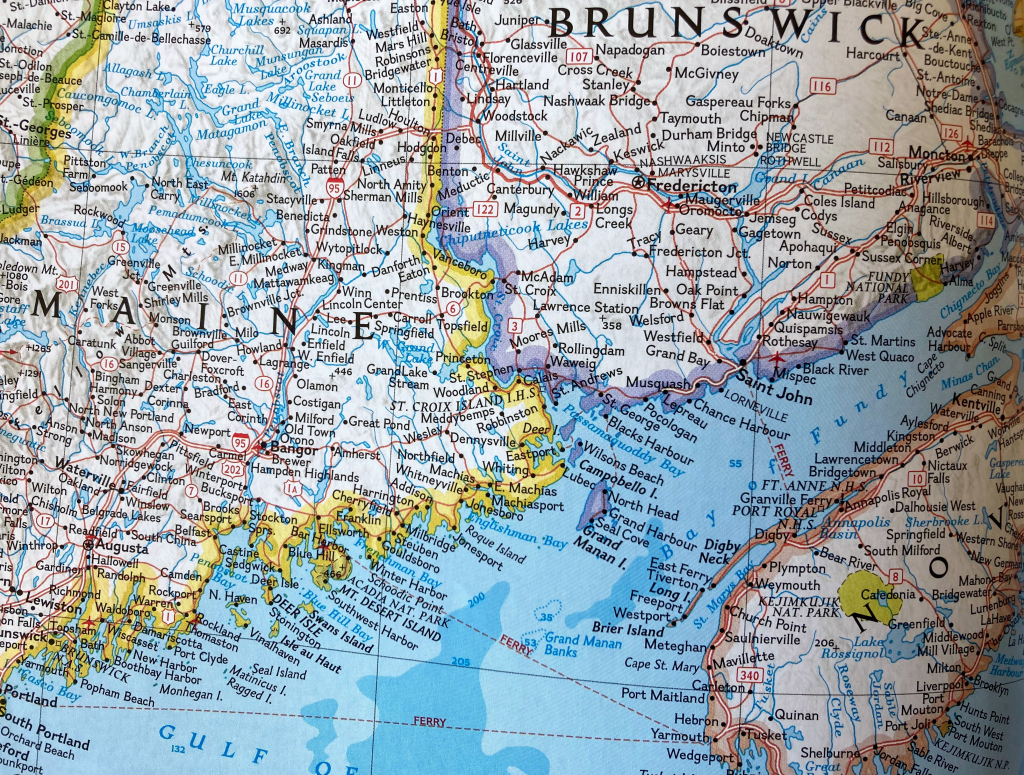
The tiny island sits off the coast of Grand Manan (in the center of the Bay of Fundy). It measures about 800 metres wide (at its widest point) and three kilometres long. It’s too small to spot on the map above but – if you look closely – at least you can see Grand Manan. Its southern tip is just about as far south as you can get in New Brunswick (map courtesy of National Geographic).
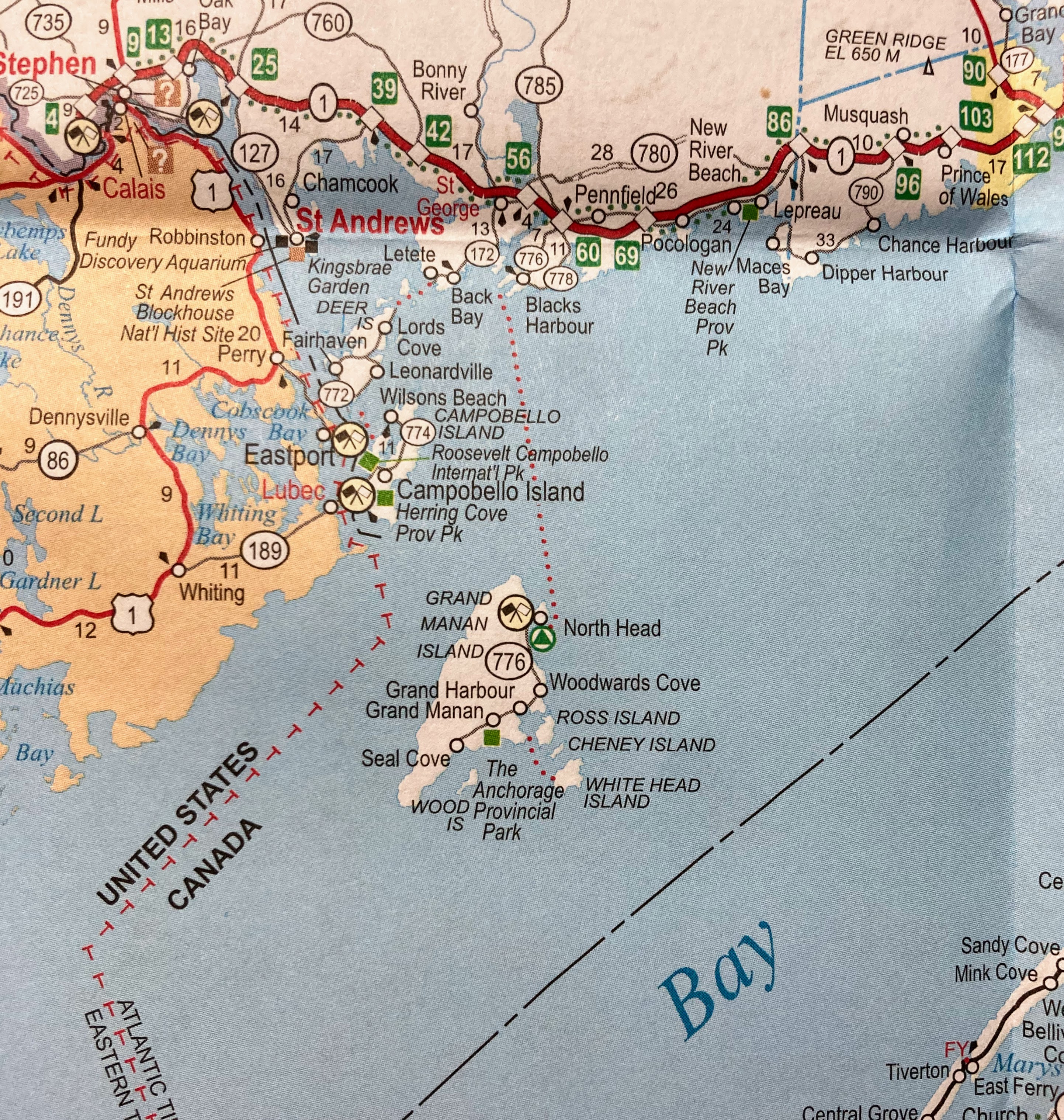
Here’s a closer look, taken from a 2021 AAA/CAA map. More detail of Grand Manan and including four smaller islands. But still no sign of Kent:
Why do I care, you might ask? At first blush, the place seems to have little to do with me or my interests. The answer becomes clear as you read into the CBC story: it has to do with the survival of the Common Eider duck species.
Two men are to be thanked for that survival: naturalist/taxidermist Allan Moses and philanthropist John Sterling Rockefeller. The former urged the preservation of Kent Island as a bird sanctuary and the latter put up the necessary funds to make it happen.
All in return for the gift of a rare stuffed albatross, one desperately wanted by New York’s Museum of Natural History and one that Moses owned. Before then, the island’s declining eider duck population had been under severe threat; after that purchase, it rebounded dramatically.
As every reader of The Ravenstones knows, the Eider duck represents one-half of the saga’s two main protagonists. Our story begins in the high Arctic with Eirwen, the polar bear, on the hunt for his lost friends. He needs some help and, right on cue, he comes across Fridis, the duck.
Although, at first blush, Fridis comes across as an unlikely ally for the bear, she proves her worth time and time again, and, at the dramatic finish, provides a crucial role in defeating the forces of darkness. Enough said, you’ll have to read to the end of Prophecy Fulfilled to find out.
My choice of character needed to be an animal common to that part of the world. The Cornell University Ornithological Lab provides the lowdown on the species, including a map showing breeding locations throughout much of the coastline of the Arctic Ocean. Its description of the bird reads as follows:
“A bird of the cold north with a warm reputation, the Common Eider is famous for the insulating quality of its down (typically harvested from nests without harming the birds).
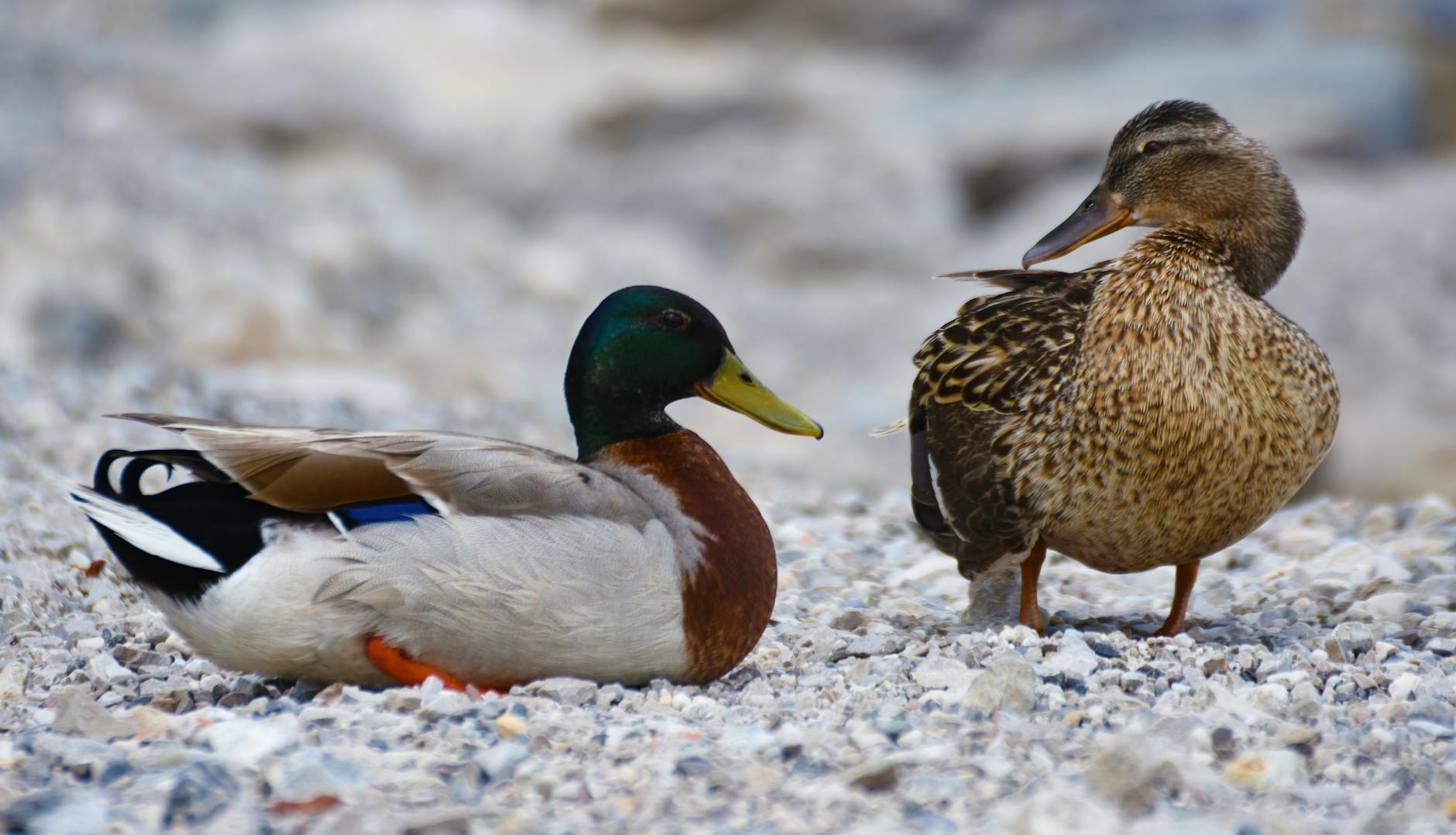
“Breeding males are sharp white and black, with pistachio green accents on the neck. Females are barred with warm brown and black. These largest of all Northern Hemisphere sea ducks gather along rocky ocean shores, diving for mussels and other shellfish, which they pry from rocks using long, chisel-like bills. Males court females throughout the year with gentle, crooning calls.”
Cornell’s website goes on to provide a sound recording of that “crooning”, a most accurate description of the sound.
Although with a current breeding population of 2.3 million, the species’ immediate future seems bright, some risks remain. Here is a summary of Cornell’s status report:
“Market hunting reduced southern populations of Common Eider in the Atlantic to near extinction by the end of the nineteenth century, but their numbers increased in the twentieth century. Arctic populations are declining, in part due to hunting and to contamination…The overharvest of Common Eiders’ main prey species (blue mussels, green urchins) as well as algae—and the creation of aquaculture farms in sheltered coves—have reduced food available to them.”
Should you be inspired to visit Grand Manan, here’s a tourism link, with details on the local bird life: http://www.grandmanannb.com/
Cover photo by Anna Storsul on Unsplash

Leave a comment