
I used to own a complete set of Samuel Pepys’ famous diaries (1660-1669). An edition published earlier in the 20th century. Not any longer though. The nine volumes, adding to my already weighty collection of books, became too much to hang onto. Finally, at one house move, they were tossed overboard. Well, not literally. Given away to the Salvation Army or Habitat for Humanity most likely.
Truth be told I only ever looked at the books to read about the famous Great London Fire of 1666, wherein much of the city was destroyed. Pepys’ diaries provide a dramatic and rare testimony to the dire event.
Given the disposal of Pepys, I had to content myself with this:
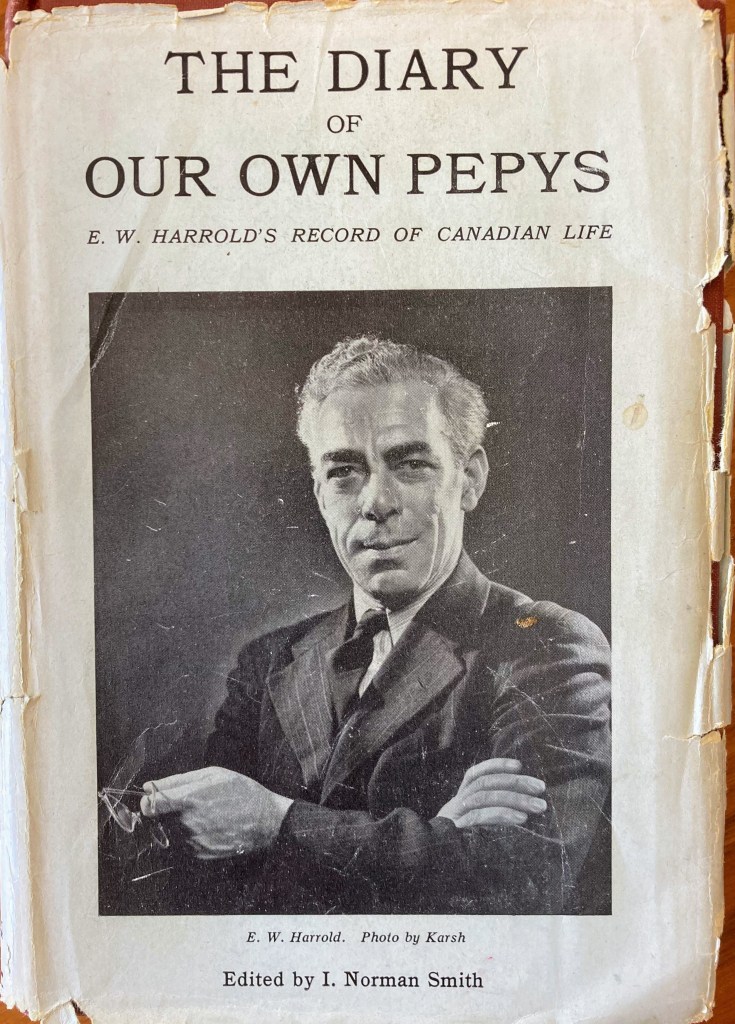
Toronto: The Ryerson Press, 1947
E. W. Harrold was Associate Editor of The Ottawa Citizen from 1923 to 1945. From 1930 on, he kept a diary, “a Canadian version of Pepys’ diary”, so the book cover says. It was published in weekly instalments in the newspaper for 15 years, a “genuine and intimate record of his thoughts, doings and his times”, becoming the oldest continuous feature of its kind in Canada.
My copy of this well-worn book was a birthday present (June, 1947) from my Dad to his Dad. Winnowing Harrold’s 800,000 words down to 100,000 was quite a task. In fact, it took the combined work of eleven assistant editors under the overall direction of I. Norman Smith, journalist and editor of the Citizen’s rival daily, The Ottawa Journal, to pull it off. [Available on Abe Books for $23]
Given the period covered by these diaries (the roaring twenties, the depression, the build up to the Second World War and the wartime itself), its locale (Ottawa, the nation’s capital, and the home of my father and grandfather) and the fact it was a gift from one to the other, I did read the entire book, finding it as fascinating and interesting a record as its many weekly followers. Of course, having spent many years in Ottawa myself, much of the city and local history is familiar to me.
Here are a few excerpts:
Wednesday, September 29, 1937
The day’s most important news is that Mussolini, on the arm of Hitler, harangued “a million rain-soaked Germans” on the great purpose of Fascism, which is “Peace” and Lord! if a million Germans take that at its face value they are soaked with something besides rain, for as W. Lipman saith, Fascism is martial law, and a philosophy designed to deny all the things a thousand years of human trial and error have proved sound.
Saturday, February 10, 1940
Up and see that the Prime Minister hath filled six places in the Senate, which means 600 disappointed and envious fellows in the background, and I wondered how one becomes a Senator, for as I approach the sere and yellow I begin to think it would be nice to become a lifelong law-giver at $4000 a year, but in my saner moments I realize the price one is expected to pay is too great…
Sunday, June 22, 1941
Wakened past 8 by my boy who tells me that the wireless do say that Germany hath attacked Russia, and I could scarcely believe the news to be true, but it was. So, my mind full of the business and perversely glad that another vast area of the Earth had become embroiled against the enemy, I fell to wondering what madness did prompt Herr Hitler to embark upon such a colossal gamble, and thought that lust for power did account for much in his dark and devilish calculations, and mused, also, that the war hath now assumed a character that for potential consequences upon the history of the human race has never been matched. Then I fell to wondering what the Communists would now say, and whether we should now allow the Daily Clarion to reopen for business and where Harry Binder [Ontario Communist party leader imprisoned when the war began] would be let out of jail with an apology, and Lord! It is going to be a bit of a task to readjust our thinking. So listened to what tidings there were and smiled wryly at Molotov’s lament concerning Nazi treachery and his virtuous indignation at the attacks on Norway and Belgium, Holland and France and then heard a summary of Ribbentrop’s message to the Germans, a bit of crooked dissembling if ever there was one and cynical too…
Ottawa’s anglophone community was quite homogeneous back in the day and the capital was not a big place, only growing to 140,000 in the mid 1940’s due to the expansion of the war effort. From his diary, I know that Mr. Harrold attended All Saints Anglican Church in Sandy Hill; whereas my grandfather attended St. Matthew’s Anglican Church in the Glebe, a mere nine minutes away by car (or 16 minutes by bicycle). Both were born in England, my grandfather about 10 years earlier, both immigrated to Canada and both served in the First World War. I would imagine they’d much in common.
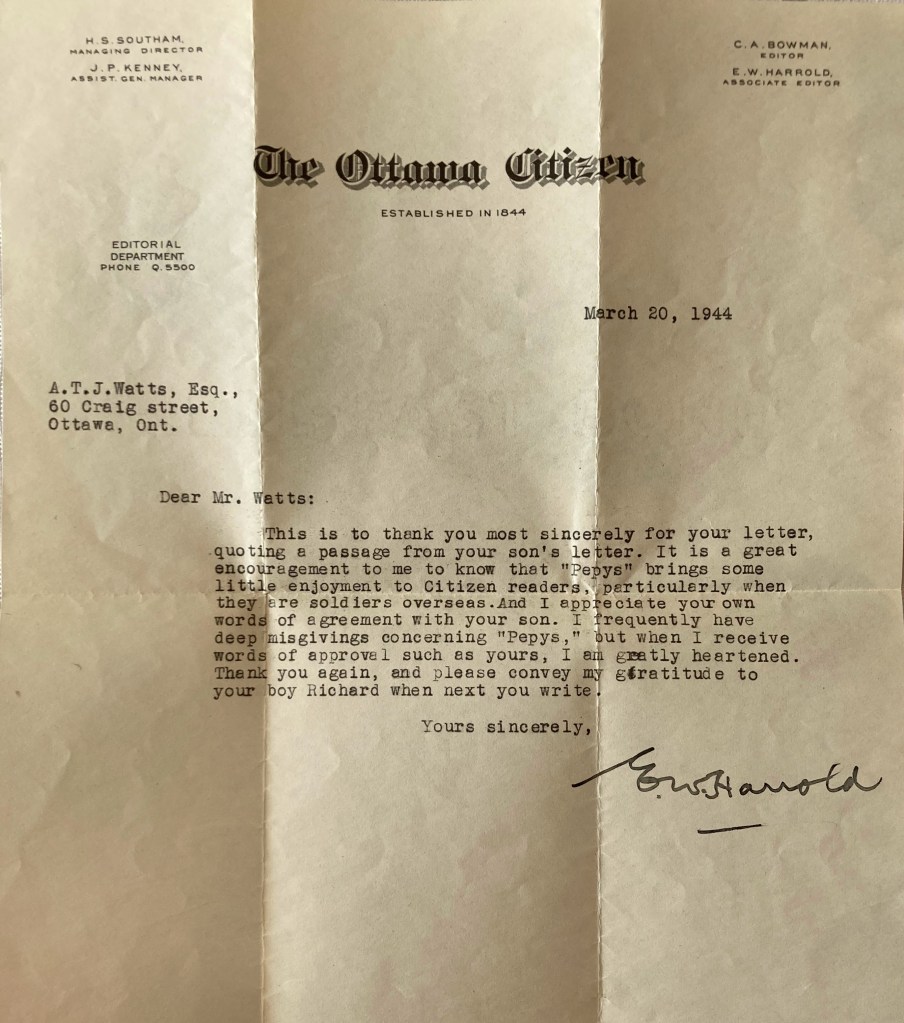
From a letter from Harrold to my grandfather, tucked inside the book, it’s clear that both my father and grandfather were two of the column’s many avid readers:
Harrold’s untimely death at age 56 was regretted “far beyond his profession”. A biographical note in the book reads as follows:
“On the evening of october 23, 1945, after a normal day’s work,Mr. Harrold was reading a bedtime story to his daughter Julia when he complained of feeling ill. He finished the story – and then went up to bed. At nine o’clock he died. In addition to Julia [his wife] he was survived by a daughter and one son, Philip, who was then overseas with the Royal Canadian Navy.”
It is further noted that the publishers of the Citizen, Mr. and Mrs. Hamilton Southam, assured readers that the proceeds of the books’ sale would go to the family, and that the many editors donated their services “in affectionate memory of E.W.H.”.
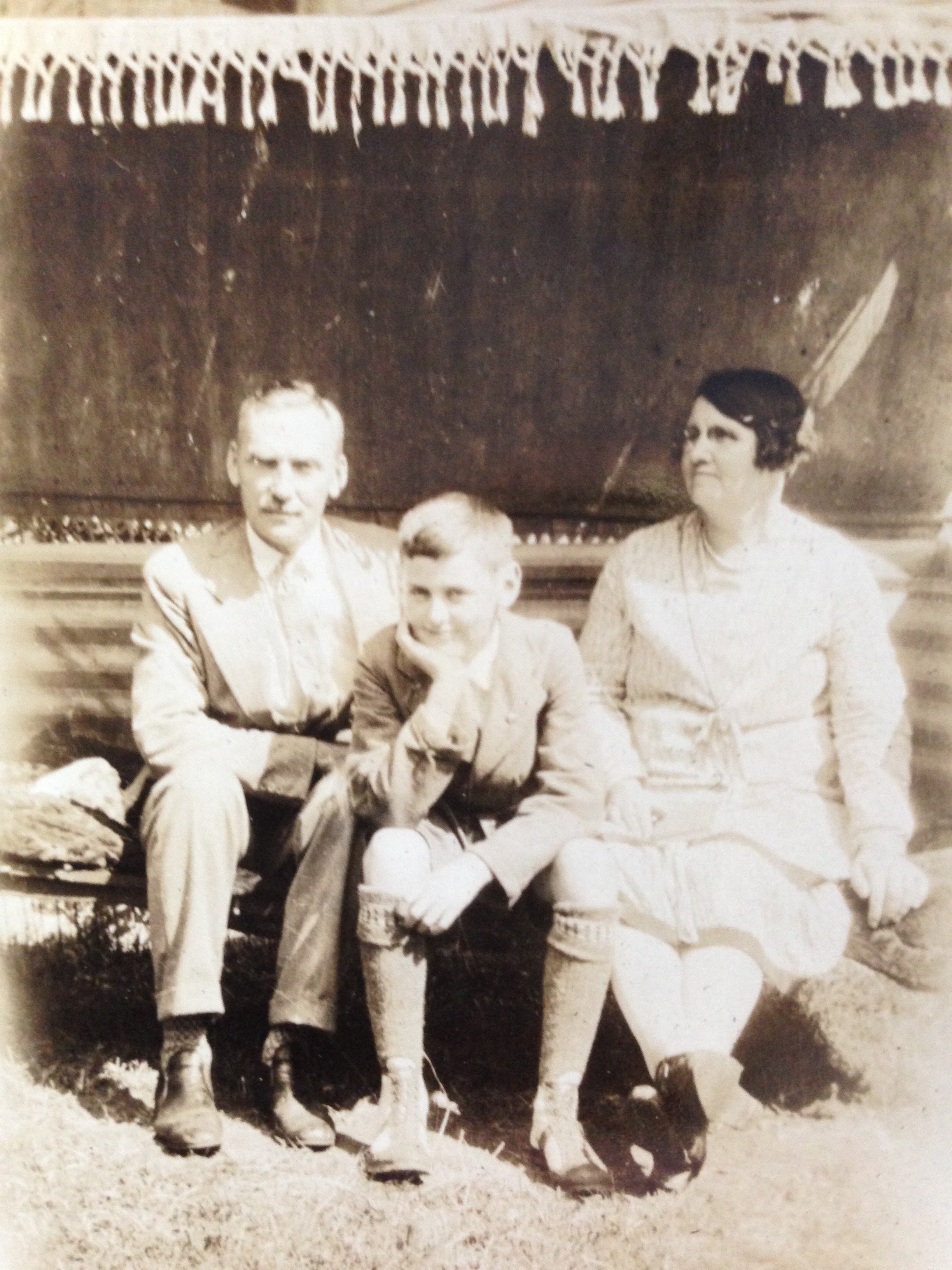
My father with his parents in Ottawa in the 1920’s

You must be logged in to post a comment.