Well, certainly I do.
Recording any unusual bird provides me no end of pleasure. Over the course of last summer and fall, using my Merlin Bird ID app, I identified over 78 different species, including a Sharp-Shinned Hawk, a Cooper’s Hawk and a Caspian Tern (the largest tern in the world so I’ve discovered), as well as a whole host of birds I’d never even heard of: a Western Wood-Peewee, a Golden-Crowned Kinglet, an Orange-Crowned Warbler, a Dunlin and a Sanderling, just to name a few.
Eleven owl species inhabit this region, the Great Horned Owl being the third largest. In case you’re interested, the largest is the Great Grey and the smallest is the Northern Pygmy.
I was inspired to write this post by the 2023 publication of Jennifer Ackerman’s What An Owl Knows: The New Science of the World’s Most Enigmatic Birds:
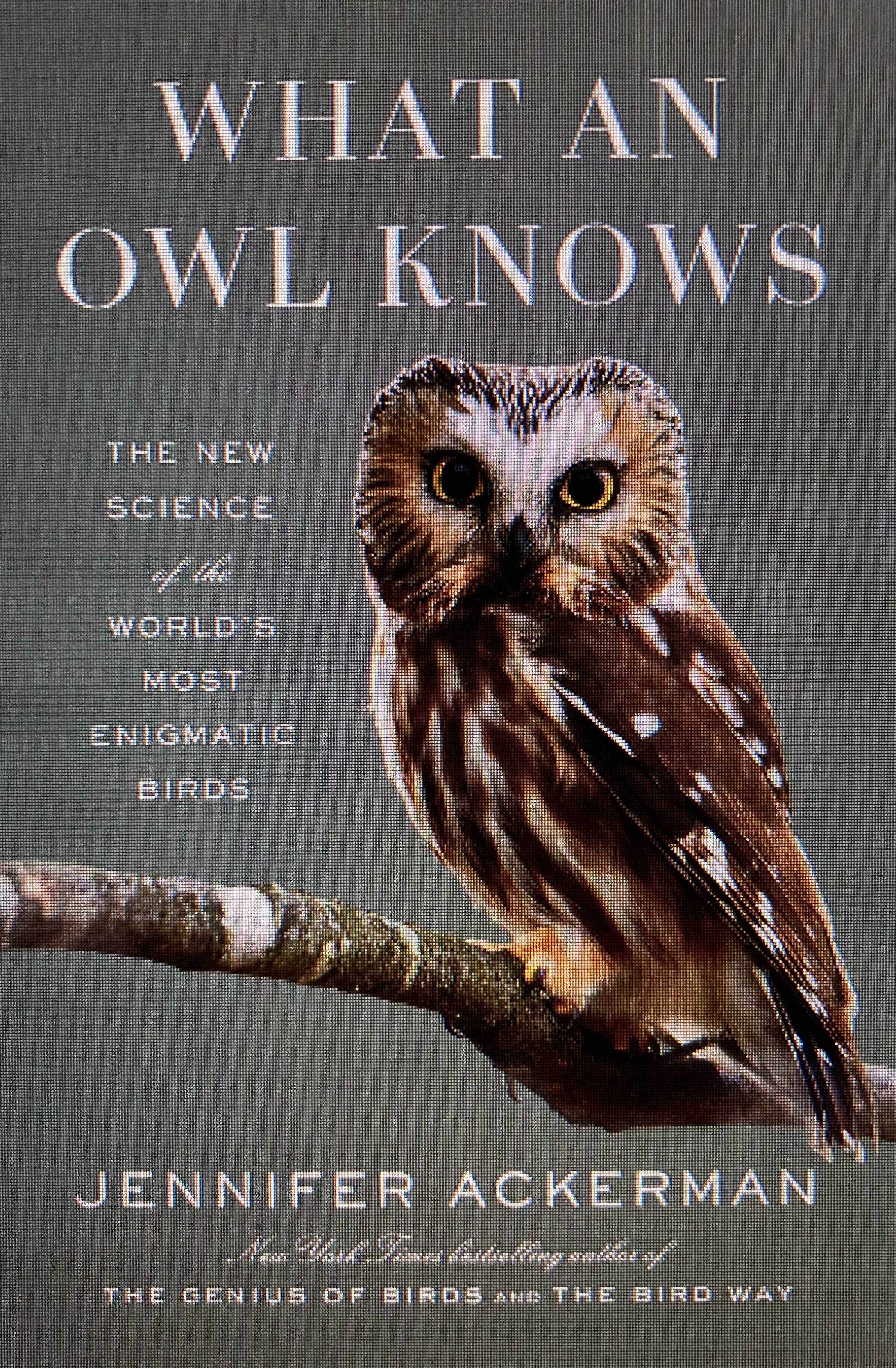
Penguin Press, New York, 2023
Ackerman is a frequent and acclaimed science writer on birds and this latest publication has already garnered great praise. Here are two excerpts from the June 24, 2023 New York Times review by Jennifer Szalai:
“Ackerman is a warm and companionable guide, so enthusiastic about her subject that I suspect even the avian-indifferent will be charmed by her encounters with owls and the dedicated people who study them. Each species seems like a marvel, but certain owls are so special that her book is peppered with superlatives. The Eurasian eagle owl is ‘the most powerful hunter of all owls’ (though not to be mistaken for the [Australian] powerful owl, which will eat as many as 250 to 350 possums a year). The Northern saw-whet is, she says, ‘arguably the world’s most adorable owl,’ with its heart-shaped face and tiny, rounded form.
“The photos in Ackerman’s book are fascinating. In addition to predictable images of various owls looking stately and majestic with their penetrating stares, Ackerman includes some candid shots. A great horned owl after the rain looks downcast and scraggly. We also see a burrowing owl regurgitating a pellet of indigestible food.”
Here, for your viewing pleasure, are two Great Horned Owls engaged in a duet, courtesy of Cornell Lab Bird Cams:
Inevitably, the biggest threat to owl populations worldwide is, according to Ackerman, the loss of native habitat. Anyone who wishes to support entities engaged in preserving what habitat remains can look to their national conservation organization. In Canada, three entities leap to mind:
Birds Canada (https://www.birdscanada.org/), Ducks Unlimited (https://www.ducks.ca/) and Nature Canada (https://naturecanada.ca/).
From Cornell University feel free to download the Wonderful World of Owls poster.
The Ravenstones series has only one owl in its large cast of animal characters. Not surprisingly, he plays to type: Seanan (pronounced see-a-nan; the origins of the name now lost to me), also a Great Horned owl, the sensible, honest imperial court doctor who tries to do the right thing in the challenging world of political intrigue. In my character notes, I describe him as “professional, competent, intelligent, impartial but ‘under the hoof’ of the Empress”.
The owl becomes caught up in the manipulations and games played between the two great rivals of this fantasy series, Vigmar’s First Secretary Gloton and Aeronbed’s Archduke Rithild. He became a favorite character of mine; thus, he escapes a cruel fate.

You must be logged in to post a comment.