
If one book could be chosen to represent an entire geographic entity, and for the sake of argument, the entity was the province in which I live, British Columbia (BC), this book would likely be that choice.

Toronto: Vintage Canada (a division of Random House), 2006
The Golden Spruce was the local library’s book club choice for May 2024 . Published in 2006 about an event that occured in the dead of night in the middle of winter back in 1997. I recall the story well (with as much horror as any BC inhabitant): the felling of a unique, beautiful, 300-year-old tree, sacred to the Haida Gwaii nation and beloved by anyone who knew it.
But I did not know what happened next nor did I learn about the many efforts to replicate the famous tree. So, two mysteries slowly unfold in this retelling:
- what exactly was the crime and what happened to the obsessive perpetrator; and
- did the efforts to reproduce the spruce tree succeed?
And these two stories are interspersed with the history and practices of the logging industry, initial contact between European explorers and First Nations, the sea otter fur trade, the challenging geography surrounding this coastal region of BC, both land and water, the place of the golden spruce within Haida legend and society, the science of tree growth and so much more.
The book is full of fascinating character sketches, details and anecdotes. I thought I knew a lot about this part of the world, but I understand now that I’ve still a lot more to learn. The evocative descriptions of the landscape and dangers of felling trees for a living alone make this book worth reading.
Here’s part of Vaillant’s description of the coastal rain forest (p. 8):
“A coastal forest can be an awesome place to behold: huge, holy, and eternal-feeling, like a branched and needled Notre Dame, but for a stranger it is not a particularly comfortable place to be. You can be 20 paces from a road or a beach and become totally disoriented; once inside there is no future and no past, only the sodden, twilit now. Underfoot is a leg-breaking tangle of roots and branches, and every 15 metres or so, your way is blocked by moss-covered walls of fallen trees that may be taller than you and dozens of metres long.
“These so-called nurse logs will, in turn, have colonnades of younger trees growing out of them, 50 years old and as orderly as pickets. In here, boundaries between life and death, between one species and the next, blur and blend: everything is being used as a launching pad by something else; everyone wants a piece of the sky.
“Down below, the undergrowth is thick, and between this and the trees, it is hard to see very far; the sound of moving water is constant, and the ground is a soft and spongy as a sofa with shot springs. You have the feeling that if you stop for too long you will simply be grown over and absorbed by the slow and ancient riot of growth going on all around you. It can be suffocating and the need to see the sun can become overpowering – something you could do easily if it weren’t for all those trees.”
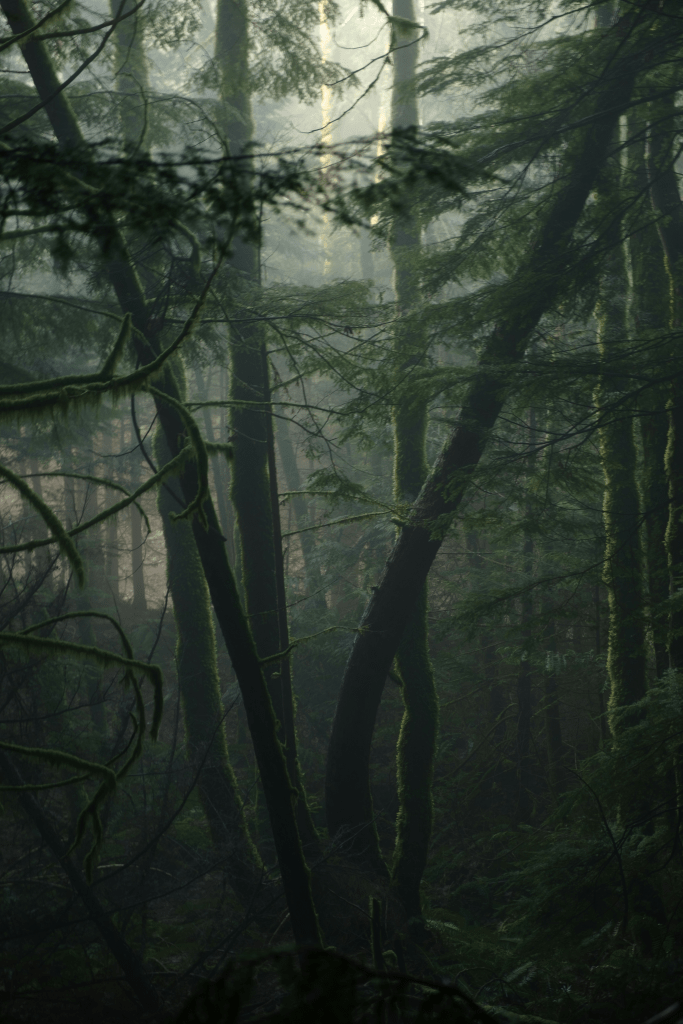
BC coastal forest, by Nicholas Bullett on Unsplash
One weekend, during my university days, I made the mistake of trekking into the coastal forest, alone and without telling anyone else. Vaillant’s description above was exactly how it felt. At one point, scrambling over a fallen, rain-soaked, mossy (nurse) tree, I realized I was walking not on the ground but twenty feet off the ground. Down below, was a conglomeration of fallen trees, going every which way. I slipped and almost fell off, down into cavernous region below. Fortunately I caught myself in time. Since no one knew I was even there, a broken leg would have spelled a quick end (or rather a slow end).
Trees are to British Columbia as oil is to Texas – something of lore and legend, something both controversial and symbolic, something upon which the economy grew. Of course, one could be sustainable; the other clearly not.
For British Columbia, trees are essential to its identity. From my time in government, I recall how the committee rooms in the BC Legislature were all named after and decorated with panelling from trees native to the province: hemlock, cedar, maple,pine, oak,birch and Douglas fir. How cool is that? I asked the Legislative Library to confirm this memory; the following is their reply:
”The most notable feature of these committee rooms is their use of native woods from across B.C. The Parliament Buildings’ original design included four such rooms: the Hemlock, Cedar, Maple and Pine rooms. The Pine and Hemlock rooms were destroyed at some time, but were re-created during the restoration and renovation in the 1970s and 1980s. The Hemlock Room features a series of painted panels designed by numerous Indigenous artists from B.C. During these renovations, the Oak, Birch, and Douglas Fir rooms were added…A special effort was made to select only the choicest specimens to be an example of their qualities.”
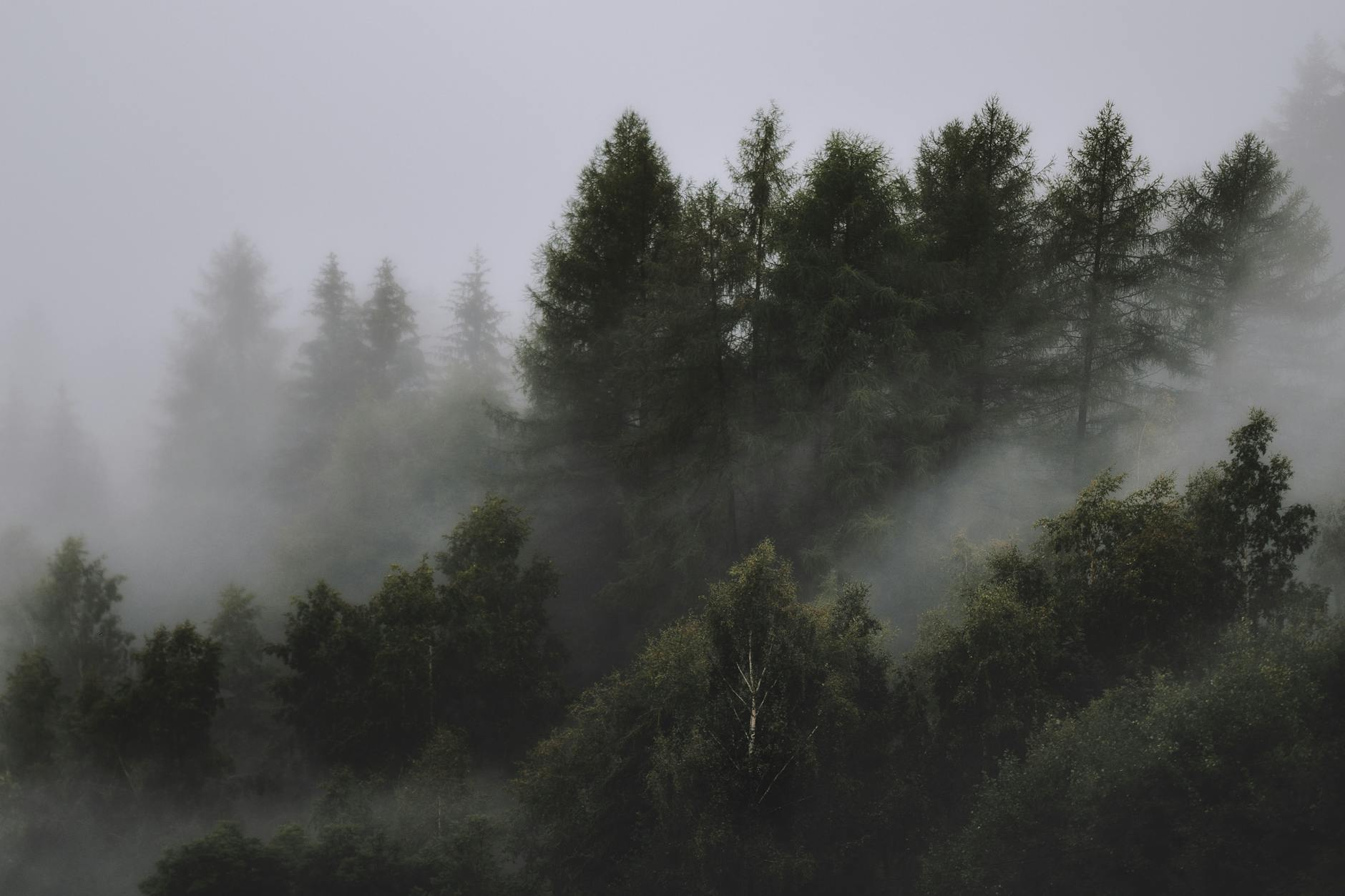
Forests are a driver of environmental health and biodiversity, mitigating climate change, providing habitat for countless species, supporting recreation, tourism and its renowned natural beauty. Something to be treasured, protected and well-managed.
&&&
I should also note that, in 2024, Mr. Vaillant published another amazing book, Fire Weather, on the devastating 2016 fire that overran the town of Fort McMurray in Alberta (Penguin Random House Canada). A most topical and prescient subject, given the recent set of fires which ravaged Los Angeles.


Leave a comment