
Some months back, I told you about a recent find at my neighbourhood Little Library. I’d come across a copy of The Norton Anthology of Short Fiction, comprising 140 stories by 116 authors. It was the Seventh Edition of the publication, a weighty one, published in 2006.
Chronologically, the first story offered in it is by Nathaniel Hawthorne (Young Goodman Brown, 1835); the last, two in 2005, one, Byron the Lyron, by Richard Bausch (who also acts as the editor), the other, The Wedding of Snow and Ice, by Alice Hoffman. I’m still working my way through it, a little over half way.
According to the publisher’s website, the 2015 8th edition ups the ante. It weighs in at 3.15 pounds, is even longer (1902 pages) and contains 152 works in all, by 130 authors (33 new stories by 22 new authors). On Amazon, the hardcover version sells for $62.01 (US); the paperback for $87.68 (US). Go figure: must be supply and demand.

Every college attendee studying English Literature will be familiar with the Norton anthologies collections. Back when I went to university, The Norton Anthology of English Literature was the required textbook, used in every first-year survey course.
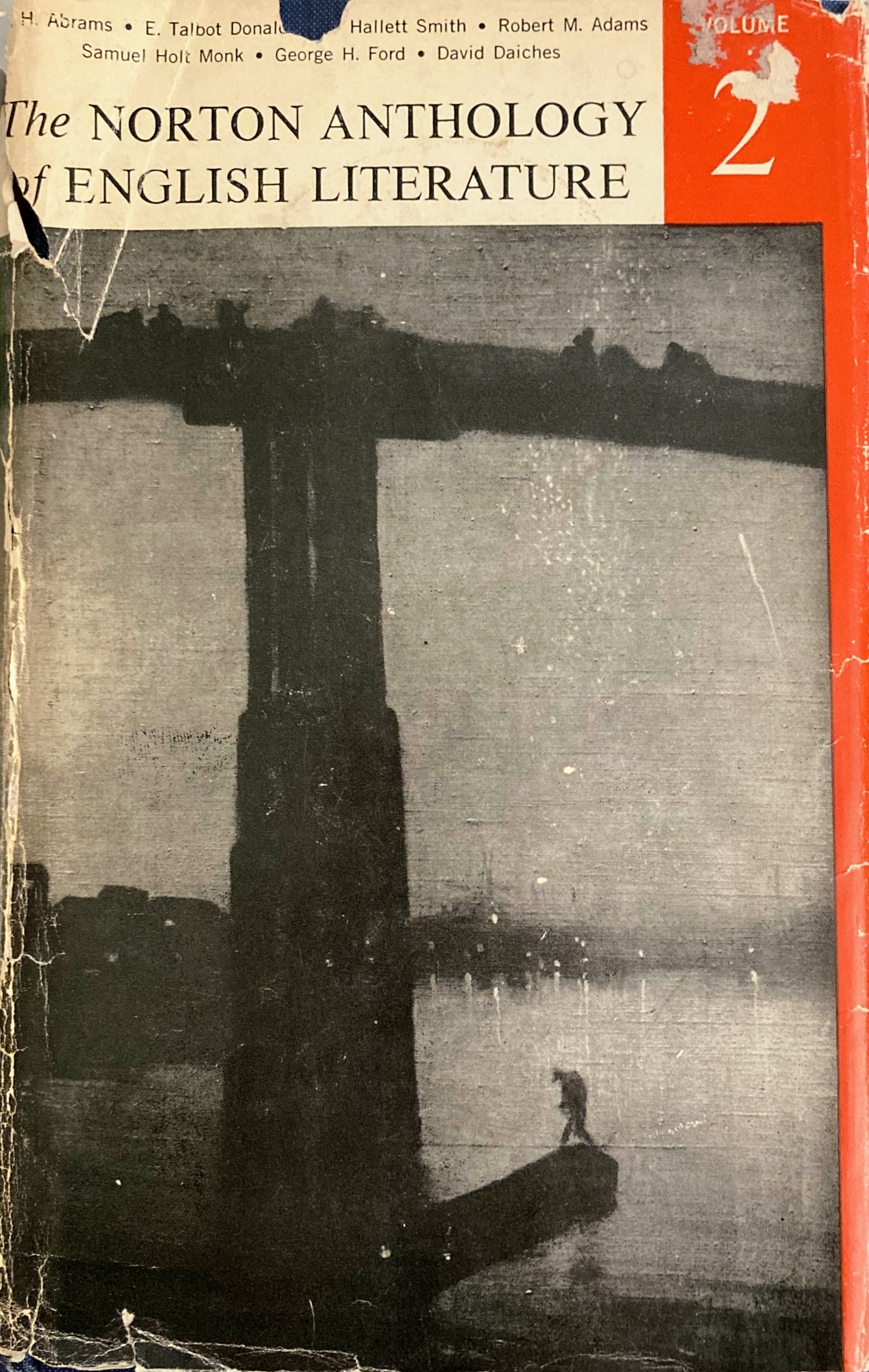
First published in 1962, the Anthology has now gone into ten editions. My well-used copy, Volume 2, from that initial publication run, remains in my possession all these years later. It covers approximately 150 years of writing, from the “Romantic period” (1798 – 1832, starting with Robert Burns and William Blake) to “Poetry Since 1930” (WH Auden, Louis MacNeice and Dylan Thomas).
My copy is still holding up, even with its tattered cover (detail from a painting by James McNeill Whistler, entitled Nocturne – Old Battersea Bridge):
I was fortunate to have had a terrific English professor at the University of Manitoba, J. C Woodbury, who opened my eyes to so much of the meanings behind the words and phrases, enhancing a long-held love for poetry. So inspiring was Prof. Woodbury that, at the end of my first year, I was tempted to change my major from Political Science to English Literature.

I thought long and hard about that choice. In the end, I stayed the course, never regretting my original decision, for it led to my lengthy and rewarding career in the public service. And my love of words, writing and literature has continued notwithstanding.
Having said that, a word or two about the exemplary publishing company is necessary.
Founded originally as the People’s Institute Publishing Company in 1923 by William Warder Norton and his wife Mary, W.W. Norton & Company is now the oldest and largest book publishing house owned by its employees. The company’s history (on their website) is well worth reading.
Warder Norton (1891 – 1945) grew up in Columbus, Ohio, and moved to New York City as an adult to start an import-export business. There he met and married Margaret Dows Herter, (known as Polly or Mary). In 1923, the couple began publishing lectures delivered at the People’s Institute, the adult education division of New York City’s Cooper Union (for the Advancement of Science and Art).
While initially modest in scope, this enterprise allowed the Nortons to pursue a progressive vision – that leaders in their fields should, in the words of Warder, “bring to the public the knowledge of our time.” When the Nortons expanded their program beyond the Institute in 1926, acquiring manuscripts by celebrated academics from America and abroad, the W. W. Norton & Company was born.

Tragically, on November 7, 1945—shortly after the end of the Second World War and twenty-two years (to the day) after the People’s Institute Publishing was incorporated — Warder Norton died. His death at age 54 could have spelled the end of the publishing house, if not for a unique and generous decision by Polly.
Within a few years of Warder’s death, she decided to entrust the firm to future generations of employees, in exchange for their commitment to keep the company independent in perpetuity. That arrangement, initiated in 1952, defines the firm to this day: W. W. Norton & Company has been owned wholly by its employees since the early 1960s.
The Norton Anthology of English Literature, a landmark collection of literary works spanning the rich history of English literature, traces its origins to the mid-20th century. Over the years, the initial publication has undergone multiple revisions and expansions, incorporating diverse voices and perspectives to reflect the evolving landscape of literary studies.
As a result, the Anthology has become a standard resource in literature courses across the globe, its success resting not only in the breadth of its coverage but also in the insightful introductions, annotations, and contextual materials provided by its editors.
Nineteen Norton anthologies now exist, covering such subjects as Western Literature, Drama, World Religions, Nonfiction, Theory & Criticism, African American Literature, and Native Nations Poetry.
Today, the company has four additional imprints:
- Liveright – 20th century classics
- Norton professional books – professional development, covering four disciplines education, mental health, psychotherapy & Psychiatry, Architecture & Design
- Countryman Press – founded in 1973; cooking, lifestyle, nature, travel, etc.
- Norton Young Readers – picture books, narrative fiction & nonfiction, graphic novels
While readers today have an overabundance of fiction and non-fiction options from which to choose, the publishing industry has seen a significant decline in full-time employment, shrinking by about 40% over the last three decades. Many companies have merged, with only about half of the major publishers from the early 1990s still existing today. Digital self-publishing, rising production costs, and the dominance of a few large conglomerates have all contributed to this shift.
As such, one might say that the survival of Norton is nothing short of a miracle, one that can largely be credited to the (very) rare decision taken by Polly Norton back in the mid-20th century.


Leave a comment