
The year 1553 in merry old England was not a great time to have strong religious beliefs, either Catholic or Protestant.
Succession crises were the order of the day. On July 6 of that year, following the death of King Edward VI, a staunch Protestant, the line of succession was altered to maintain Protestant rule and bypass his Catholic half-sister, Mary Tudor, in favor of his cousin, Lady Jane Grey.
On July 10, the ill-fated Jane was proclaimed queen. Her reign lasted only nine days, for Mary, with strong public and noble support, wasted no time in gathering an army, overthrowing Jane on July 19 and asserting her right to the throne.
Mary Tudor became Queen Mary 1, marking the beginning of a sharp religious reversal in England. She moved to restore Catholicism and repealed Edward VI’s Protestant reforms.
Jane’s supporter, John Dudley, was executed in August, and Jane herself remained imprisoned in the Tower of London, ultimately being executed the following year. These events set the stage for Mary’s turbulent reign, which would become infamous for the persecution of Protestants and the attempt to re-establish Catholic rule in England.
It was in this year of conflict that Beware the Cat was written. Wisely, the author waited until 1561 to publish it, just three years after the Protestant Elizabeth 1 was crowned. Even that eight year delay proved insufficient for the pragmatic monarch, who always sought to keep a lid on religious turmoil. It took another nine years before another edition was published.
I’ve written before about the first animal fantasy stories (see my post of July 8, 2023). Prior to being collected and written down, Aesop’s fables were oral stories.
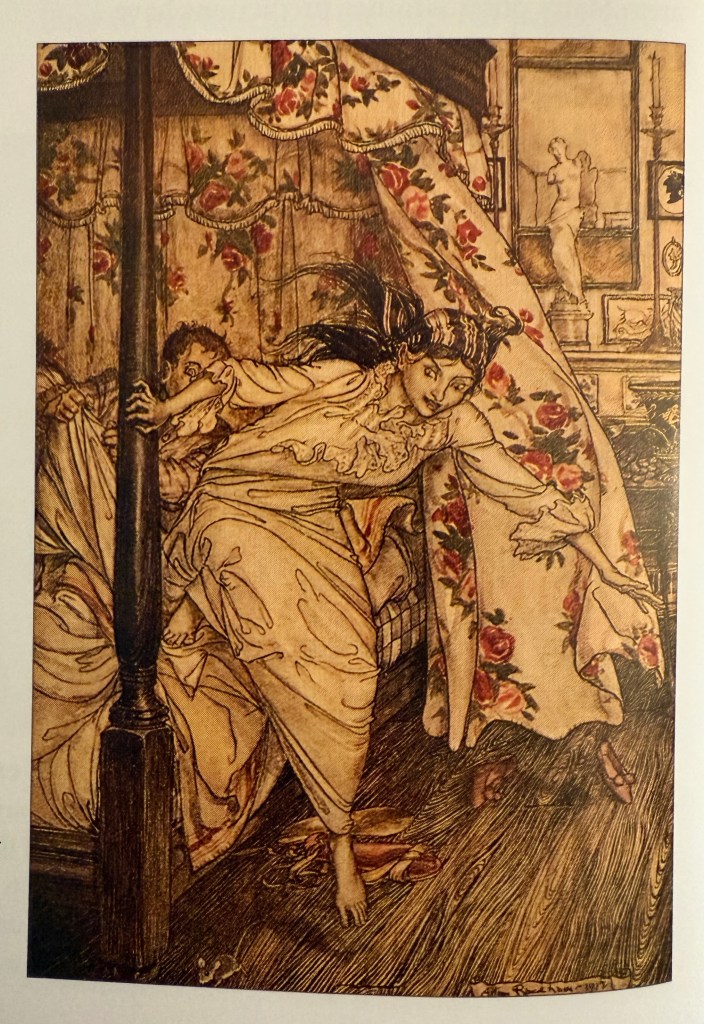
Aesop’s tale of Venus and the Cat
Most are well-known to most people today, having been usually told as cautionary tales to children.
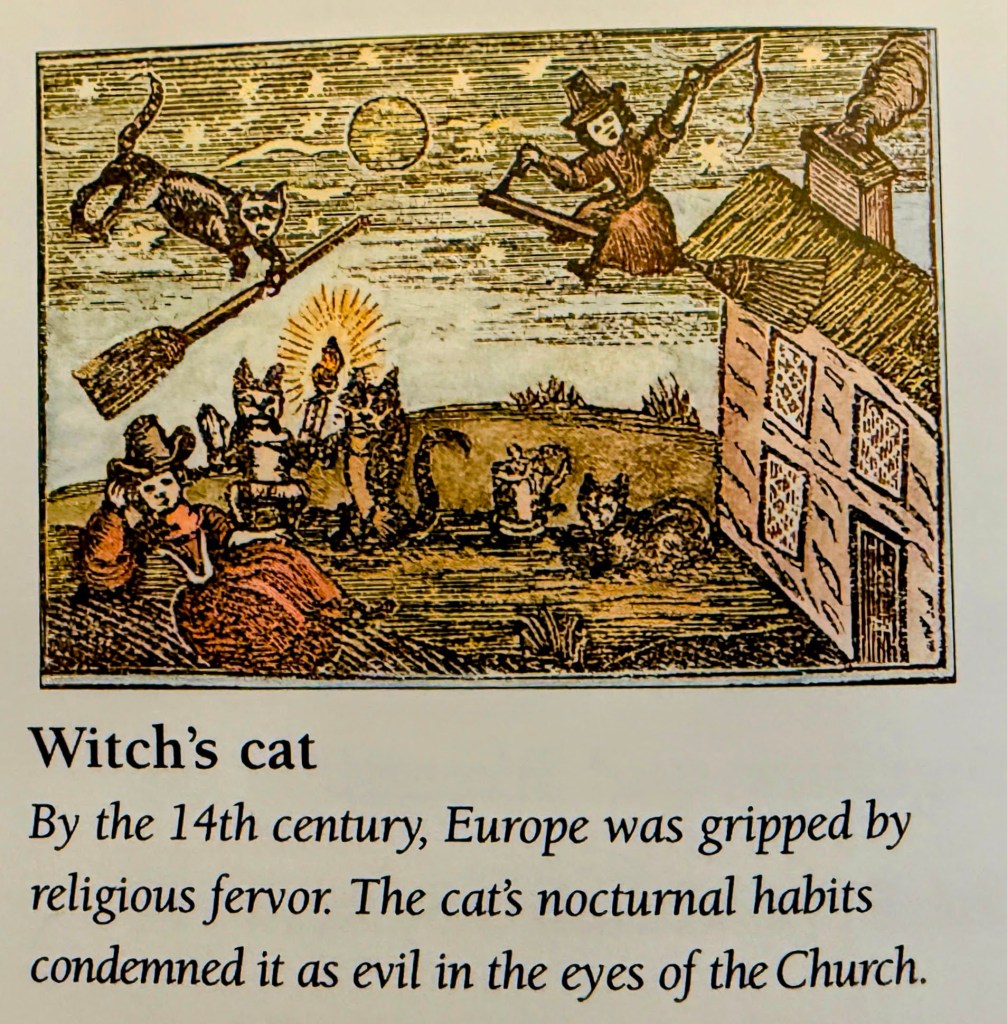
From The Encyclopedia of the Cat, Firefly Books, 1997
Beware the Cat by William Baldwin is considered the first English language novel (maybe the first novel ever?). It is a satirical and allegorical work that blends folklore, humor, and political commentary. It’s akin to the Arabian Nights, where stories within stories hold sway and are presented as a series of conversations among scholars, with one of them, Master Streamer, recounting his supposed ability to understand the language of cats (gained through eating a horrendous concoction of wild game).
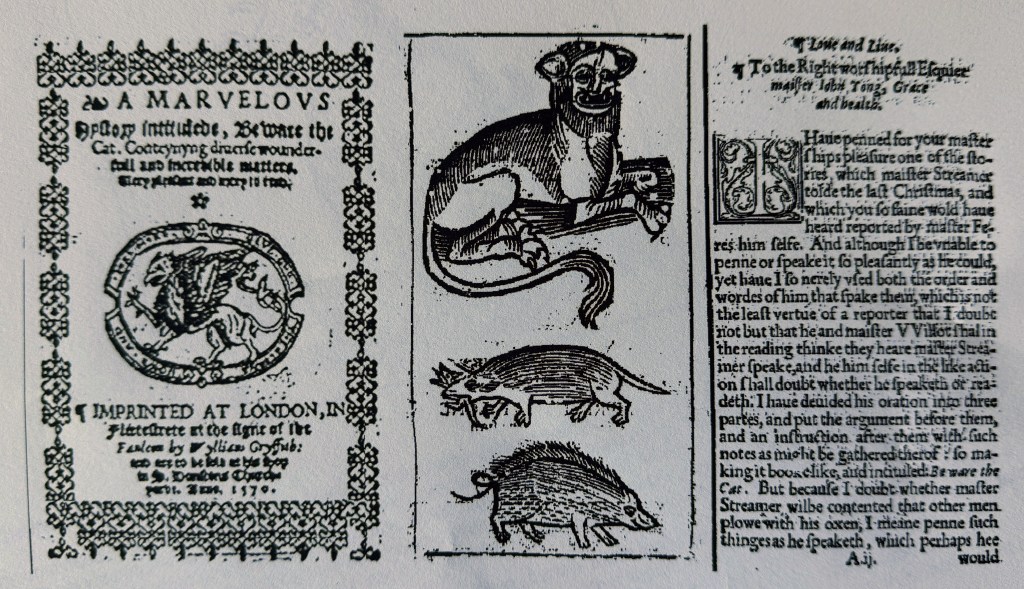
The recounting starts out as follows:
“I got into a debate with Master Streamer. Masters Streamer and Willmot had already slept their first sleep, and so were awake for while before going back to sleep. I had only just gone to bed. Anyway, the debate was about whether birds and beasts had reason and was provoked by the news that the Kings Players were learning a play of Aesop’s Crow in which most of the actors played birds.
“I wasn’t in favour of this device because I didn’t think it funny to make dumb creatures talk or depict brutish creatures talking reasonably. Although it was reasonable enough in imaginative tales, such as Aesop’s tales, I didn’t think it suitable for a play.
“Mr Streamer, being more learned in this point then I was aware of, held the opposite point of view, asserting that birds and beasts could reason as well as men and, in fact, had a great deal more reason in some regards.
“Mr. Streamer supported his claims by telling us of tightrope-walking elephants, weather-predicting hedgehogs, foxes and dogs that spent the night killing geese and then went home in the morning and put their necks into their collars, parrots that mourned the deaths of their keepers, swallows that opened their nestlings’ eyes with celandine, and a hundred other such things. I contradicted many of his claims, saying they were natural instinctive actions, not acts of reasoning, citing the authority of some solemnly learned Philosophers.”
And so on.
Through his tale, Baldwin describes a secret feline society, their knowledge of human affairs, and their supernatural abilities. The main plot revolves around the trial of a she-cat named Mouse-slayer, who is charged with breaking the laws of the cat world, and shunning the advances of a male.
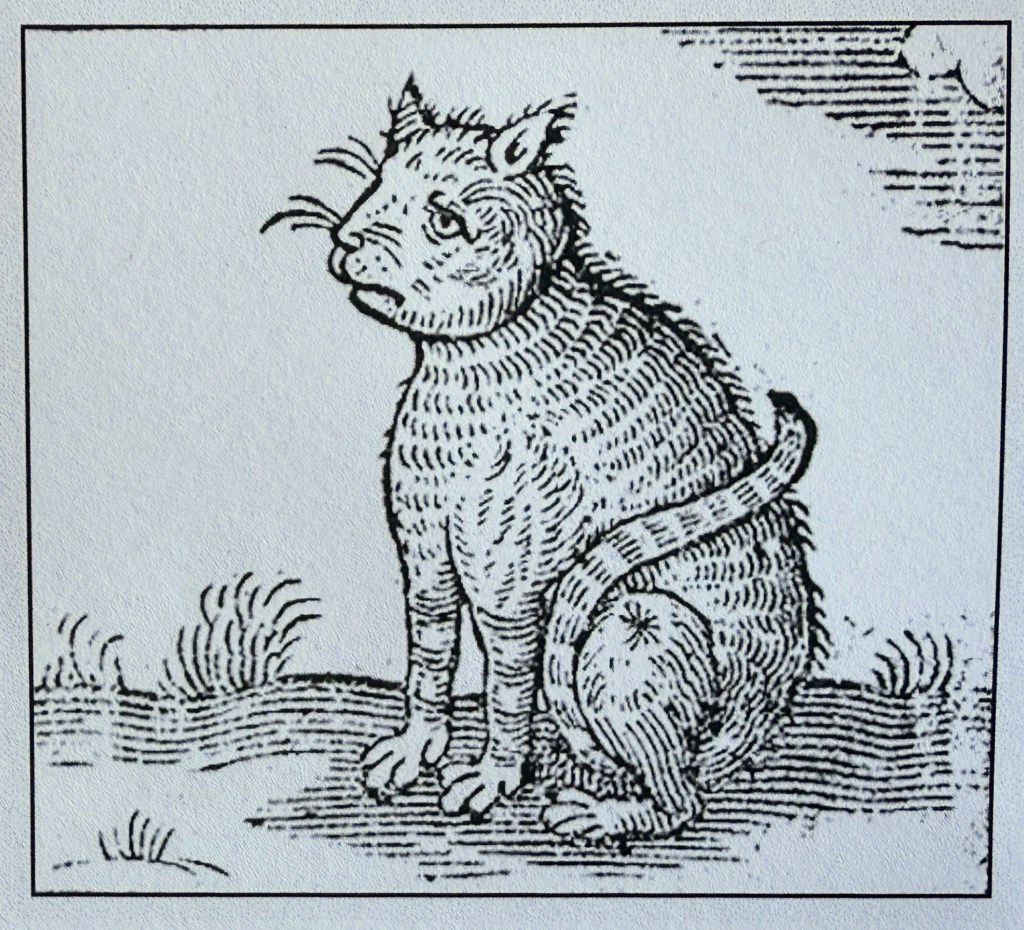
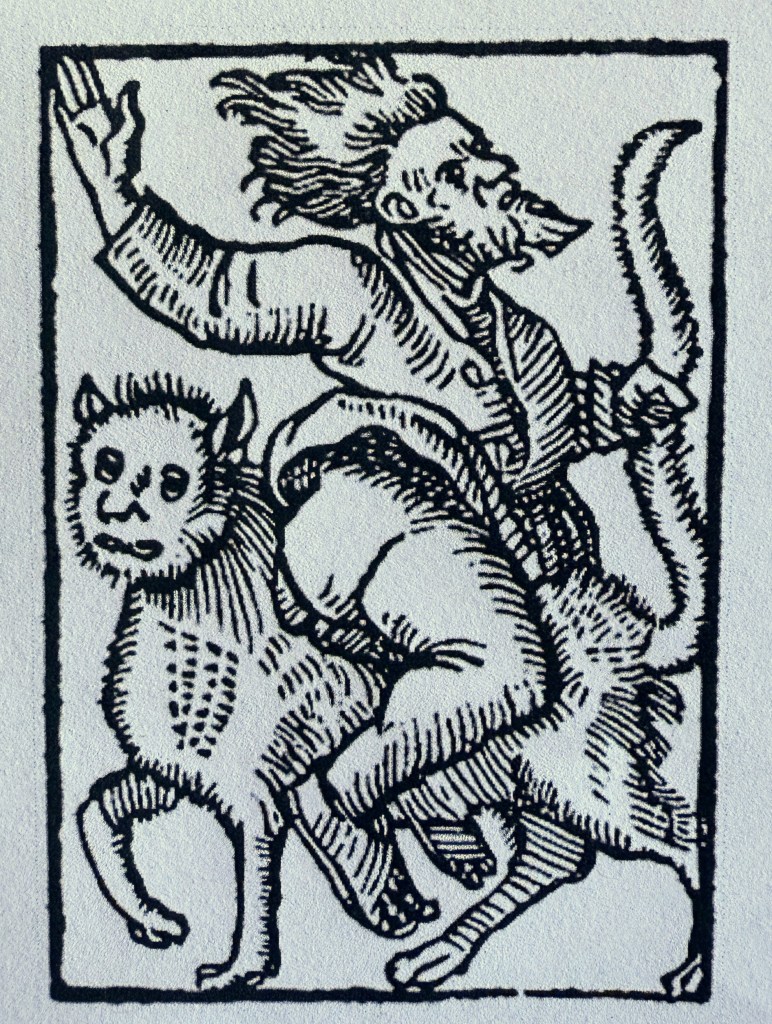
The interlinked stories feature a version of “The King of the Cats”, an Irish werewolf, the Grimalkin, and an underworld society of talking cats, as well as magical elements such as an ancient book of forbidden lore and magic potions. In the tale of the Irish soldier and Grimalkin, the invincibility of the cats is a metaphor for the undying power of the Catholic Church, which ultimately cannot be destroyed (see link above).
The novel critiques religious superstition (lots of references to the connections between witches and cats), societal norms, contemporary politics, and the power of storytelling itself. Despite its playful tone, Beware the Cat offers insight into the anxieties of the Tudor period, particularly concerning censorship and the control of knowledge.
According to Wikipedia, little is known about William Baldwin. It appears that he wrote several works, primarily poetry, and played an occasional role in the production of theatrical exhibitions at court, while continuing to work at a London printing shop.
Records of the master of the revels, Thomas Cawarden, show that he had a hand in “a comedy concerning the way of life” and a morality play, but this cannot be confirmed. It’s also probable that, later in life, he gave up writing for a clerical appointment, as a deacon and rector.
The point is – for those who still doubt the place of anthropomorphic animals in the annals of fiction – let it be known that they were present at the very beginning.
& & &
I am indebted to the website of messybeast.com for the period illustrations and source material above. For those interested, the website’s creator, Sarah Hartwell, provides an impressive list of historical books on cats.
& & &
Here we are at the end of June, or rather, a week past the official start of summer. To my fans, thanks for reading, commenting on and liking these posts. I wish you all a wonderful summer, a break from your daily routine and look forward to connecting with you again in September.


Leave a comment