
It happened 80 years ago this very weekend.
Faithful readers will know that, although my regular focus on this blog site is books, I’m also a fan of film noir, especially from its heyday in the 1940’s and 1950’s.
So when I recently came across a movie of this genre and one with a Canadian theme, I was doubly pleased. Then, when I found out that it was partly filmed in Canada, and in my former home town of Ottawa, even better.
Finally, to discover the film was based on a true story of international espionage, well, that was the coup de grâce.
The story is a famous one, especially in Canada. In mid-1945, as the Second World War came to an end, anxiety about Soviet intentions was in its infancy; this case would explode that anxiety.
It turned out the fears were well merited.
The film had a stellar cast (Dana Andrews and Gene Tierney) and a big-name producer (Sol Siegel, known for High Society and Gentlemen Prefer Blondes). Even more intriguing, the impressive music score featured compositions by several of Russia’s finest living composers (see below).
The 1948 history crime thriller film was called The Iron Curtain. It was directed by William A. Wellman (known for the first A Star is Born, The Ox-Bow Incident and many others), with a screenplay by Milton Krims, based on a series of magazine articles by the agent in the centre of things, entitled “I Was Inside Stalin’s Spy Ring” (1947).
The movie is about Igor Gouzenko, a GRU lieutenant and cipher decoder at the Soviet Embassy in Ottawa, who on Sept. 5, 1945 (three days after the end of the war), walked out of the embassy carrying a briefcase filled with code books and decryption materials: a total of 109 documents that revealed a network of Soviet spies stealing information about the development of the atomic bomb. The result was a series of highly publicized trials leading to ten convictions.
Among those implicated were a Member of Parliament and one of the scientists working on the Manhattan Project. Historians have also linked the investigation following Gouzenko’s defection to the Rosenbergs in the U.S. and the Cambridge Five in England. The incident is often credited as the official start of the Cold War because of its revelations that former World War II ally, the Soviet Union, was secretly spying on the western powers.

Alfred Newman, the head of the 20th Century-Fox music department, scored this picture. Adding to the forbidding tone, the score featured works by Dmitri Shostakovich, Sergei Prokofiev, Aram Khachaturian and Dominik Miskovský. Afterwards, Soviet authorities ordered all four composers to sign a letter of protest that claimed their music was appropriated via a “swindle” in order to accompany this “outrageous picture”.
Although none of the four had the opportunity to actually see the movie, lawsuits followed. While Shostakovich unsuccessfully sued 20th Century-Fox in New York court, all four plaintiffs were victorious in France (analog Société Le Chant du Monde v. Société Fox Europe and Société Fox Americaine Twentieth Century).
The film opened in 20 key American cities, grossing over $500,000 in its first week and becoming the number one film in the United States (for a second week as well).
It’s a fascinating period-piece, an anti-Communist propaganda film, based on a true spy story and presented in semi-documentary style. Nicely photographed, played by a tightly knit cast and ending with an exciting climax. As noted above, also filmed in Ottawa (during a cold Canadian winter) at places where the story actually happened. It seems several Soviet sympathizers attempted to disrupt shooting but were unsuccessful.
When I first moved to Canada’s capital in the early 1970’s, I lived in the Sandy Hill neighborhood, on Marlborough, just off Laurier Ave. East, midway between the Soviet and Yugoslav Embassies (see map below). The Soviet (now Russian) Embassy took up the entire corner between the Rideau River and Charlotte Street, next to Strathcona Park. The Yugoslav Embassy was two blocks over on Blackburn.
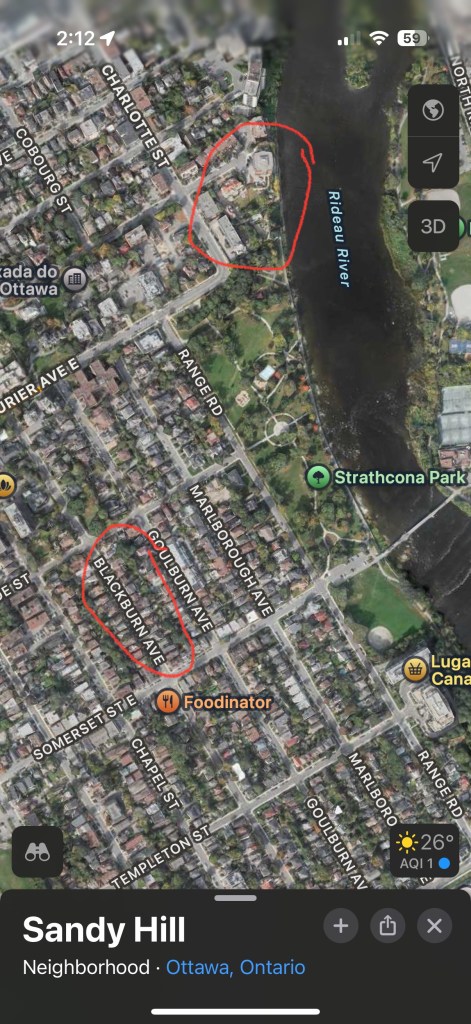
I recognize all the local scenes shown in the movie and recall the apartment block at 511 Somerset Street in which Gouzenko lived (closer to the downtown area, where it survives to this day). Wikipedia provides an excellent summary of the affair, as well as a photograph of the apartment.
The RCMP guarded all the buildings (unmarked cars out front at the very least) and things were tense whenever a visit was in the offing. Just after I moved there in the summer of 1971, Soviet Premier Alexei Kosygin made a rare visit to the city. Bomb scares and heightened security were the order of the day. But that’s another story.
As for Gouzenko and his family, they went on to live in Canada for the remainder of their lives, under protective custody. I’d call him a real hero. Igor died in 1982; his wife Svetlana in 2001.

Leave a comment