
Once upon a time (not so very long ago) in a fair and magical land (otherwise known as Southern California) a youngish couple had the idea to become book publishers. And not just any books. Special ones.
The young couple, who went by the surname Darling, founded Green Tiger Press. Could there be a more appropriate surname for a fairy tale writer? Not in my books.
Now, many years ago I came across the following publication:
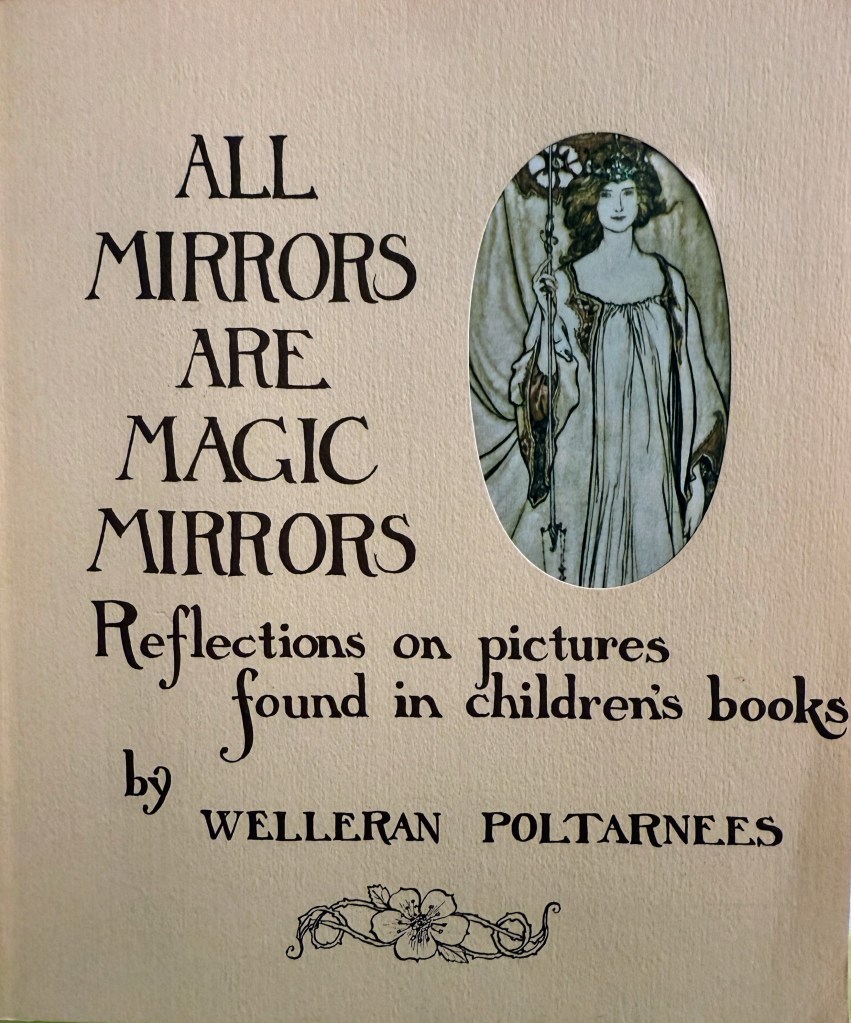
I purchased the book because a) it dealt with two of my favourite subjects, children’s literature and illustration, and b) it was of rare quality for a small paperback: hand-pasted pictures, no less.
A statement of the publishers’ intent is inscribed on the back cover:
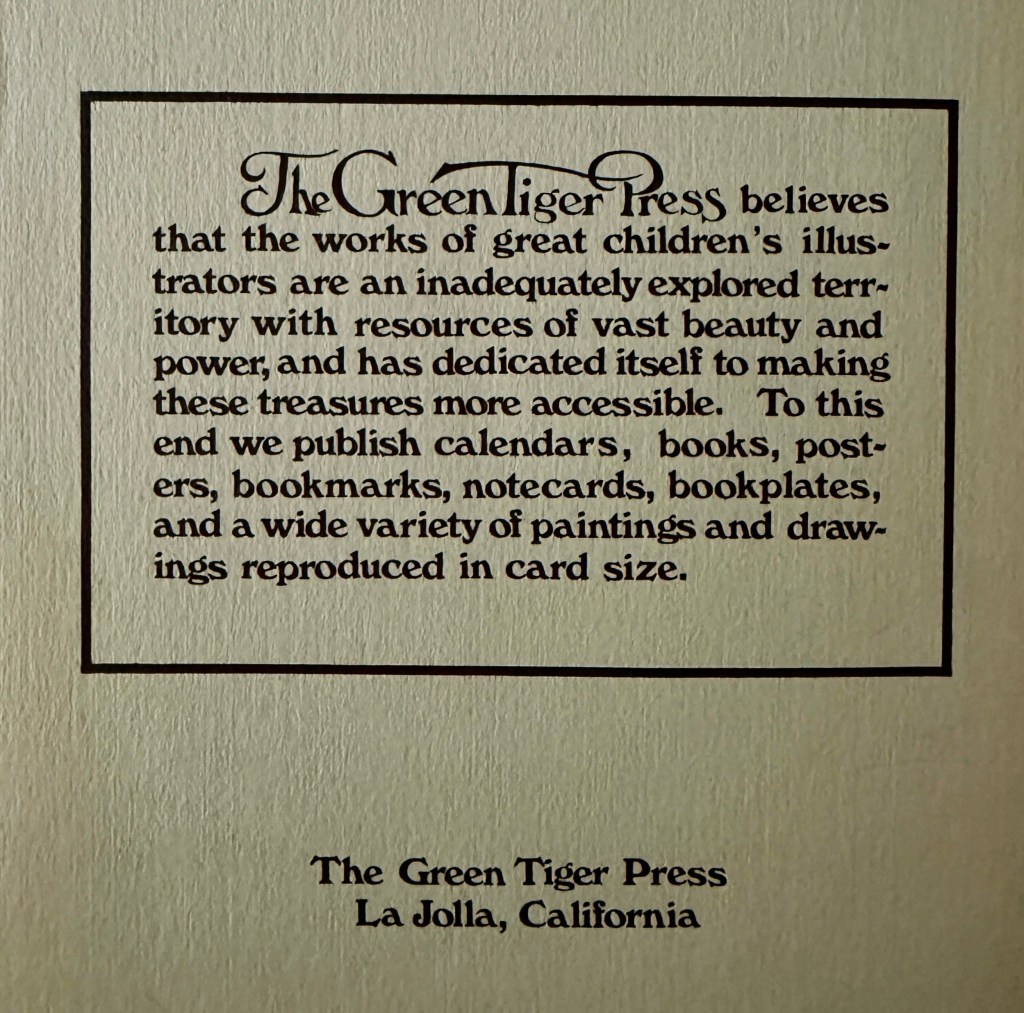
The book’s back cover.
I’d never heard of the author (whose name I found rather odd, to say the least) but didn’t think more about it at the time. Only recently did I discover that Welleran Poltarnees was the pen name of Green Tiger’s publisher, Harold Darling (1932-2016).
This chosen pen name was based on two of Lord Dunsany’s most famous stories: The Sword of Welleran and Poltarnees, Beholder of Ocean.
Dunsany, otherwise known as Edward John Moreton Drax Plunkett, the 18th Baron Dunsany (1878-1957), was a prolific Anglo-Irish writer and dramatist. Largely forgotten today, he was well regarded by critics and public during the apex of his writing career (1905-25).
Today, Dunsanay is best known for the 1924 fantasy novel The King of Elfland’s Daughter. According to Wikipedia, his influence on future science fiction and fantasy authors was immense, with many critics regarding his early work as laying the grounds for today’s fantasy genre.
Given that history (and my interests), I’d say Dunsany deserves a blog post all to himself. So, I’ll leave the 18th baron aside and return to the original subject of this post, Green Tiger Press and All Mirrors are Magic Mirrors in particular.
The book, published in 1972, has been reprinted five times since then. It’s a mere 60 pages in length, ending abruptly and without conclusion, as if the author suddenly realized he had an unexpected deadline to meet elsewhere and chose to cease writing at that very point.
Rather than chapters, the book contains sections with titles like: The various relations of pictures to words within children’s books; Pictures of Domestic Happiness; Picturing the Realm of Faërie; Looking at Pictures of Animals; and Answer to the argument that illustrations block the imagination, that without them the mind would do what the illustrator does, ONLY for the reader, more satisfyingly.
Now, in contrast to that last title (a real mouthful), the actual section is no more than half a page. In fact, the length set for each section is all over the map. The one below (only two paragraphs of text) takes up a whole nine pages, making space for the (essential) illustrations.
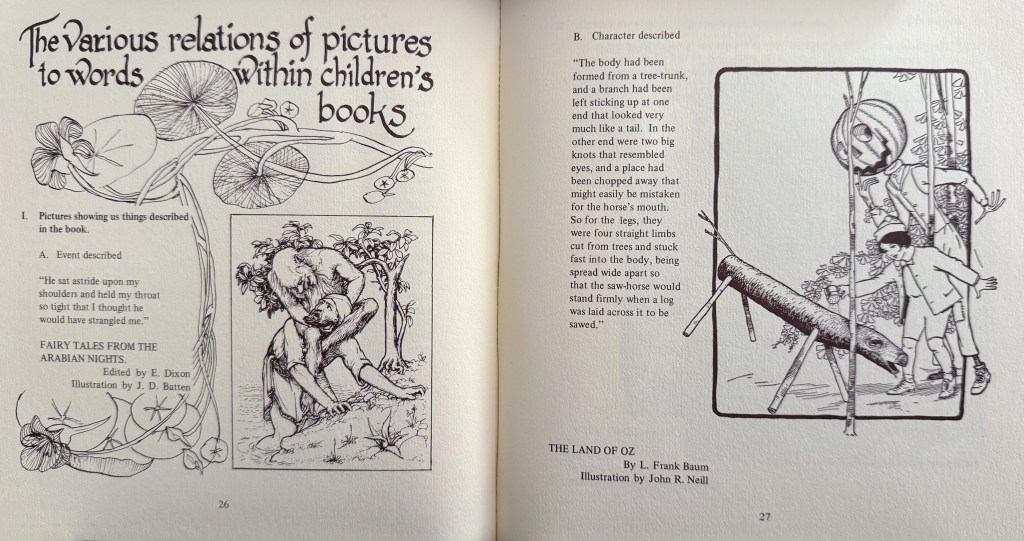
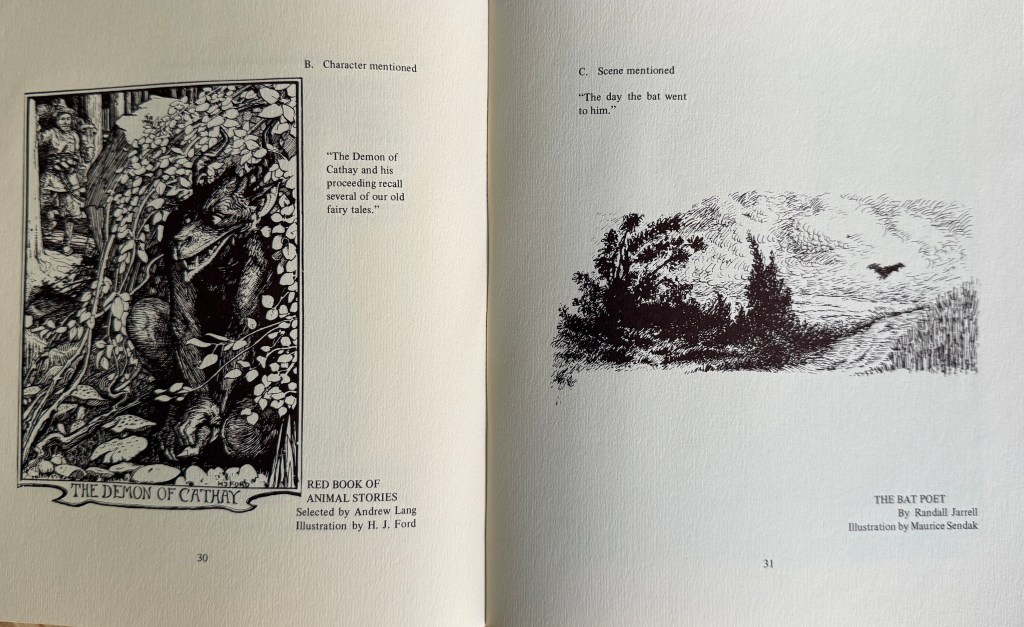
But these points are mere quibbles. The author’s treatment of the subject of illustration is sensitive, fair, critical and astute. He even notes where an otherwise excellent illustrator was the wrong choice for a specific book (e.g. Arthur Rackham for Edgar Allan Poe’s Tales of Mystery and Imagination).
Naturally, the book is full of illustrations, both in color and black and white. One would have only wished for more of them.
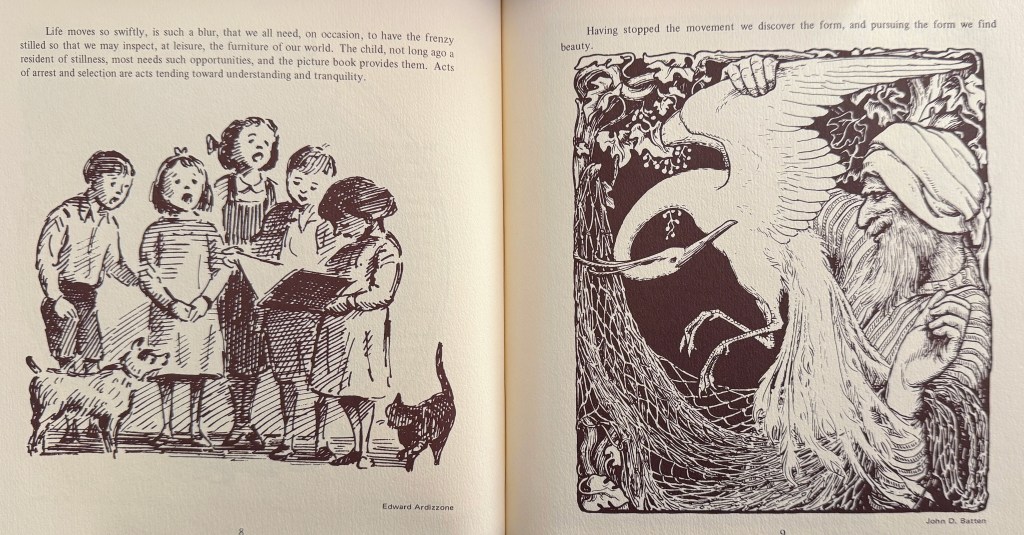
Polternees/Darling showcases several of my favorites: Edward Ardizzone, Kay Nielsen, Maurice Sendak, E.H. Shepard and others. And a few that were new to me: John Batten, Dorothy Lathrop and H.J. Ford. He even looks at authors who took on the task of illustration themselves, and deserve high praise: Tolkien, Lofting, St.Exupery and de Brunhoff (father and son).
Here’s the author’s exquisite description of a little domestic scene, drawn by the brilliant E.H. Shepard, whose drawings Darling describes as “masterful in their terseness”:
“The spirit of graceful conviviality is gently expressed in the small picture on the title of THE HOUSE AT POOH CORNER. Pooh, and Piglet and Christopher Robin are sitting on a small rug before a fire.
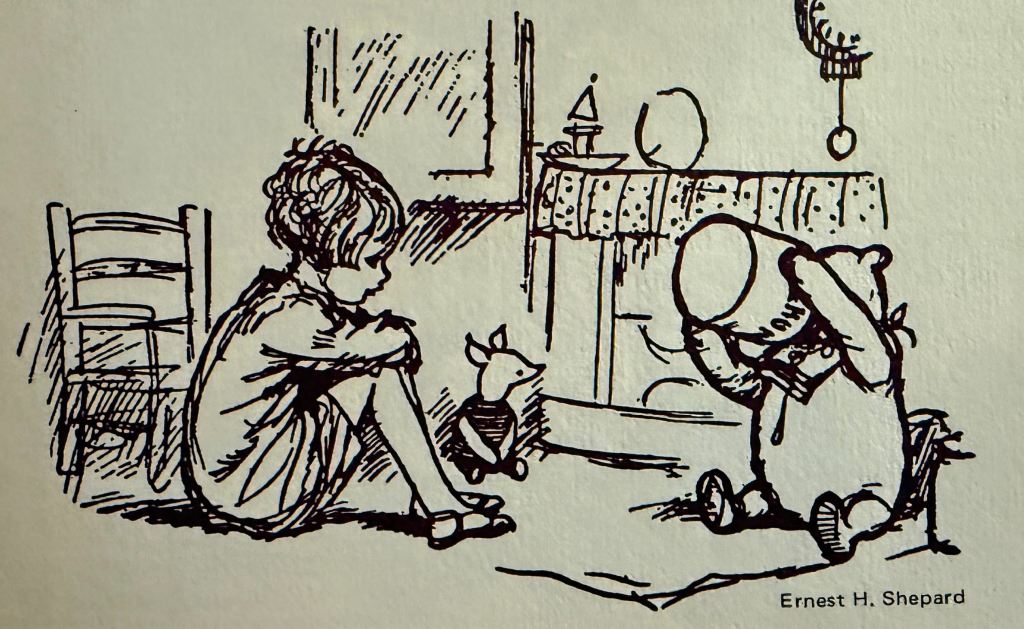
Piglet stares into the fire in an intense but relaxed manner of fire starers, Pooh has his back to the fire and a jug of honey raised to his mouth, but the center of importance in the picture is Christopher Robin’s face as he looks at Pooh. His is a look of concern, almost a paternal look. He is that most remarkable, affecting thing, a child with the feelings of an adult.”
Goodreads has a list of 55 books authored by “Welleran Poltarnees”. Most titles, mainly compilations of articles and illustrations about life’s simple pleasures, deal with creature comforts, life’s blessings, appreciation and praise for the work of others. In essence, a whole lot of gratitude.
Green Tiger Press started in the 1960’s as a postcard business specializing in reproductions of out-of-print illustrations by artists and illustrators. It was owned and run by Harold and Sandra Darling. It seems, by most accounts, that the pair were, if not reclusive, very private people, preferring to keep behind the scenes, even avoiding being photographed and connecting with customers.
It also appears they stumbled on a great idea at just the right moment, first, for republishing old postcards and pictures and, then, for putting together collections and publishing a large line of well-illustrated books about the contents. The family-run enterprise became a huge success, meeting an unmet demand (or, more likely, creating a new one), although it always struggled financially.
In 1986, Green Tiger Press was acquired by Simon and Schuster, leaving the Darlings with their stationery, prints and greeting card line (Laughing Elephant Gifts). The Darlings reacquired Green Tiger in 2010 and created a new publishing house (Laughing Elephant Books), focusing on classic and new children’s books.
Today, while another generation of the family continues to publish children’s books in San Diego, the gift company operates in a new green and pleasant land called Washington State.
I couldn’t agree more with Green Tiger’s premise, and regret I never met the author to explore the subject.
& & &
The only other editor who (to my knowledge) followed a similar path of interest was the English book designer, David Larkin. I’ll prepare a post on his work in the weeks to come.
& & &
Finally, being the season of thanksgiving in North America, let me extend a word or two of gratitude and thanks for all those who have consumed, liked and reposted these little essays. It means a great deal to me.


Leave a comment