
“I read about it in the paper, in the subway, on my way to work. I read it, and I couldn’t believe it, and I read it again. Then perhaps I just stared at it, at the newsprint spelling out his name, spelling out the story. I stared at it in the swinging lights of the subway car, and in the faces and bodies of the people, and in my own face, trapped in the darkness which roared outside.”
Thus begins James Baldwin’s short story, Sonny’s Blues, first published in 1957.
Last year (Jan. 25, 2025) I told you about coming across the 7th edition of The Norton Anthology of Short Fiction in my local Little Library. I also told you I would read every story and report back on my progress.
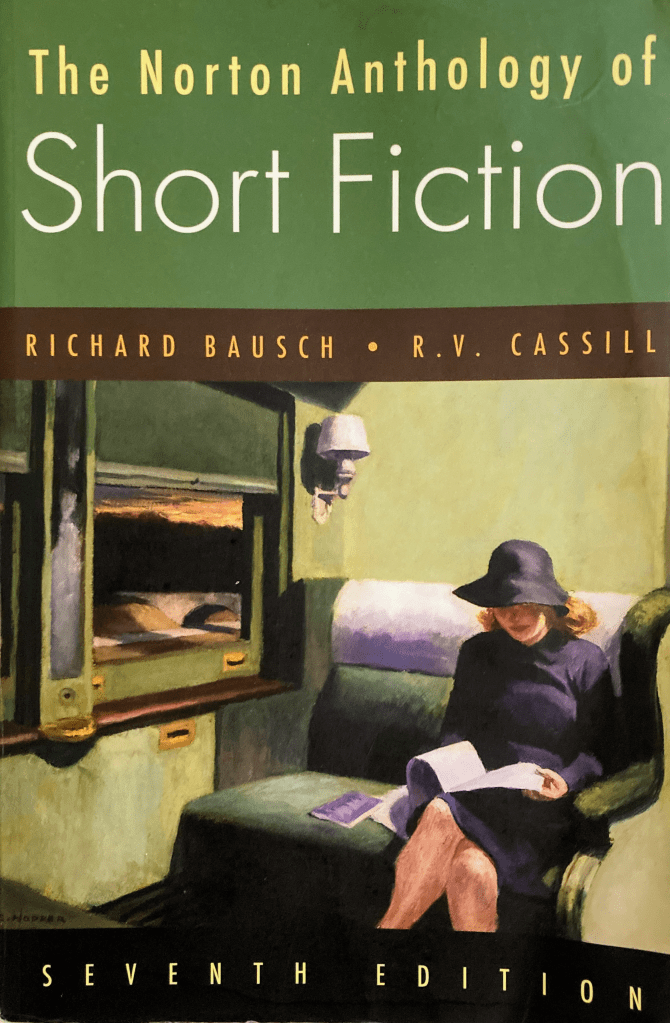
Well, I’m halfway there, having read up to the end of the letter M. That’s 79 authors and 97 separate stories, from the likes of Chekov, Cheever, Kafka, Conrad, Lawrence and Mann, to name but a few of the more famous writers included in this 2006 edition.
At that point, I was left with the challenge of trying to summarize my reading effort, choose a few standout highlights or select one for special mention. Many writers were known to me from past reading; some I knew by reputation alone; a whole lot were a complete revelation; not surprisingly, every selection was worth reading.
I will save you my rendition of winnowing down the top ten list to a manageable one. That one will be clear to you from my opening paragraph.
James Baldwin (1924-87) was, according to the short bio in the book, the stepson “of a revivalist minister and…active in the ministry for three years”, as well as someone who “drew on and refined the passionate eloquence of religious oratory as one ingredient of his style.” (p.37)
Sonny’s Blues follows in that vein and doesn’t shy away from dealing with difficult topics, in this case a wayward brother addicted to heroin. In doing so, the story is full of disquieting images, every character portrayed both with sympathy and menace at the same time: a grin is “repulsive”; laughter is not joyous; a dancing barmaid is “doomed”; the narrator – Sonny’s estranged, straitlaced brother – hates the boy he meets but feels that, in another moment, he’d start “crying like a child”; Sonny’s welcome reply to his letter makes him “feel like a bastard”.
However, it was Baldwin’s ability to turn music into prose that really impressed me. Here, it’s both the subject and the means of communication. On the surface, the story is about two brothers in Harlem—one a cautious school teacher, the other a troubled jazz pianist—but at its core it’s about the power of music to translate pain into meaning. Baldwin doesn’t just write about music; he makes his prose vibrate with its rhythms.
Early on, before we ever hear Sonny play, Baldwin frames music as a kind of private speech. The narrator recalls the Sunday street revival outside the housing projects:
“The music seemed to soothe a poison out of them; and time seemed, nearly, to fall away from the sullen, belligerent, battered faces.”
The “poison” is the city’s hardship—the inheritance of racism, poverty, addiction—and the antidote Baldwin offers is rhythm and song. Later, when Sonny explains his devotion to music, he tells his brother that jazz isn’t about showing off skill but about staying alive:
“It’s terrible sometimes, inside… and there’s no way to get it out—that’s why I play.”
Music here becomes a pressure valve for emotions that would otherwise destroy him.
Baldwin structures the story itself like a jazz composition—two themes (the brothers’ opposing lives) introduced separately, then brought together in variations. The schoolteacher-narrator speaks in measured, grammatical sentences, mirroring his orderly world. Sonny’s dialogue, by contrast, slides, repeats, and circles back, echoing improvisation.
When they finally begin to understand each other, the prose loosens. The narrator’s sentences lengthen, clauses repeat like riffs:
“Freedom lurked around us and I understood, at last, that he could help us to be free if we would listen, that he would never be free until we did.”
By the time the story reaches the nightclub scene, the prose itself has learned how to play. The climax of Sonny’s Blues—Sonny’s performance at a jazz club—is, as I now gather, among the most celebrated passages about music in American fiction. Baldwin describes the event as a mystical conversion:
“Sonny’s fingers filled the air with life, his life. But that life contained so many others.”

The narrator’s transformation during the performance is framed in spiritual terms. The final image—“the very cup of trembling” on the piano—comes from Isaiah 51:22, symbolizing both suffering and divine mercy. Through music, Sonny and his brother experience what Baldwin elsewhere called “the universal communion of pain.”
What makes Sonny’s Blues truly remarkable is how Baldwin pulls the reader into the act of listening. When he writes, “Creole smiled and closed his eyes for a moment. Then he stepped forward, very slowly, into the space between the two pianos,” one can almost hear the hush before the downbeat. By the time the final note fades, one feels the story rather than merely reads it.
For Baldwin, jazz, blues, and gospel all emerge from struggle; they turn private anguish into a shared experience, a communion of sorts:
“Creole was having a dialogue with Sonny. He wanted Sonny to leave the shoreline and strike out for deep water. He was Sonny’s witness that deep water and drowning were not the same thing—he had been there, and he knew. He was waiting for Sonny to do the things on the keys which would let Creole know that Sonny was in the water.” (p.58)
Later (p.58), “Creole stepped forward to remind them what they were playing was the blues. He hit something in all of them, he hit something in me, myself, and the music tightened and deepened, apprehension began to beat the air. Creole began to tell us what the blues were all about. They were not about anything new. He and his boys were keeping it new, at the risk of ruin, destruction, madness and death, in order to find new ways to make us listen. For, while the tale of how we suffer, and how we are delighted, and how we may triumph is never new, it always must be heard. There isn’t any other tale to tell, it’s the only light we’ve got in this darkness.”
Finally (p.59), Creole lets Sonny take over. “He made the little black man on the drums know it, and the bright brown man on the horn. Creole wasn’t trying any longer to get Sonny in the water. He was wishing him Godspeed. Then he stepped back, very slowly, filling the air with the immense suggestion that Sonny speak for himself.”
“Then, they all gathered round Sonny…Every now and again one of them seemed to say, amen. Sonny’s fingers filled the air with life, his life. But that life contained so many others.” The narrator sees the stories of his whole family captured in the music. “And he was giving it back, as everything must be given back, so that passing through death, it can live forever.”
Ultimately, reading Sonny’s Blues is both an act of listening and of communion. Baldwin’s story ends not with reconciliation in speech but with communion in sound—the two brothers joined by rhythm rather than argument. In doing so, Baldwin gives us one of literature’s purest renderings of how art redeems human suffering: it doesn’t erase the blues; it makes them sing.
&&&
On a personal note, I want to mention the passing of my mother, Jean, yesterday, at the age of 105 (just three months short of 106!). I owe many of my life’s achievements to what she passed on to me as a child: a love of reading (of many genres), of public libraries, of grammar and the English language, of the game of Scrabble and, finally, of art and design. I could say a whole lot more, but, today, time and space work against me.
So, just let me close with a simple expression of gratitude: thank you, Mum, and rest in peace.

Leave a comment