
My grandaughter once asked me to name my favourite author.
I found it a challenging question to answer, because I love (and appreciate) so many talented writers. And of course, it wouldn’t take long for me to start expanding such a list to incorporate all the fiction genres I prefer. And so on. I’m sure you get the idea.
In the end, I’ve decided to base my answer on the number of books I own of my favourites. Three writers top that list: John Irving, Anthony Trollope and Sinclair Lewis. Three very different birthplaces, backgrounds and eras.
But if my answer was based upon which of the trio I truly relate to, the choice would be very clear: it would be Sinclair Lewis. And I suspect that fact has a lot to do with where he and I grew up (although in different time periods).
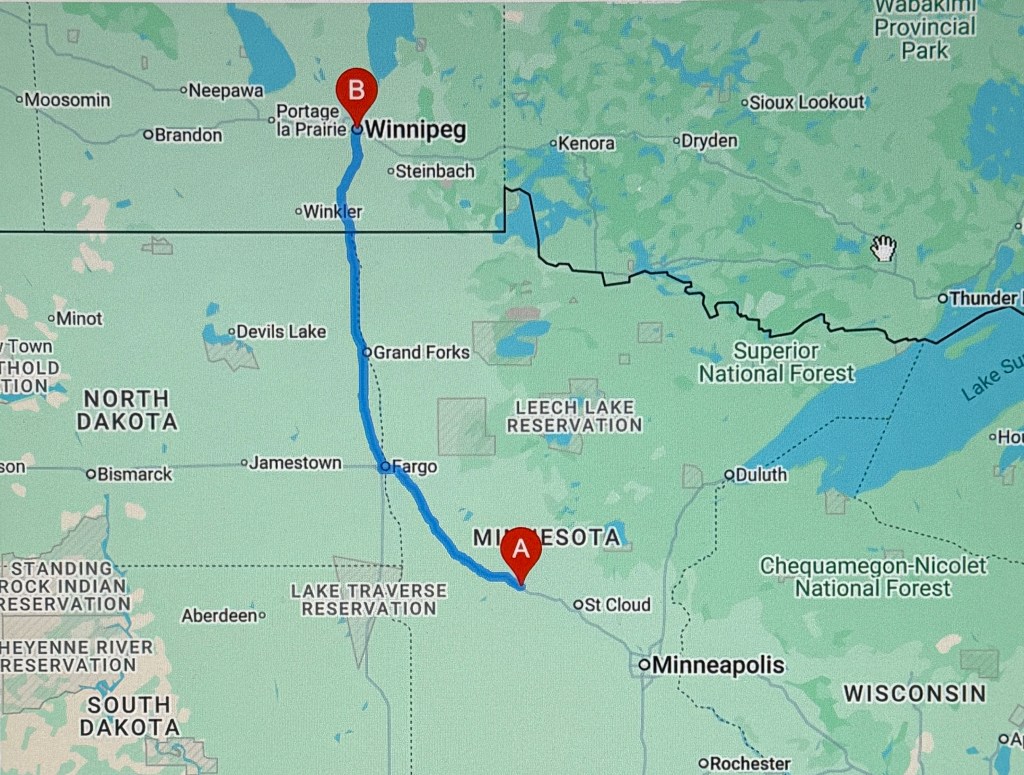
Google Maps
If you drive south from my prairie hometown of Winnipeg, Manitoba, through North Dakota and into Minnesota, past the Red River Valley and across the flat, fertile stretch of the I-29 corridor, down to Lewis country, you’re traveling through more than just geography.
You’re moving through the very landscape that birthed the American “middle class” and the man who became its greatest, most reluctant chronicler: Sinclair Lewis.

My collection of Lewis first editions
Growing up watching minor league baseball, the names of these midwest towns and teams (Winnipeg Goldeyes, St. Cloud Rox, Duluth Superior Dukes, Fargo-Moorhead Twins) were all known to me. The world of Sinclair Lewis wasn’t just a literary setting. It was a familiar map.
Lewis was born in 1885 in Sauk Centre, Minnesota—a town positioned almost exactly at the midpoint between the baseball diamonds of Fargo and St. Cloud.
Back in the 1960’s, the young prospects of those Northern League teams were dreaming of the Major Leagues. Back in the 1920’s, Sinclair Lewis was dreaming of a way to describe the towns they played in—towns that were both the backbone of the continent and, in his eyes, a gilded cage of conformity.
When Lewis published Main Street in 1920, he didn’t call the setting “Sauk Centre.” He called it Gopher Prairie. But everyone in the region knew exactly where he meant.
As someone who knows the drive from Winnipeg to Minneapolis, the descriptions in Main Street resonate with a specific, prairie-bred clarity. Although today, one might look back with nostalgia, back in the 1920’s Lewis had a different take, capturing in his prose the “unsparing, unquenchable, and incredibly dull” nature of small-town life. He wrote about the rigid social hierarchies of the doctor’s wife and the bank president, the same kind of local royalty that likely sat in the “good seats” at the ballpark in Grand Forks or Aberdeen.

Lewis was the first to suggest that the “friendly” mid-westerner had a dark side: a “village virus” of gossip and judgment that could crush anyone who dared to be different. He was the first American to win the Nobel Prize in Literature (1930), precisely because he could map this regional psyche with the precision of a surveyor.
After skewering the small town, Lewis turned his sights on “Zenith”, a fictionalized version of a city like Minneapolis or a larger-scale Fargo. In his 1922 masterpiece Babbitt, he created George F. Babbitt, a real estate man who is the ultimate “booster.”
Think of the local businessmen who sponsored the small town baseball teams—the guys in the loud blazers who belonged to the Elks Lodge and the Kiwanis Club—you’ve met Babbitt, a man who measures his worth by his gadgets, his car, and his standing in the community.
“He was a man who had never done anything he didn’t want to do, and had never wanted to do anything that wasn’t expected of him.”
To Lewis, the “Babbitt” was the quintessential American of the 20th century: prosperous, busy, and profoundly empty. In naming this character, Lewis gave us a word that still exists in the dictionary, one describing a person who conforms blindly to middle-class standards.
The Northern League of Literature: A Decade of Hits
Just as the Goldeyes had their “Golden Age” in the 60s, Lewis enjoyed a decade where he simply couldn’t miss. His “Big Five” novels were like a championship winning streak:
Main Street (1920): stifling conformity
Babbitt (1922): hollow boosterism
Arrowsmith (1925): a doctor’s struggle against greed
Elmer Gantry (1927): the hypocritic evangelist
Dodsworth (1929): a businessman looking for his soul
While Main Street and Babbitt captured the static nature of the prairie, Dodsworth followed the man who finally got out. If George Babbitt was the man who stayed in the bleachers, Samuel Dodsworth was the successful industrialist—perhaps the owner of the very factory that sponsored the local ball team—who decides to retire and see the world.
The novel is a poignant “Grand Tour” story, taking Sam and his socially ambitious wife, Fran, from the familiar comfort of the American Midwest to the sophisticated drawing rooms of Europe.
Dodsworth is a “big” man—honest, capable, and unpretentious—who suddenly finds himself feeling like a “hick” in London and Paris. Lewis uses his dilemma to explore whether a man forged in the direct, literal world of Midwestern industry can ever truly adapt to the subtle, cynical complexities of European culture. It is arguably Lewis’s most mature and sympathetic work, proving that even a “Babbitt” has a soul worth saving if he has the courage to travel beyond the horizon.
It Can’t Happen Here: A Warning from the Prairies
By the 1930s, Lewis’s personal life was fraying. He struggled with alcoholism and a tumultuous marriage to journalist Dorothy Thompson. Yet, even as his health declined, his regional intuition remained sharp.
In 1935, as fascism took hold in Europe, Lewis wrote It Can’t Happen Here. While other writers imagined a foreign invasion, Lewis knew the American character too well. He imagined a populist dictator named Buzz Windrip—a folksy, “plain-talkin’” politician who rose to power by promising to return the country to a mythical past.
Lewis’s warning was clear: tyranny in America wouldn’t arrive as a goose-stepping army; it would look more like a friendly neighbor at a Rotary Club meeting. It was a book born of his deep understanding of how “niceness” and “conformity” can be weaponized.
The View from Highway 75
For a kid growing up in Winnipeg, the border to the south felt like an entrance to a different world. Yet the landscape remained the same: the same endless horizon, the same grain elevators, and the same obsession with “being a good neighbor.”

Lewis was the man who looked at that horizon and saw both its beauty and its limitations. He was a “Red Boy” (nicknamed for both his hair and his politics), a writer who couldn’t stay in Sauk Centre but in his writing couldn’t ever truly leave it behind.
Although he died in Rome in 1951, a long way from the Minnesota plains, his ashes were brought back to Sauk Centre. In a final irony, the town that once viewed him as a traitor now celebrates “Sinclair Lewis Days.” Ultimately, everyone realized that his criticism wasn’t born of hate, but of a desperate, frustrated love for the place.
& & &
America celebrates 250 years of history this month, and this post pays tribute to one of its greatest authors. My next post, on July 4, will highlight another cultural icon.
Sinclair Lewis belongs to another era, but we need to read him today because the Babbitts and Windrips are still with us—they just have better technology and different cars. We also need to read him because the tension between the Main Street need for belonging and the Arrowsmith need for truth remains a central conflict of our lives.

You must be logged in to post a comment.