It was 1978. The world was divided between west and east; a stagnating cold war still in effect; Leonid Brezhnev had four years left as General Secretary; the USSR was months away from invading Afghanistan; the tearing down of the Berlin Wall still eleven years away.
Allan Blakeney, then Premier of Saskatchewan, was planning a trade mission to the Soviet Union. I was the Department of External Affairs’ desk officer for Canada’s four western provinces, responsible for liaison with the province and with our Moscow Embassy, and aiding in planning for all provincial government international travel.
Because of Saskatchewan’s motherlode of uranium and potash, two industries of great interest to the USSR, the scientific side of the trip took up a great deal of time in our planning. The Science Counsellor of the Soviet Embassy came by the Pearson Building one day to consult about the visit.
After the meeting and after ushering my counterpart back outside, I returned to my office and sat back down to continue with work. The phone rang almost instantaneously. It was someone I did not know but who quickly identified himself. He asked whether the Counsellor had just been to see me. I replied yes, he had. In fact, I declared, this visit had been his second.
“Ah, we missed him that time,” the RCMP Security Service officer admitted.
That was my second meeting with a Soviet spy. It would not be the last.
The Mountie asked for details about the conversation, which I was happy to provide. In fact, much of what the Soviet official voiced had surprised me greatly, especially the personal tone he had taken.
Very quickly, beyond the organization of the provincial mission, he talked a great deal about himself, spoke about a father who’d been an alcoholic and his own circuitous path to the Soviet diplomatic corps. Of course his purpose was to get me to share my past in an equal fashion. Most people’s favorite topic being themselves, normally it was a task easily done. However, I’m not like most people: I don’t like to talk about myself and rarely divulge personal details.
So, our friendly spy came away with very little. Still, I’m certain a file on me exists in Moscow, probably begun during my prior time in Washington, and if I’d carried on in the diplomatic field, it would have followed me wherever I went in my travels. Doubtless, further contacts to connect with me would have been initiated.
The Science Counsellor was a traditional spy, working in the Embassy and thus under diplomatic immunity if exposed. Many more are hidden away, under deep cover, called “illegals” in the trade.*
These memories of the world of spies were triggered by my recent reading of an old Frederick Forsyth thriller about espionage and the art of spycraft during this era and later.
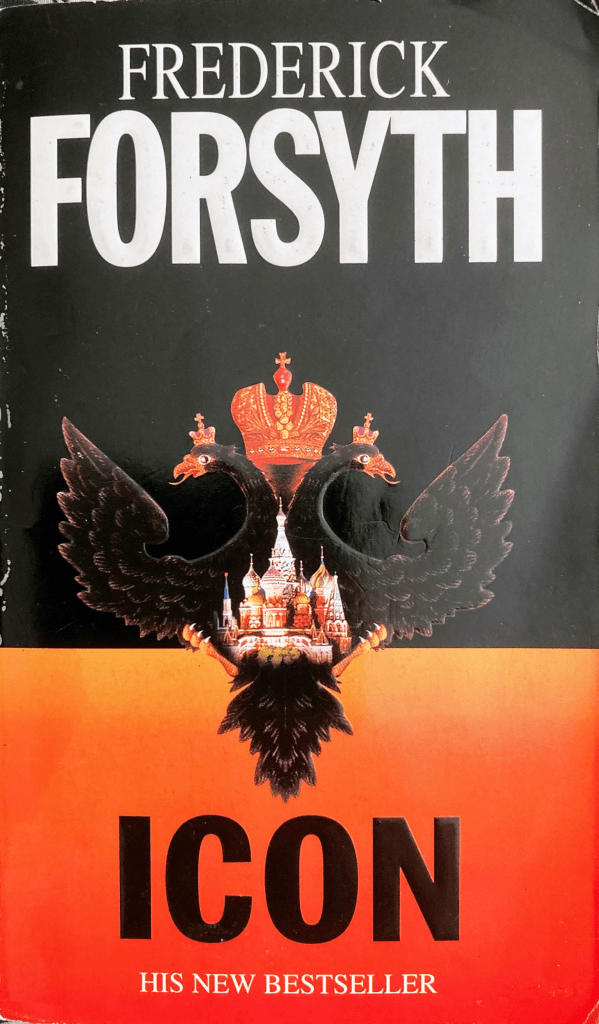
(Corgi Books edition, 1997; originally published by Bantam Press, 1996)
It’s akin to the book I read and talked about on the one year anniversary of Russia’s invasion of Ukraine (February, 2023): Archangel by Robert Harris. Forsyth’s book covers a similar time period – the transition from Gorbachev to Yeltsin to Putin. (Both books, I hasten to add, were found in my neighborhood Little Library.)
The storyline is incredibly far-sighted, surmising the rise of a dynamic, nationalistic political leader who wants to take Russia down the pathway of international aggression and into the worst excesses of domestic tyranny, nothing less than the genocide of ethnic minorities.
Much like Forsyth accomplished with The Day of the Jackal (1971, detailing an attempt to assassinate French President Charles de Gaulle) and The Odessa File (1972, about ex-Nazis at large in post-war Europe), Icon combines great research with great writing, providing an accurate rendering of Cold War espionage and political history. It throws in the attempted KGB coup of 1991 (against the new Gorbachev regime), the simultaneous rise of oligarchs and organized crime, the invasion of Chechnya (the First Chechen War, 1994-96) and the CIA’s amazing failure to uncover the treason of Aldrich Ames. Then Icon finishes off with a classic Mission Impossible-like climax.
Given the current tragedy in Ukraine, Icon – historical fiction at its best – is well worth reading to understand the forces at play here. As well, it treads a path that goes far beyond the usual shoot-em-up thriller and into other aspects of coup attempts, like the manipulation, culpability and over-reaction of mass media.
As the ever-prescient (20 years before 2016) Mr. Forsyth says:
“Public relations, they had called it in America, the multi-billion-dollar industry that could make a talentless oaf a celebrity, a fool a sage and a base opportunist a statesman. Propaganda, they called it in Russia, but it was the same tool.” (p. 477)
The rest of my story, part 2, will follow, as usual, in two weeks time.
***
* The 2020 book Russians Among Us: Sleeper Cells, Ghost Stories and the Hunt for Putin’s Spies (by BBC security correspondent Gordon Corera) provides an excellent account of the illegals, including two “Canadians”, Donald Heathfield and Ann Foley. In reality, Donald was Andrey Bezrukov and Ann was Elena Vavilova, recruited out of Tomsk in their university days and provided with fake identities, based on two Canadian children who died in infancy.
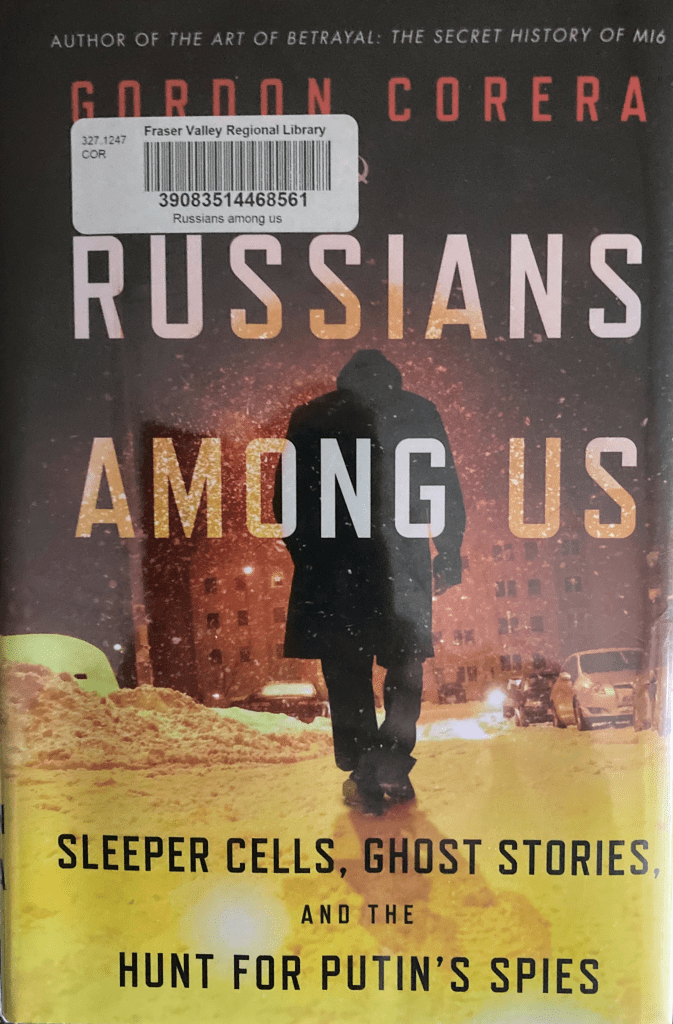
(New York: William Morrow, An Imprint of Harper Collins, 2020)
It appears that Canada was seen by Soviet spymasters as the ideal launching pad for illegals (four of the eleven arrested in the US in 2010 possessed Canadian documentation), the culture and language allowing for an illegal to acclimatize and build up an identity while – sad to discover -document and border checks were largely ineffective. (p. 42)

You must be logged in to post a comment.