
I was watching CNBC some months back when I happened to come across a series called American Greed (not to be confused with the more famous American Crime Story).
Little did I know that the series, which focused on corporate and white collar crime, ran for 15 years, and included 222 episodes. I’d say that’s a whole lotta’ greed! This episode, numbered #49, entitled “The Wizard Of Sarasota”, was initially broadcast in 2011 (season 5).
The episode focused on a fraudster working out of Sarasota, Florida named Arthur Nadel, primarily in the first decade of this century. Nadel was the manager of a hedge fund named Scoop Management Co., which reportedly lost $350 million. He was arrested on January 27, 2009 after surrendering at the Tampa Federal Bureau of Investigation (FBI).

Like Bernie Madoff (although a much smaller fry in a much smaller pond) and operating in the same era, Arthur Nadel preyed upon the gullible, desperate and naive. In 2009, he was indicted on fifteen federal counts of securities fraud, wire fraud, and mail fraud; a maximum sentence of 280 years in prison and forfeiture of all assets connected to the crimes could have been his punishment. For those interested in the gory detail, Wikipedia provides a fulsome account.
In the end, Nadel pleaded guilty to securities fraud and was sentenced to 14 years in Butner Federal Correctional Complex (the same one Madoff went to), where he died in 2012 after serving only 2 years.
It’s a cautionary tale, for both the predators of this world and their potential victims.
But that’s not all. One of the things that struck me in watching the show was a book, laying on the desk of the attorney who represented many of those who had lost significant savings to Nadel: Three Cups of Tea.
The title rang a bell, and as soon as the show ended I went to look it up.

The book was first published by Penguin in 2007. Here is the blurb in its Amazon listing:
“The astonishing, uplifting story of a real-life Indiana Jones and his humanitarian campaign to use education to combat terrorism in the Taliban’s backyard.
“Anyone who despairs of the individual’s power to change lives has to read the story of Greg Mortenson, a homeless mountaineer who, following a 1993 climb of Pakistan’s treacherous K2, was inspired by a chance encounter with impoverished mountain villagers and promised to build them a school.
“Over the next decade he built fifty-five schools—especially for girls—that offer a balanced education in one of the most isolated and dangerous regions on earth. As it chronicles Mortenson’s quest, which has brought him into conflict with both enraged Islamists and uncomprehending Americans, Three Cups of Tea combines adventure with a celebration of the humanitarian spirit.”
According to the author, the title of the book, Three Cups of Tea, comes from a Pakistani proverb that says when you share the first cup of tea you’re a stranger, with the second cup you are a friend, and with the third cup you become family.
Despite the noble quest, an underlying problem with the book existed: much of Mortenson’s story was false.
According to Wikipedia, on the April 17, 2011, broadcast of CBS News 60 Minutes, correspondent Steve Kroft alleged several inaccuracies in Three Cups of Tea and its sequel, Stones into Schools: Promoting Peace with Books, Not Bombs, in Afghanistan and Pakistan, as well as financial improprieties in the operation of the foundation co-founded by Mortenson, the Central Asia Institute (CAI).
The 60 Minutes report made the following allegations:
- Some of the events recounted in Three Cups of Tea, including Mortenson getting lost on the way down from K2, stumbling into Korphe, and promising to build a school, did not take place.
- The story recounted in Stones into Schools about Mortenson’s capture by the Taliban did not occur. His purported kidnappers state he was a guest, and the Taliban did not exist in the country at that time.
- Schools that the CAI claims to have built either were not built, were built but abandoned, were used for other purposes such as grain storage, and/or were not supported by CAI afterwards.
- The amount of money CAI spent on advertising Mortenson’s books and paying for the travel expenses of his speaking tours, including hiring private jets, was excessive compared to similar charitable institutions.
Although 60 Minutes asked Mortenson for an interview before their broadcast, he did not respond to their requests.
Further allegations, criticism and lawsuits against Mortenson ensued. Ultimately, following an inquiry into the Bozeman-based charity by Montana’s Attorney General, in April 2012, Mortenson agreed to repay $1 million to CAI and resign as Executive Director.
Then, in a tragic turn of events, his co-author, David Oliver Relin, on November 15, 2012, at age 49, died by suicide,by stepping in front of a freight train outside Portland, Oregon. His obituary in The New York Times reported that he had suffered emotionally and financially when basic facts in Three Cups of Tea were called into question.
In a January 2014 interview on Today with Tom Brokaw, Mortenson apologized, acknowledging that he had let a lot of people down, and admitting he had “failed in many ways, and it’s an important lesson.”
Now, to be fair in my reporting, subsequent examination of this story by others also criticized the investigations by CBS and others. Once again, Wikipedia has the whole (and well documented) story.
So, what to make of all this? First, this is not Fyodor Dostoevsky: Raskolnikov is fiction. Little sign of remorse or conscience in these stories is revealed, and even less hope of redemption. What we see instead are cautionary tales, not just for the predators of this world, but for the rest of us — the readers, viewers, investors, and donors who can be drawn in so easily by smooth-talking charlatans.
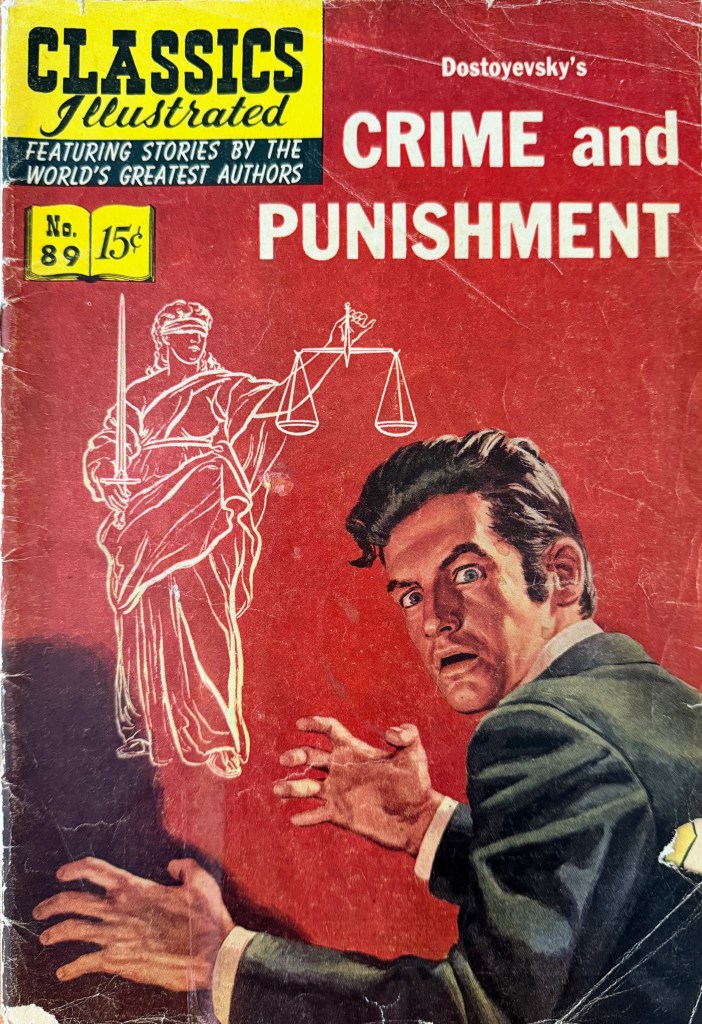
From my own collection of Classics Illustrated, Gilberton C0., Inc., New York, November, 1951
So what are the lessons to be learned from this story?
- Appealing stories can blind us to reality – Whether it’s the promise of secure, high returns or the romance of building schools in remote valleys, emotionally satisfying narratives often silence our skepticism.
- Fraud exists on a spectrum – From deliberate Ponzi schemes to embellished personal myths, all forms of deception corrode trust and damage lives.
- The media is both spotlight and sword – Investigations can uncover wrongdoing, but they can also oversimplify complex truths and sometimes become part of the spectacle they report.
- Collateral damage is real – Exposés can devastate not just perpetrators, but also associates, bystanders, and the legitimate good work intertwined with flawed conduct.
- Disillusionment is costly – Victims of these stories lose not only money, but also the sense of security or inspiration they once held.
- Trust is the most fragile currency – Once lost, financial and moral trust are hard to regain, and their absence leaves lasting scars on communities and causes.
In the end, whether in the boardroom, the charity office, or the pages of a best-seller, the same lesson holds: trust is precious — and once broken, the cost of rebuilding it can be higher than anyone is willing to pay.
In greed and glory alike, the fall comes fastest when the story’s too good to check.

Leave a Reply