
Nothing gives me more pleasure than coming up with a post that combines two of my great passions: history and art.
I wasn’t searching for Vertigo by the German journalist Harald Jähner, but came across his book in a search on another topic. Although I’ve read a great deal about the interwar period, this is the first book I’ve discovered by a German author, and one who’s clearly much closer to the subject.
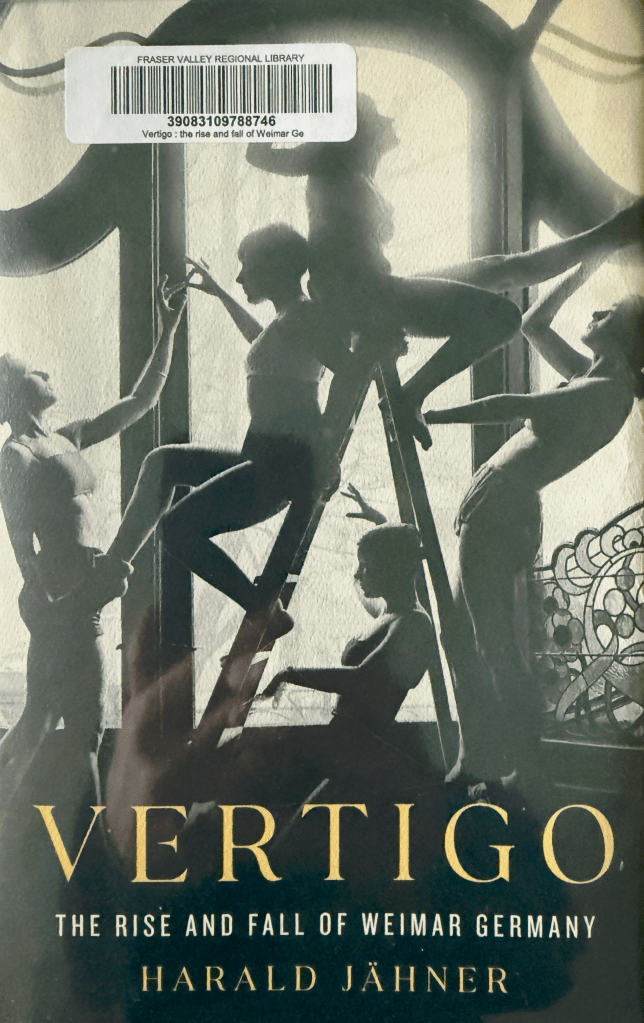
Basic Books, New York, 2024; translated by Shaun Whiteside
What struck me most were the parallels between that era and our own:
The Death of Truth
The 1920s “Stab-in-the-Back” myth (Dolchstoßlegende)—the false idea that the army hadn’t lost WWI but was betrayed at home—poisoned public discourse.
- Today: Social media algorithms create echo chambers where “alternative facts” and conspiracy theories gain the same footprint as verified information, eroding the shared reality necessary for a functional democracy.
Hyper-Polarization and the “Missing Middle”
Weimar politics became a battle of extremes: Communists on the left, National Socialists on the right, and a centrist government that looked increasingly weak and out of touch.
- Today: Across the West, political polarization has reached a fever pitch. The “sensible center” is often hollowed out, leaving a vacuum filled by populist movements promising radical change and a return to “traditional values.”
Cultural Whiplash
The era’s revolutionary gender issues (women’s emancipation and sexual identity), especially in cosmopolitan Berlin, felt more like a moral collapse in rural Germany.
- Today: The intense culture wars, with rapid shifts in gender identity, social norms, and secularism, have created a vertigo effect for conservative populations, fueling a backlash.
The Decline of Mainstream Media.
According to Jähner, the Weimar Republic was the first era of “permanent sensation.” By the late 1920s, the public was bombarded with “extras” (special newspaper editions printed multiple times a day) and live radio broadcasts.
Rather than making people feel more informed, the constant stream of news overwhelmed them, fostering cynicism. Jähner suggests that when the world feels like it’s moving too fast to comprehend, people begin to suspect that the mainstream media is either incompetent for not explaining it or, more dangerously, actively manipulating the chaos.
As trust in an objective, “liberal” press faded, Germans retreated into hyper-partisan media.
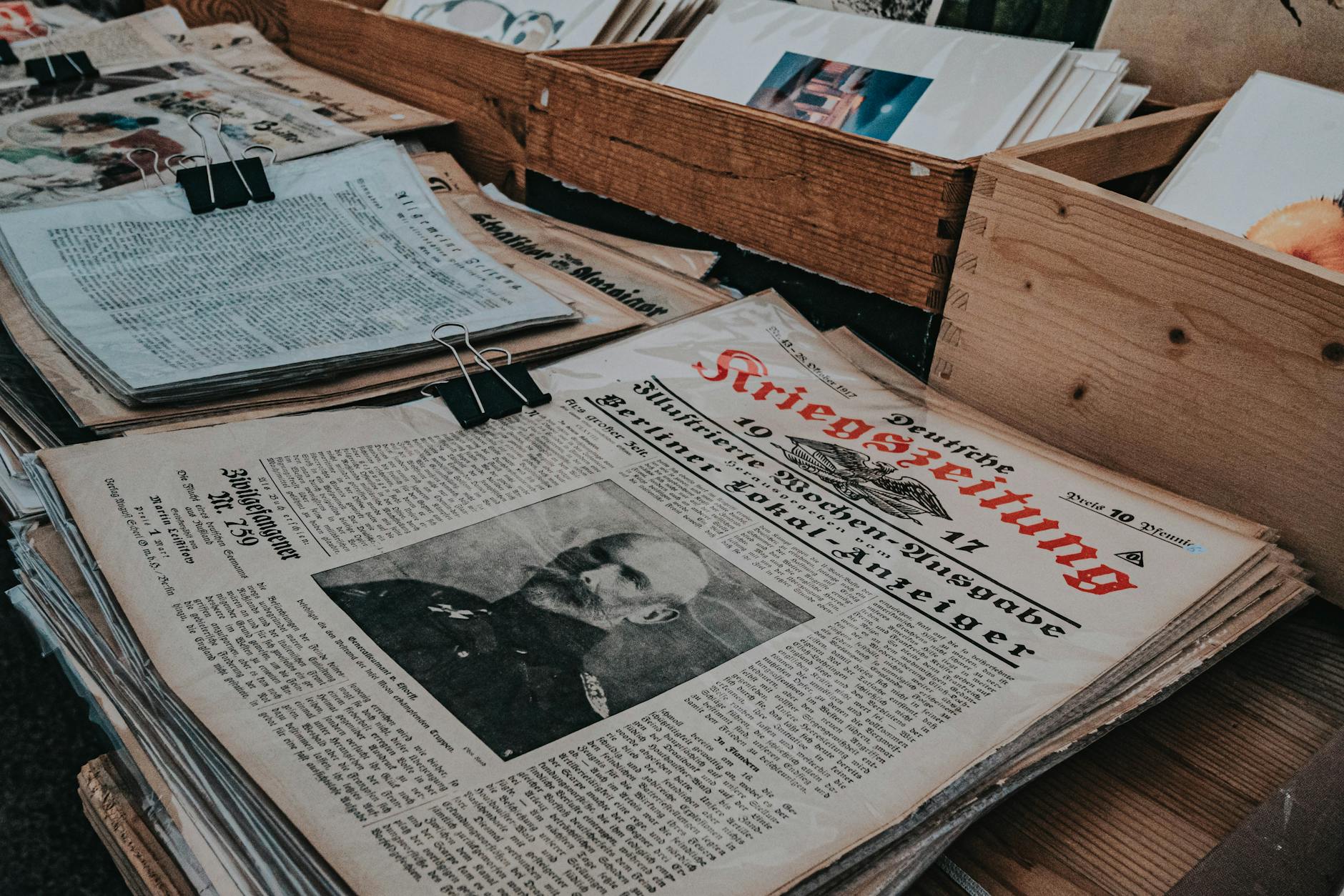
Jähner describes how the media landscape fractured into echo chambers. Every political party had its own news ecosystem that didn’t just report different opinions, but lived in different universes. By 1930, Jähner notes that the “middle ground” of shared reality had essentially vanished. If you were a reader of the Völkischer Beobachter (Nazi) or Die Rote Fahne (Communist), the mainstream papers weren’t just “wrong”—they were viewed as “enemy propaganda.”
The Collapse of Expertise
A major component of the ensuing vertigo was the sense that traditional experts (economists, journalists, politicians) had no idea what was happening.
After the hyperinflation of 1923 and the onset of the Great Depression in 1929, the mainstream media’s promises of stability felt like lies. Jähner points out that the situation created a vacuum of authority. When the “sensible” people in the media couldn’t explain why people were starving while the shops were full, the public turned to radical voices who offered “simple truths” over complex, institutional explanations.
Polarization as a “Lifestyle”
Jähner observes that polarization in the 1930’s became more than just a political choice; it became a cultural identity. Your choice of newspaper dictated which cafes you went to, which clubs you joined, and even which beer you drank. By the time the Weimar Republic actually collapsed, the society had already emotionally decoupled. The polarization wasn’t just about policy; it was a total breakdown of social trust.
& & &
This brings me to the 1930 painting, Evening Over Potsdam (Abend Uber Potsdam)by Lotte Laserstein:
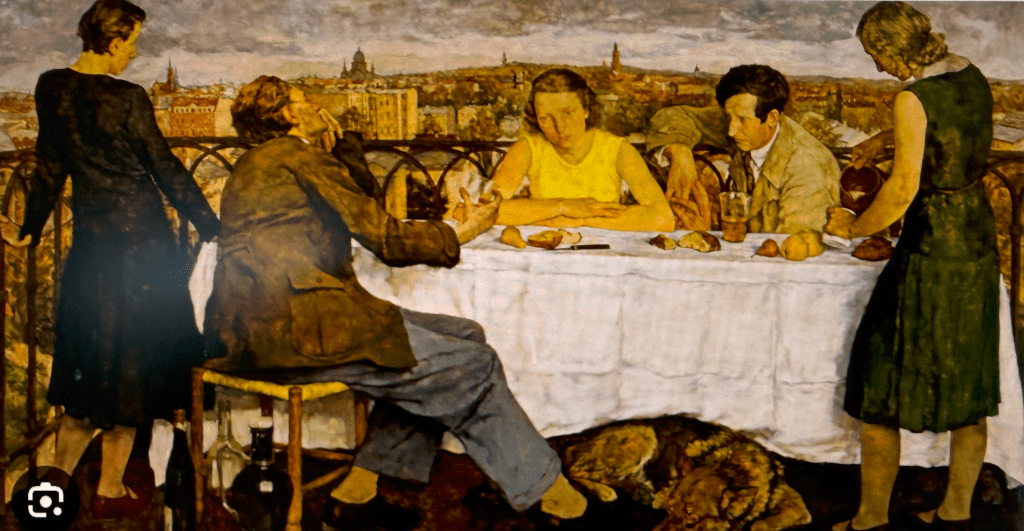
Evening Over Potsdam is one of the most significant cultural artifacts Jähner uses to illustrate the vertigo of the era. In fact, it’s often described as the “final photograph” of the Weimar Republic before the lights went out.
The painting depicts five young people—friends of the artist—sitting on a balcony overlooking the city of Potsdam. On the surface, it’s a typical scene of urban youth, but the atmosphere is heavy with what Jähner calls “the melancholy of the end.” The five are seen as “weary and weak, drained over” just like the “exhausted society”. (p. 329)
Its composition, the author notes, “recalls Leonardo’s Last Supper, not least because of the refined agitation of of the essentially calm scene, and the Christ-like pose of the woman in yellow at the centre of the painting, sitting stiffly, in blank reflection.” (p. 328)
Jähner highlights the paintings key elements :
- The Emotional Distance: Despite being physically close together, none of the figures are looking at or interacting with one another. They’re lost in their own thoughts, a visual representation of social fragmentation. The “shared reality” of life has already dissolved.
- The “New Woman” in Repose: The central figure is a woman leaning on the table, looking drained. She represents the “New Woman” Jähner writes about throughout the book—formerly liberated and energetic, now exhausted by the economic and political grind.
- The Looming Horizon: The position of the city of Potsdam — the seat of Prussian military power — in the background is significant. By placing these modern, secular, somewhat aimless Bohemians in front of that specific skyline, Laserstein captures the tension between the fragile democracy and the old, rigid authoritarianism waiting to reclaim the stage.
- The “Wait”: There is a profound sense of waiting in the painting. By 1930, Jähner argues, the “Golden Twenties” were over. Everyone knew something was coming, but no one knew exactly what. The painting captures that breathless moment before a freefall.
It’s a warning that the “Golden Age” doesn’t end with a bang, but with a quiet, collective realization that the party is over and no one knows where to go next.
Ultimately, the German voters chose to support a self-proclaimed “unifier” and “liberator of a nation in a state of discord” over the alternative. (p. 368) The results proved disastrous for humanity.
& & &
Lotte Laserstein’s life is essentially the “final chapter” of the Weimar story. She was one of the first women admitted to the Berlin Academy of Arts, and by the late 1920s, a rising star.
However, her biography perfectly illustrates the vertigo Jähner describes—the sudden, violent transition from a world of infinite possibility to one of total exclusion.
Because Laserstein had Jewish ancestry, her world collapsed when the Nazis took power in 1933. Overnight, she went from a celebrated vanguard of German culture to being “racially impure.” She was banned from exhibiting her work and excluded from the Reich Chamber of Culture.
For a few years, Laserstein tried to survive by teaching at a private art school, but as the vertigo deepened into a nightmare, she realized there was no place for her in the new Germany.
In 1937, she managed to move an exhibition of her work to Stockholm, Sweden, using the opportunity to flee Germany the next year, and even managing to take the famous painting along (no mean feat since it’s over 2 metres wide). She spent the rest of her long life in Sweden (she lived to be 94). While she continued to paint, her style shifted to more traditional portraits and landscapes to make a living.
For decades, Laserstein was largely forgotten. It wasn’t until a major exhibition in London in 1987—and later the 2003 “Rediscovery” exhibition in Berlin—that she was finally recognized as one of the greatest realists of the 20th century. The painting now hangs in Berlin’s Museum of Modern Art.
&
On a final note, for any readers who take up this book, I’d encourage them to read to the very end, both the last chapter and the epilogue. Here, Jähner describes the final collapse of the Republic, the abolishing of constitutional rights, the slide into the Third Reich and the ultimate fate of so many of the individuals he profiles.
It’s a sobering read.


Leave a Reply