
I moved into my current home barely three years ago, just over the Christmas period. As a result, I’m still learning its secrets.
One of those secrets is what lies under the topsoil both front and back. The backyard offers two small gardens, one an overgrown rock garden, consisting largely of beds of lily of the valley and Western sword ferns, along with encroaching ivy and some kind of mint (the former a pain and the latter a pleasure).
Since the gardens were planted by the previous owner, I can take no credit for what lies within them, for both good and bad.
The point is, for a few days in spring – like right now – two red tulips bloom out of these modest lilies. It’s a sight that gives me inordinate pleasure.
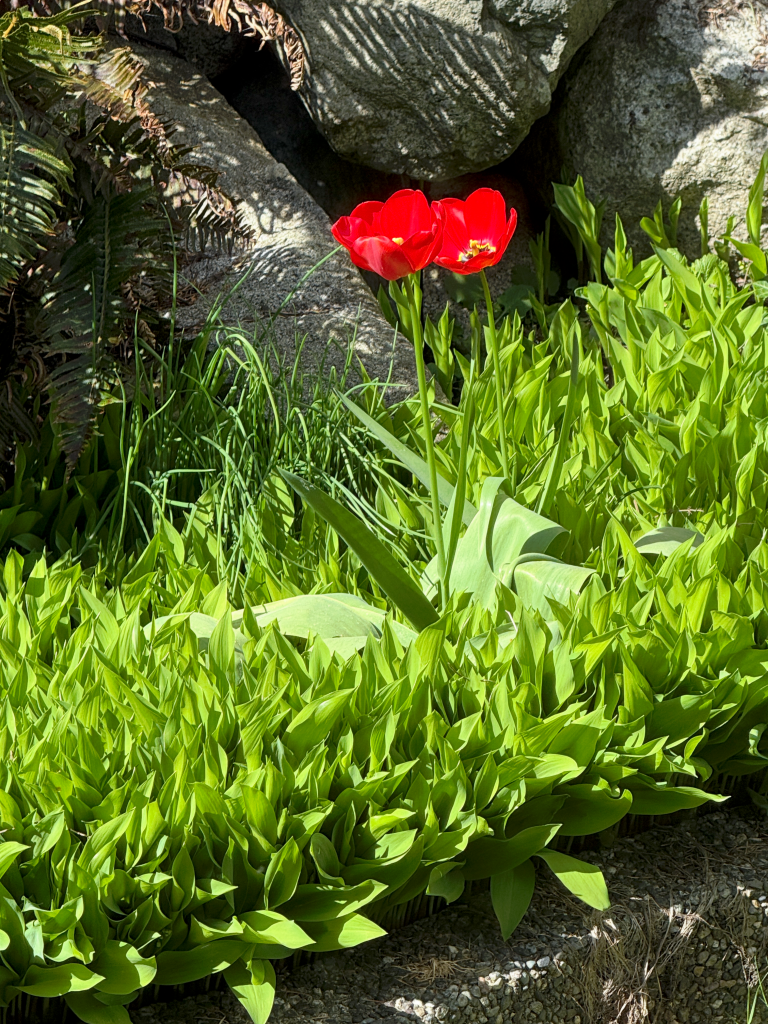
A section of my back garden.
Wondering why this simple vista appealed to me so much, I asked my good friend Chat for an answer. This was his reply:
Color contrast does the heavy lifting. The saturated red of the tulips sits opposite green on the color wheel. That complementary pairing creates maximum visual tension, so your eye locks onto the blooms instantly. The brain reads that as vivid, even “alive.”
Figure–ground clarity. Those red cups rise cleanly above a dense green field. Your visual system likes clear separation: this (flower) against that (foliage). It’s the same principle that makes good design legible—your brain doesn’t have to work to parse the scene.
Rhythm with a focal point. The repeated, blade-like leaves form a pattern; the tulips break it with a few bold accents. That balance—order plus a small disruption—keeps attention without feeling chaotic.
Seasonal signaling. Bright flowers puncturing fresh green is a classic “spring has arrived” cue. We’re wired to treat that combination as a positive environmental signal—more light, more growth, better conditions.
A touch of rarity. A couple of standout blooms in a sea of similar leaves feel special. Scarcity increases perceived value; your brain rewards you for spotting it.
Quite scientific as far as answers go and not to be disputed. But it seemed to me more was afoot here: something emotional and spiritual.
It turned out the answer was to be found online, for just after I took this photo, I came across a Mar. 17, 2026 essay on meditation by Anthony Garner on his site, zenothestoic.com. It inspired me to write this post.
In that essay, Mr. Garner speaks of his search for life’s answers:
“I was a “seeker” for over thirty-five years. I looked in every corner for the “Philosopher’s Stone”—the answer to life, the universe, and everything. I studied the Book of Common Prayer for its sublime, calming language, the Buddhist sutras for their powerful remedy, and the works of modern science to see if the “men in white coats” had finally unravelled the mystery of consciousness.”

My 1992 edition (Ebury Press, London) of the 1662 authorized version of the BCP
I didn’t pursue all of Mr. Garner’s pathways, but I appreciate his longing for answers. As for me, I’ve always been attracted to the majesty and uplifting language of the Book of Common Prayer (BCP), lamenting its slow disappearance from Anglican church pews.
Mr. Garner notes how he chooses a combination of meditation and pilates/yoga, finding it has changed how he “greets the world”.
I can’t say that I’ve practised long bouts of meditation, but I try to be watchful and deliberate in my daily behaviour and decision-making. As for yoga and pilates, yes, definitely: two thumbs up. Calmness, acceptance and an appreciation for the beauty of the natural world are what he finds. I couldn’t agree more.
Mr Garner sums up his search for answers as follows: “the answer lies within, and it requires a level of persistence and rigorous self-discipline that few are willing to apply.”
Interestingly, this is one of the themes of my Ravenstones book series (available on Amazon).
I can easily come up with a host of other simple pleasures, things to delight every sense: touch, taste, smell, sight and sound. Too many to list here, I’m afraid, but for which I remain thankful.
And now I have one more one reason to be grateful. Mr. Garner’s thoughts and prose resonate, providing me with yet another thing to appreciate this day. So, thank you, Anthony; I will definitely keep up with your essays.


Leave a Reply