Some weeks back, I posted about a book that I’d recently discovered in my local library, Vertigo by Harald Jähner. Its subject was the Weimar Republic, about the years in Germany between the First World War and the coming to power of the Nazi regime in 1933.
Upon reading this fascinating book, I took note that Jähner had written an earlier one, similar in approach (covering the era’s zeitgeist) but of the post-World War Two era. The book was entitled Aftermath and subtitled Life in the Fallout of the Third Reich, 1945-1955.
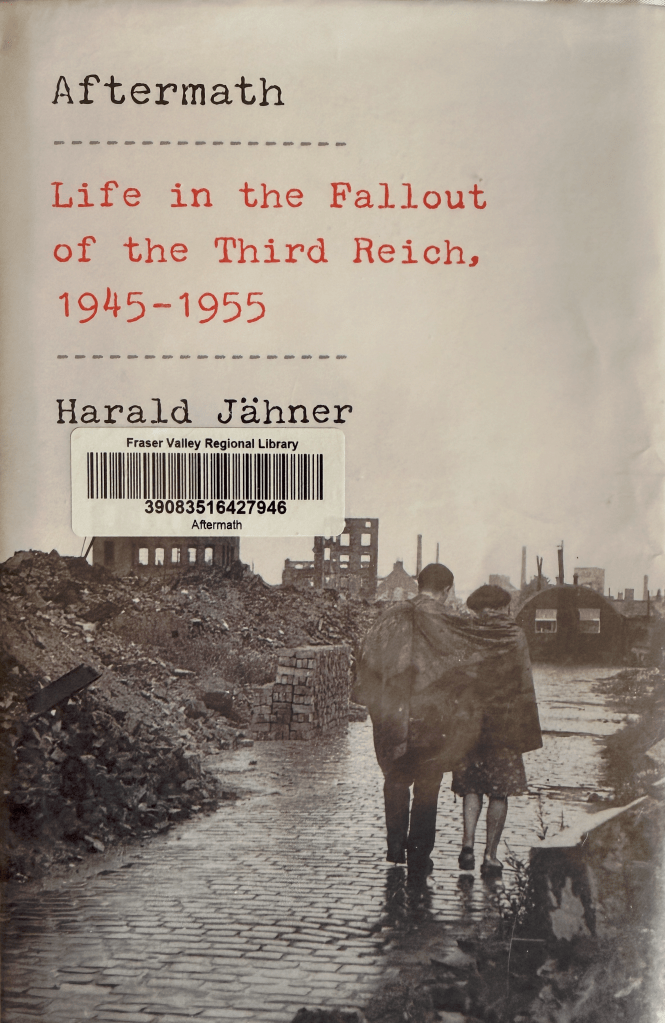
New York: Alfred A. Knopf, 2022
I’m a devotee of the history genre in general, but the twentieth century has always been of greatest fascination (after all, I did live through 50% of it). That being said, sometimes there’s a serendipitous reason books fall into my lap, and that reason only becomes clear later on.
I’d barely started to read Aftermath when we received a rare call from a dear friend in Ottawa, Renée Levcovich-McHale. She proceeded to tell us about a book she’d recently published on Amazon. It’s a memoir about her parents, entitled Kaddish for my Father, Flowers for my Mother: A Holocaust Story.
I will quote from the book’s description on Amazon:
The story is “not just a testament to the remarkable lives of the author’s parents, holocaust survivors Rosa and Gershon Lewkowicz. It’s a warning at a time of rising intolerance, authoritarianism and — as illustrated in the December 2025 Bondi Beach massacre in Australia — anti-semitism around the world.
“Through courage and luck, Rosa and Gershon were among the tiny fraction of Poland’s three million Jews to survive Hitler’s industrial-scale extermination program.
“During six years of Nazi occupation they faced and witnessed unspeakable cruelties. Losing their entire families.
“And the Jew hatred and murderous violence didn’t end with the Nazi defeat in 1945. Rosa was seven months pregnant with their daughter, author Renée Levcovitch-McHale, during the worst of those post-war massacres. Only surviving the infamous Kielce pogrom because the mob thought she was Christian.”
It was that last detail that brought me up short, for I’d just read about it in Jähner’s book (pp. 52-53):
“As if they hadn’t already suffered enough horrors, the few Polish Jews who had survived the Nazis had once again fallen victim to cruel persecution – this time at the hands of the Poles. Having evaded arrest by the Germans, a small number of Jews had hidden themselves in forests in Poland, as well as in hiding-places in Russia and underground in Ukraine.
“Others had been liberated from the concentration camps by the advancing Red Army. They had returned to their Galician or Lithuanian places of origin, which in the meantime had become part of Poland/Soviet Union, only to discover they could no longer call these places home. Their families and friends had been murdered by the Germans, their towns destroyed. The returning Jews were met with a hostile reception from many Poles, whipped up by bruised Polish national pride and anti-semitism.
“In Kielce, 180 kilometres south of Warsaw, terrible atrocities were carried out against the Jews a year after the end of the war. Of the original 25,000 Jewish inhabitants only 200 survivors had returned – less than 1 percent. But even that was too many for some. In July 1946 anti-Semites forced a young boy to declare that he had been abducted and abused by Jews. A furious mob then killed 40 Jews and seriously injured another 80. For most Jewish survivors in Poland the Kielce pogrom was the final sign that they no longer had any prospect of a life there. A third of them fled to occupied Germany and struggled onwards…via various routes to Munich.”
Merely to quote these words is painful. To have experienced that terrible event is unthinkable. Yet, one must think about it. And not forget it. As Renée was quick to remind me (not that I needed reminding) that, with my 1/4 Jewish ancestry, I would not have survived the holocaust if I’d been living under that odious regime.
Renée’s parents survived and ultimately made their way through Germany and Palestine and then onto Canada. As Jähner notes, (p. 53) the “escape of the Polish Jews to Germany is one of the most shattering migrations of this time in exile and deportation. Having to seek refuge in the land of the Nazis, of all places, required a great struggle on the part of many Jews; they could only justify it by considering occupied Bavaria to be no longer German but American.”
Although Renée’s book has received many accolades, I will quote from only one, that of Bernie Farber, Past CEO, Canadian Jewish Congress and Chair Emeritus, the Canadian Anti-Hate Network: “a moving memoir of grief, memory and spiritual reckoning. The author turns Kaddish into more than a prayer – it becomes a path back to meaning…How love endures, how ritual steadies us, and how remembrance can heal…fresh insight and quiet courage. A powerful, necessary read.”
Is this a subject I want to write about? No. Not in a million years. But it is one that should never be ignored or forgotten, and if my simple post helps in any way, then it has been worth it.

Leave a Reply