As lyricist George Gershwin said, “it’s summertime and the living is easy”. The opportunity for long days on the beach, sheltering away in cottage country or simply forgetting about work, spending time with family, taking it easy and settling down with a good book.

In fact, I hope that’s what most of you are doing. Although, normally, I don’t post over the holidays, it’s occured to me that since many of you weren’t around in the early days of these posts (2020) you might welcome a (slightly modified) encore selection from my initial year of posting. I’ll send out three more until we return to regular programming in September.
&&&
H.G. Wells has generally been credited with originating the science fiction/fantasy genre. In the space of six years between 1895 and 1901, he wrote The Time Machine, War of the Worlds, The Invisible Man, The Island of Doctor Moreau and The First Men in the Moon. A prodigious accomplishment, to be sure (I wish I could be so prolific and imaginative), accompanied and followed up by many, many more, both fiction and non-fiction over the decades to follow. He deserves all the praise he gets.
However, not to take anything away from Wells, I’d like to think it was Jules Verne, who wrote a generation earlier (primarily the 1860s and 1870s), to whom I’d give the title.

His Extraordinary Voyages series (in particular, 20,000 Leagues Under the Sea, From the Earth to the Moon, Around the World in Eighty Days, Five Weeks in a Balloon and A Journey to the Centre of the Earth) demonstrates amazing creativity and talent. And I would imagine Wells would have been aware of his works when he began to write.
Perhaps it was that Verne was French, wrote in French (naturally) and suffered from poor quality translations, or that Wells was more prolific, able to predict the future, scandalous, political, and nominated for the Nobel prize (four times!) that has led to this greater recognition in the English-speaking world. That being said, I’ve read that Verne predicted the invention of the incandescent bulb, the submarine and the electric clock, amongst other later developments.
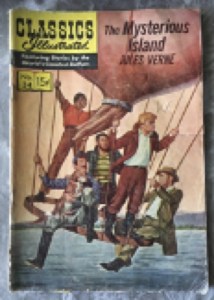
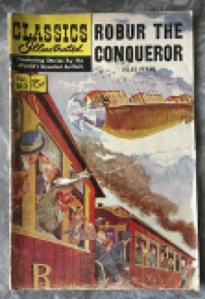
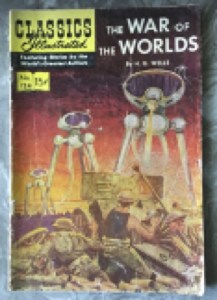
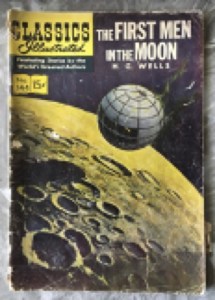
From my collection
I read both authors as a youngster, although to be honest mainly in the Classic Comics and Classics Illustrated series (most of which I still have, thanks to my parents who threw nothing away). [More on Classic Comics in another blog post.]
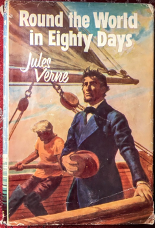
Like any great story, I read each one over and over, never tiring of the possibilities that trips to the unknown could hold. When older, I graduated to what is regarded today as true science fiction, especially the works of Isaac Asimov and Robert Heinlein (and many others).
It was only much later, I discovered Lewis and Tolkien, which led me into the fantasy sub-genre (for an excellent and brief discussion on science fiction in film, see Chapter 7 of Stranger Than We Can Imagine: Making Sense of the Twentieth Century by John Higgs, Weidenfeld & Nicolson, London, 2015).

Perhaps the memory of these stories is what led me to write in this genre rather than anything else. My wife has said that – based on my public service experience, academic work and interests – she always expected me to write about matters of history, politics, government, international relations and/or constitutional matters (don’t get me started on the Law of the Sea and Canada’s jurisdiction over its Arctic waters!).

I have a few modest pieces to my credit that I wrote during my years in government on international relations and military matters, but that’s in my past. Instead I chose a different path, much prefering the unknown worlds, the blank slate – totally open to the imagination but which make sense to and hold logic for the reader.
In sum, writing fantasy comes with rules – it must be plausible but also surprising, familiar yet unfamiliar, different but the same. Most important, it must set both the mind and heart racing. In other words, like the works of Jules Verne and H.G. Wells have done.

Leave a Reply