
It’s a cliché of writing – or at least reading – the young bibliophile devouring a book in bed, late at night, under the blankets with a flashlight when he (or she) was supposed to be sleeping. Then, when footsteps in the hallway are heard, the light is hastily turned off.
But it does happen. Loving books as I do, the habit of secret night-time reading was certainly a part of my young teen years.

One book in particular stands out. Although I cannot recall the name of the author or even how and why the book found its way into my hands, to this day I can still remember it and the excitement of that secret reading.
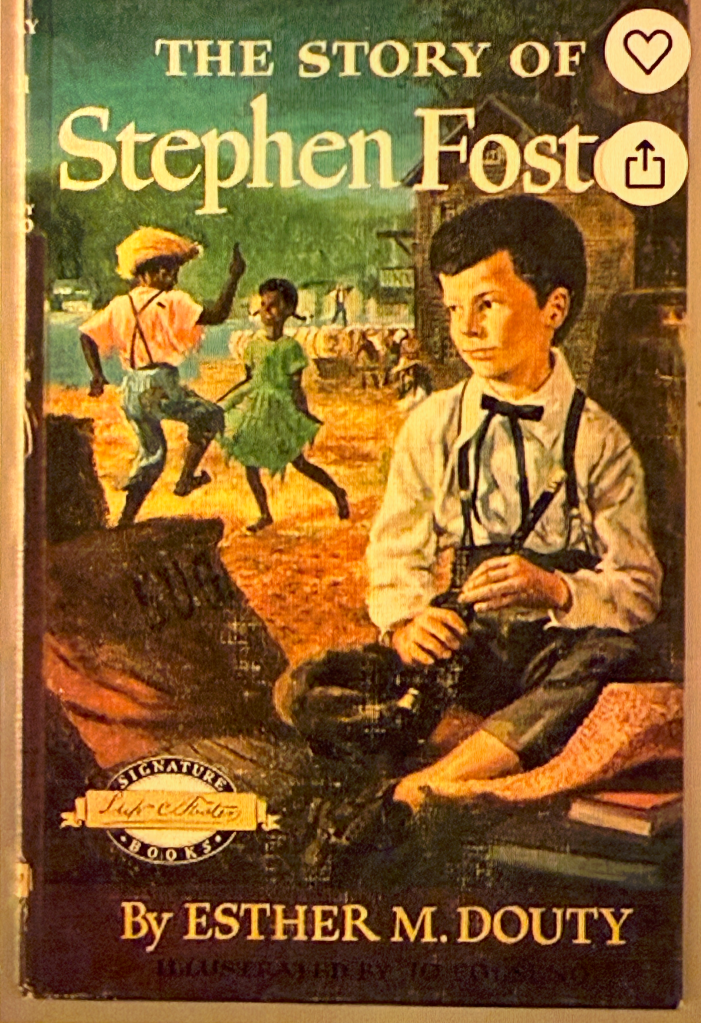
It was a biography of the American composer Stephen Foster (1826-1864), one of a series aimed at young teen readers. I imagine the story of his childhood, compositions, success and tragic end captured my attention, and am guessing the following (part of Grosset & Dunlap’s Signature Books, originally published in 1954) was the book (doubtless borrowed from the local library):
I was thinking of Foster recently because July 4, 2026 is the 200th anniversary of his birth. An appropriate date, I’d say, for the “father of American music”.
I suspect few younger readers today would even recognize Foster’s name. But the names of his songs should still resonate: Camptown Races, Oh! Susanna, My Old Kentucky Home, Jeanie With the Light Brown Hair, Swanee River, Old Black Joe and Beautiful Dreamer, to name but a few of his over 200 songs. They bridged the gap between European-influenced formal composition and homegrown American folk idioms, helping to create a national songbook.
Foster was born into a large (nine older siblings) and wealthy family in (what is now) Pittsburgh, Pennsylvania, well educated, musically self-taught (clarinet, guitar, flute, piano) and exposed to musical composition and the works of the great composers of the 18th and 19th century. He began writing songs while working as a bookkeeper in Cincinnati.
His first major success, “Oh! Susanna” (1848) was performed by many traveling minstrel troupes, the biggest form of popular entertainment at the time, giving him a ready-made national platform. It became a national hit almost overnight.
By the 1850s, Foster was one of the first professional songwriters in America, attempting to make a living entirely from royalties (a risky endeavor before strong copyright laws).
In 1851, “Old Folks at Home” (“Swanee River”) became one of the most recognized American songs of the 19th century. “My Old Kentucky Home” and “Massa’s in the Cold Ground” followed quickly, solidifying his place as the songwriter whose music was sung in parlors, schools, and public gatherings.
Stephen Foster’s legacy to American music is profound and enduring. Writing in the mid-19th century, Foster created songs that became foundational to the American folk and popular music traditions. His compositions, widely recognized for their simple, emotive melodies and lyrical accessibility, drew on styles from minstrel shows, parlor ballads, and folk melodies.
While Foster’s works are celebrated for their musical genius, they also reflect the complexities of the era, particularly with regard to race.
Inevitably, his work was a product of its time: while beloved, many of his lyrics reflected the racial stereotypes of 19th-century minstrelsy, which many modern audiences view as problematic.
Still, Foster’s ability to capture the spirit of the time, blending elements of both European and African American music, set the foundation for much of the country, folk, and popular music that followed. His influence is still felt in contemporary music, as his melodies and themes have become deeply woven into American cultural identity.
At his peak in the 1850s, Stephen Foster was as close as the U.S. had to a national celebrity songwriter, his fame rivaling that of any American composer until well into the late 19th century.
But no one, not even the most famous, is immune from evolving tastes. When new composers emerged, more attuned to the changing times, Foster turned to writing more sentimental parlor songs, narrowing his audience. His income from music (always unstable) — the chaotic American music publishing industry and piracy of sheet music was rampant — began to decline.
The Civil War changed the nation’s mood. As patriotic songs, martial music and soldier ballads began to dominate, Foster’s nostalgic, antebellum-themed songs lost appeal.
Although he tried to adapt with topical songs (“We Are Coming, Father Abraham” and “That’s What’s the Matter”), they didn’t match his earlier successes.
His personal life unraveled — financial troubles, an unhappy marriage, separation, ill health, and his alcoholism worsen.
The most accepted story of his death is that Foster became sick with a fever and, weakened, fell in his hotel in New York’s Bowery neighbourhood and cut his neck. Other versions have him taking his own life. After being discovered by his then writing partner George Cooper, alive but lying in a pool of blood, Foster died in Bellevue Hospital three days later (January, 1864) at the age of 37.
His wallet contained a scrap of paper that simply said, “Dear friends and gentle hearts”, along with 37 cents in Civil War scrip and three pennies. At the time of his death, his fame has waned, though his best-known songs were still widely sung.
After his death, “Beautiful Dreamer“, one of the best-loved of his works, was posthumously published in 1864.
Somehow, given his fate, this rather melancholy photograph of Foster seems appropriate.
Although Foster met a tragic end, publishers eventually revived interest in his work, and by the late 19th century his songs made a comeback. By the 1880s–90s, schoolchildren across the U.S. were taught “My Old Kentucky Home” (the state song) and “Old Folks at Home”, making them timeless.
& & &
This weekend, the United States celebrates the 250th anniversary of the signing of the Declaration of Independence. The document, a product of the era of the enlightenment, was drafted by a small committee under the leadership of Thomas Jefferson. Its words have had a great and lasting influence on the world, especially in movements towards increasing liberty and democracy in the century that followed.
What better to mark the moment then a recognition of one of America’s greatest composers and one who actually shares that birthday.

Leave a comment