
The year was 1983.
That September I met my kindred spirit. In recognition of our engagement, I wanted to buy her a present. One long-lasting and with meaning.
In the early 1980s, two of the most distinctive visual voices of their generation—American graphic designer Milton Glaser and Belgian artist Jean-Michel Folon—created a book unlike anything else in their careers.
The Conversation was not a conventional art monograph or an illustrated story. It was, quite literally, a visual dialogue: an experiment in seeing how two artists with very different styles could talk to each other without using a single word.
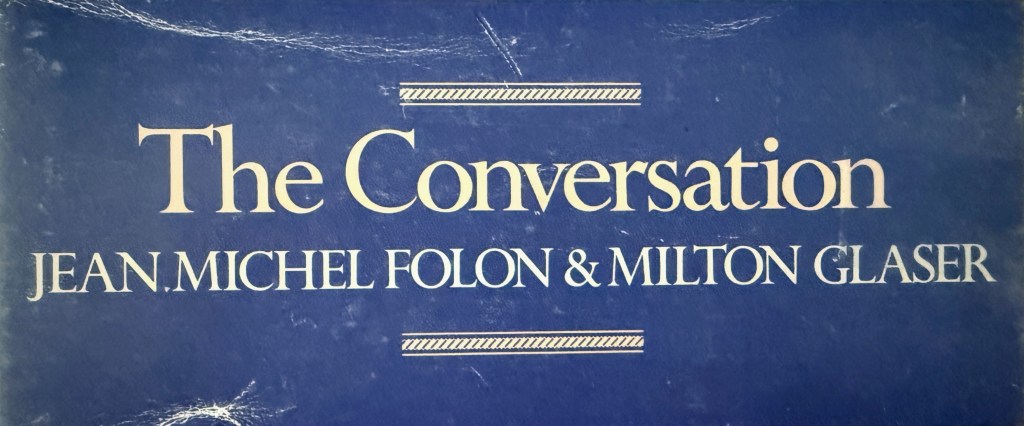
The book came enclosed in a blue wrapper; here’s the front.
First published as a deluxe, limited-edition artist’s book in Italy by Edizioni d’Arte Amatori, and later released in the United States in 1983 by Harmony Books, The Conversation has become a collectible artifact of late 20th-century design culture—an elegant testament to the possibilities of creative exchange. The latter version is the copy we have, one that is still displayed on the top of one of our bookcases (see below).
Milton Glaser (1929–2020) and Jean-Michel Folon (1934–2005) first met through the tight-knit international world of illustrators and designers in the 1960s and 70s. Both were fixtures of that era’s magazine covers, posters, and books—but their approaches couldn’t have been more different.
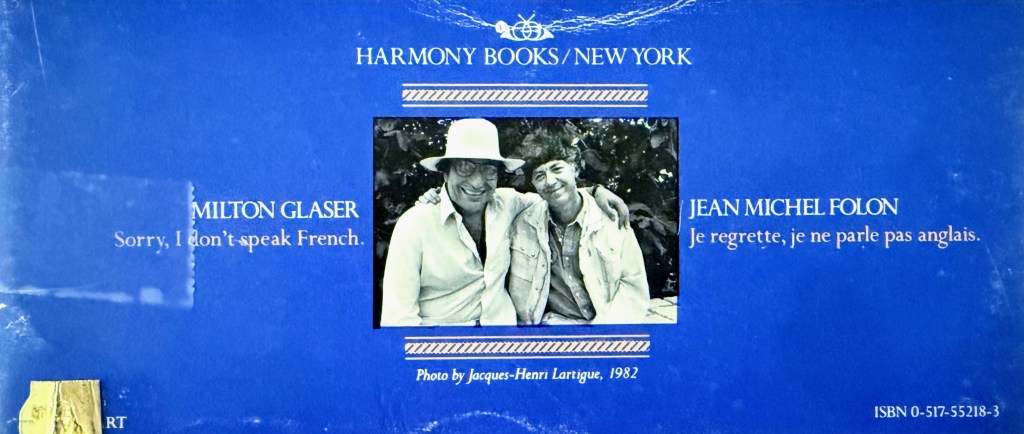
And here’s the wrapper’s back.
Glaser, the celebrated New Yorker, was known for his bold, graphic immediacy. He designed the ubiquitous “I  NY” logo, revolutionized music merchandising with his psychedelic Dylan poster, and co-founded New York Magazine. His style was colorful, witty, and populist—a belief that design was for everyone.
Folon, by contrast, was the consummate European poet of the image. His watercolors, posters and drawings were haunting, lyrical, often tinged with melancholy. His works—frequent covers for The New Yorker, Esquire, and Time—depicted solitary figures adrift in surreal landscapes, airplanes turning into birds, men walking into their own shadows.
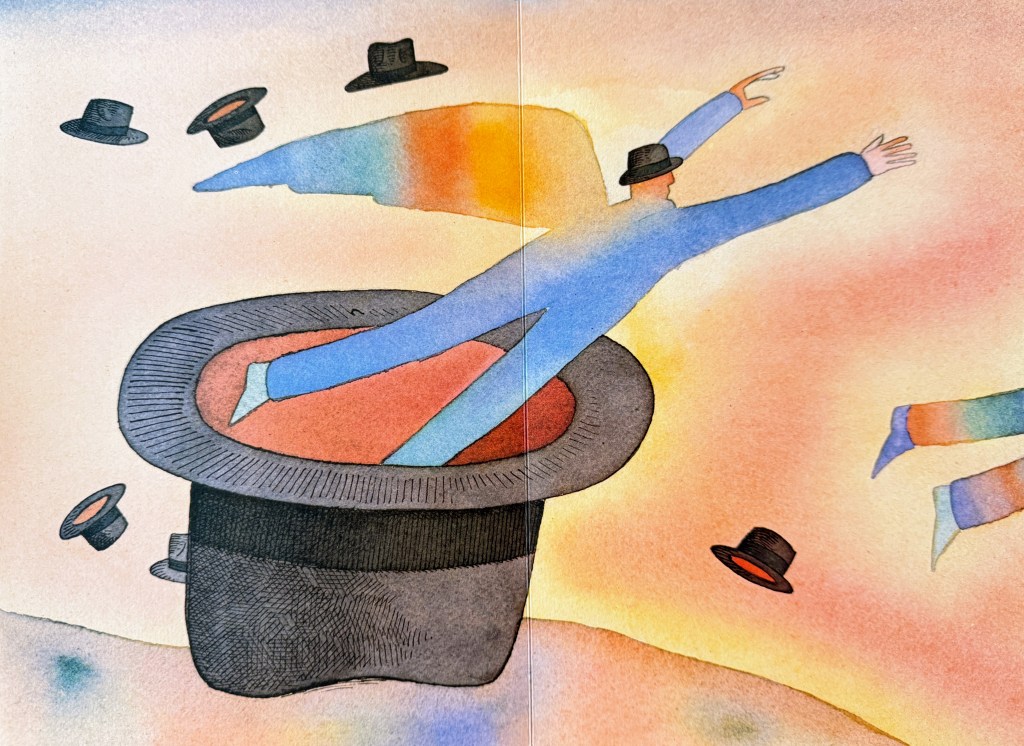
Despite these differences, both artists shared a humanist core. They believed images could communicate universally, beyond language, culture, or nationality. The Conversation was their way to prove it.
Unlike typical art books of the period, The Conversation is structured like an actual conversation in visual form. Each spread is an exchange: Glaser makes an image on one side, Folon responds on the other (or vice versa). There is no text, no captions—just a sequence of images that transform and reinterpret one another across the book.
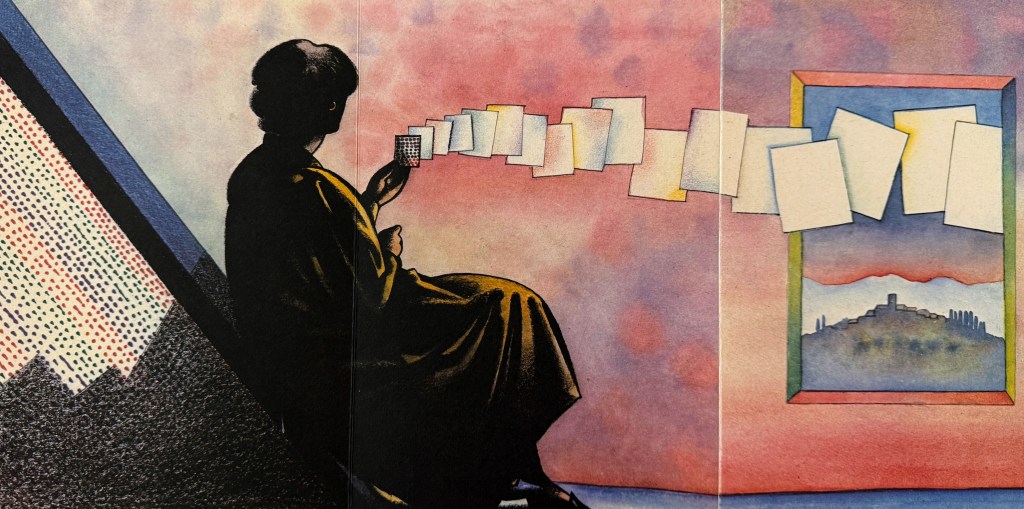
Imagine one page presenting a chair, abstracted in bold lines, while the facing page turns that chair into a soaring bird. Or a human silhouette on one side dissolving into clouds on the other. The artists traded ideas visually, each reply pushing the dialogue further, sometimes playfully, sometimes profoundly.
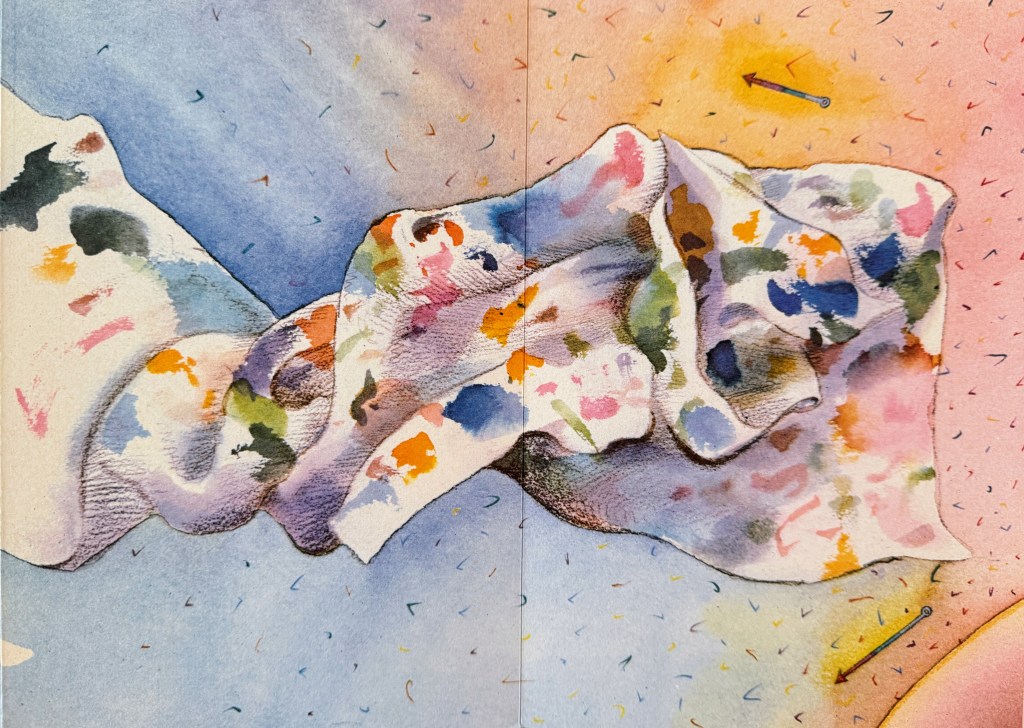
This structure does more than showcase their styles. It enacts the very thing it’s about: communication. Where words fail, images answer. Where one vision ends, another begins. In that sense, The Conversation is not just about two artists talking—it’s about the possibility of understanding itself.
Because The Conversation is rare and not widely digitized, it retains an almost secretive mystique among collectors. But descriptions and surviving photos show its hallmarks:
- Surreal transformation: Figures become birds. Cities grow from heads. Everyday objects shift into dreams.
- Human vulnerability: Both Glaser and Folon loved depicting small, lone figures—emblems of our fragile, searching selves.
- Metaphorical wit: Glaser’s playful graphic riffs meet Folon’s hushed, meditative imagery in surprising ways.
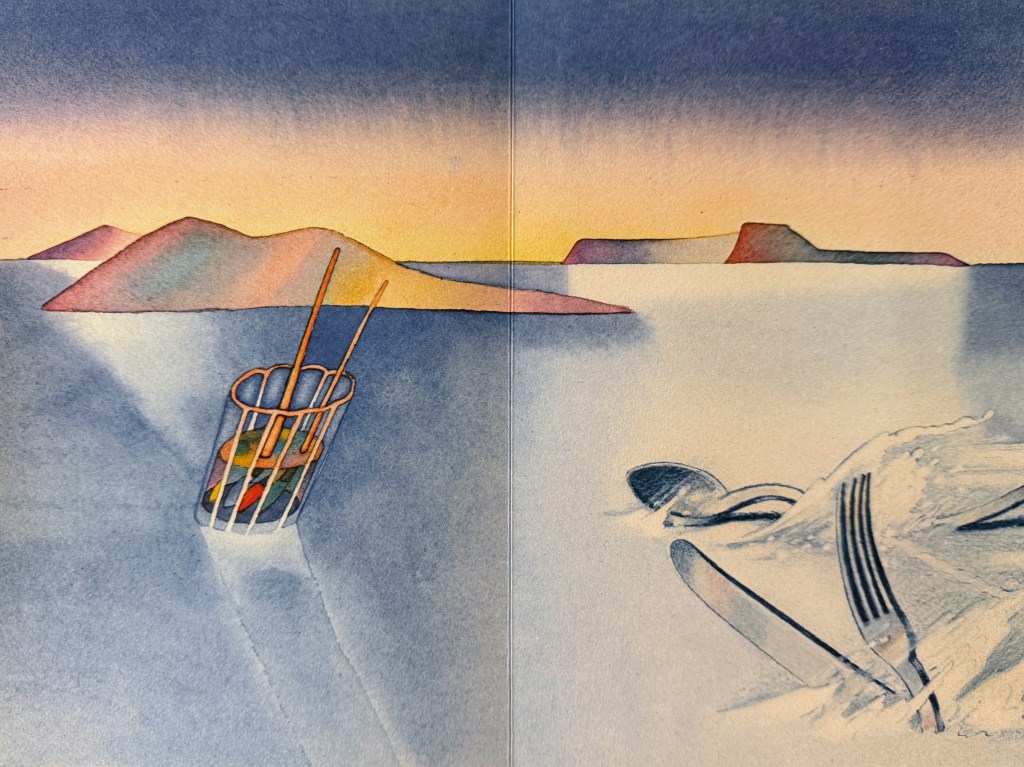
What’s striking is the generosity of the exchange. Neither artist tries to dominate. Instead, each gives the other space, listens, and responds. The book embodies true conversation: empathy, curiosity, and surprise.
The Conversation was first published in a small run, with high-quality paper and hand-pulled lithographs or silkscreens, signed by both artists. It was designed for collectors—an art object in itself.
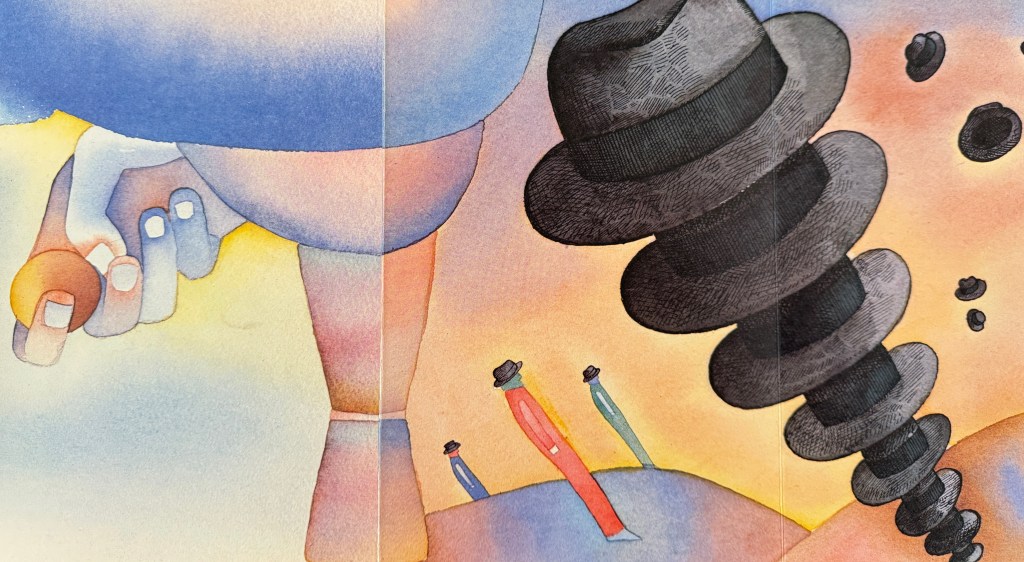
Unlike the Italian limited edition, the Harmony Books version was designed to be more affordable and accessible. It was published as an accordion-fold paperback, wrapped with a distinctive blue paper band listing the publisher’s New York address. It sold for around $12.95—a price that seems quaintly low today, given how hard copies can be to find.
Despite this more “trade-friendly” production, the Harmony edition was still relatively small-run. Although the book never became a mass-market hit, it did become a minor collector’s item, with prices often ranging from $35 to over $100 depending on condition.
The Conversation is more intimate and accessible than many avant-garde artist books. There’s no shocking conceptual rupture or ironic distance. Instead, it offers a fundamentally human question: How can two people, with different visions, really communicate? And its answer is optimistic: through attention, generosity, and playful transformation.
Today, The Conversation feels more relevant than ever. In an age of polarization and linguistic overload, it’s a reminder that communication isn’t just argument or persuasion. It can be dialogue, built on listening and response, on curiosity about the other’s vision.
Glaser and Folon’s quiet little book shows us what that looks like—without saying a single word.
If you ever find a copy, take the time to peruse it the way it asks you to: slowly, page by page, watching as one artist offers an idea and the other turns it into something new.
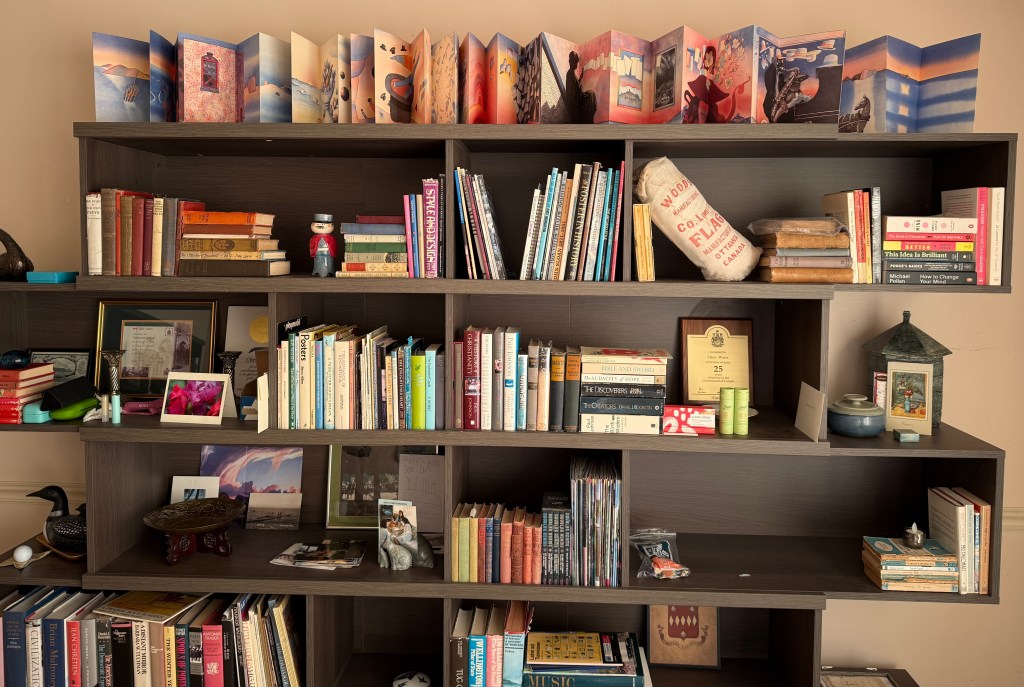
Sitting on top of one of our bookcases, the book begins and ends with pictures of water. Living next to the Pacific Ocean, it seems only fitting.
It’s not just an art book. It’s a lesson in how to be in conversation. It’s also a lesson in how to be in a relationship. And one that’s still ongoing today.
& & &
For more on Glaser and Folon, please check out the following: Milton Glaser; Jean-Michel Folon.

Leave a comment